
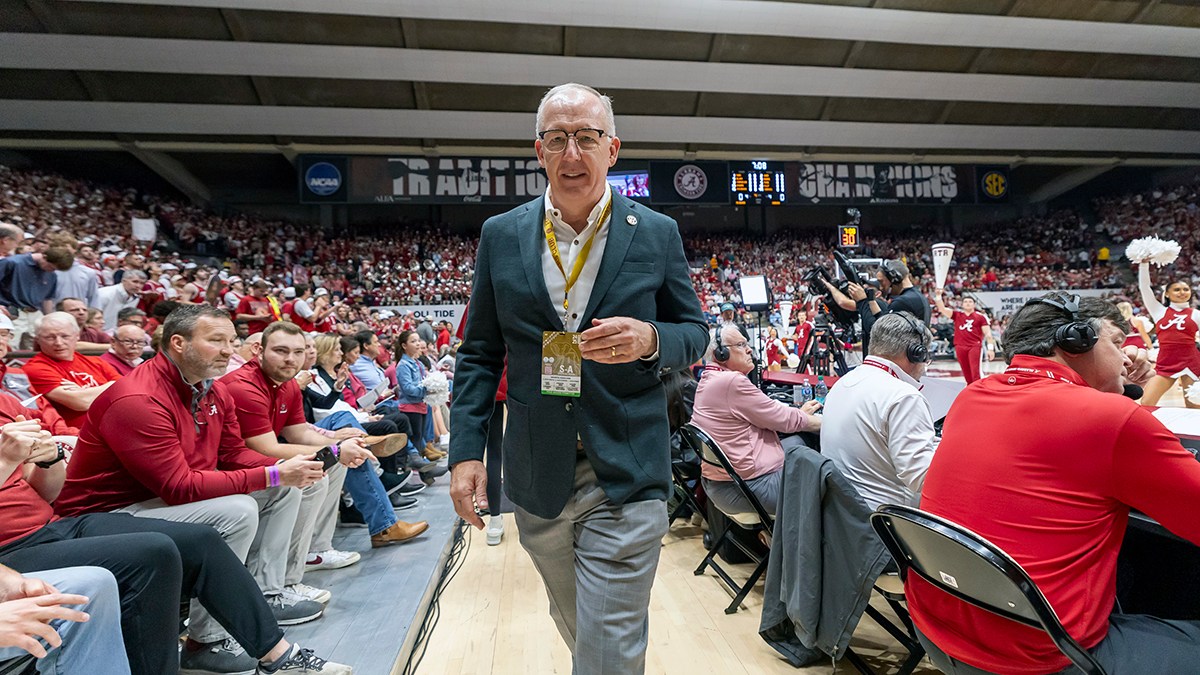
TUSCALOOSA, Ala. — Southeastern Conference commissioner Greg Sankey filed an affidavit Thursday backing the NCAA in its eligibility case against Alabama men’s basketball player Charles Bediako, who is competing in the SEC for the Crimson Tide more than two years after signing an NBA two-way contract.
“I respectfully ask the Court to uphold the NCAA eligibility rules challenged in this case, which are essential to the integrity of college sports, to the educational mission they serve, and to the opportunities they provide for current and future student-athletes,” Sankey said in the affidavit.
Bediako played at Alabama from 2021-23 before making himself available for the draft. Bediako was not selected and never appeared in an NBA game, but he did play in the NBA G League before suing the NCAA in hopes of having his college eligibility reinstated.
Since being granted a temporary restraining order in Tuscaloosa Circuit Court enabling him to play for Alabama, the 7-footer has appeared in four games and has averaged 9.5 points and 5.0 rebounds. An injunction hearing on Bediako’s case is set for Friday.
Bediako filed the lawsuit after the NCAA denied Alabama’s appeal to allow him to play for the Tide.
Tuscaloosa Circuit Court Judge James Roberts, who issued the temporary restraining order, has since recused himself from the case. The NCAA had sought this recusal while noting Roberts had made donations to the University of Alabama.
Bediako is the first player with collegiate experience to sign an NBA contract and return to college basketball. The court case could perhaps entice more players with NBA experience to pursue a second stint in college.
“Permitting former professional athletes to return to competition creates a competitive disadvantage and fundamental unfairness for current student-athletes who have not pursued a professional sports career but instead have maintained their commitment to the collegiate athletics model, fulfilling the academic standards and participating actively in an educational community while also participating in college sports,” Sankey said in his affidavit.
“It is also unfair to college sports programs that have operated within the existing framework for college athletics and thus have not sought to add former professional athletes to their rosters.”
Darren Heitner, a lawyer representing Bediako, noted on social media that the NCAA has waived eligibility rules regarding other former professional athletes. One of the athletes he specified is Baylor’s James Nnaji, who played professionally in Europe for four years and was selected in the 2023 NBA draft but never signed a contract with a league team.
“These waivers demonstrate selective enforcement, undermining Sankey’s assertion that inconsistent application fuels disruption,” Heitner wrote in his post. “Courts in similar cases have highlighted such inconsistencies as evidence of arbitrary decision-making. Also, Sankey’s reliance on outdated principles of amateurism and academic integration is not aligned with the current realities of college athletes and the proliferation of NIL deals.
“Furthermore, Sankey is a lay witness who can offer opinions based on personal knowledge, but this affidavit is littered with conclusory statements that are not tied to specific facts or data. Finally, Sankey is not only biased but has a conflict of interest while serving in the role of SEC Commissioner.”