
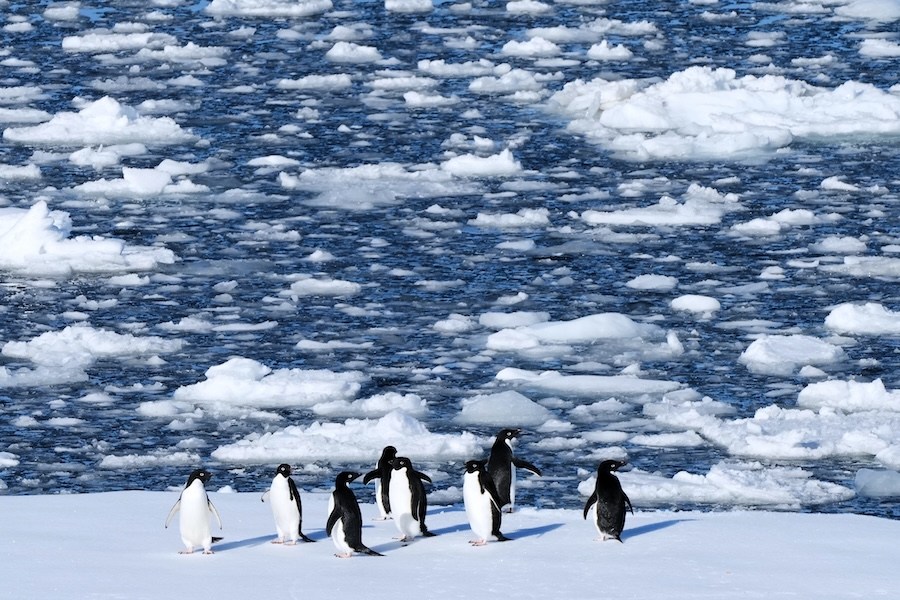
ANTARCTICA (AP) — The Southern Ocean is one of the most remote places on Earth, but that doesn’t mean it is tranquil. Tumultuous waves that can swallow vessels ensure that the Antarctic Peninsula has a constant drone of ocean. While it can be loud, the view is serene — at first glance, it is only deep blue water and blinding white ice.
Several hundred meters (yards) off the coast emerges a small boat with a couple dozen tourists in bright red jackets. They are holding binoculars, hoping for a glimpse of the orcas, seals and penguins that call this tundra home.
They are in the Lemaire Channel, nicknamed the “Kodak Gap,” referring to the film and camera company, because of its picture-perfect cliffs and ice formations. This narrow strip of navigable water gives anybody who gets this far south a chance to see what is at stake as climate change, caused mainly by the burning of oil, gas and coal, leads to a steady rise in global average temperatures.
The Antarctic Peninsula stands out as one of the fastest warming places in the world. The ocean that surrounds it is also a major repository for carbon dioxide, a greenhouse gas that contributes to warming. It captures and stores roughly 40% of the CO2 emitted by humans, according to the National Oceanic and Atmospheric Administration.
On a recent day, Gentoo penguins, who sport slender, orange beaks and white spots above their eyes, appeared to be putting on a show. They took breaks from their dives into the icy water to nest on exposed rock. As the planet warms, they are migrating farther south. They prefer to colonize rock and fish in open water, allowing them to grow in population.