
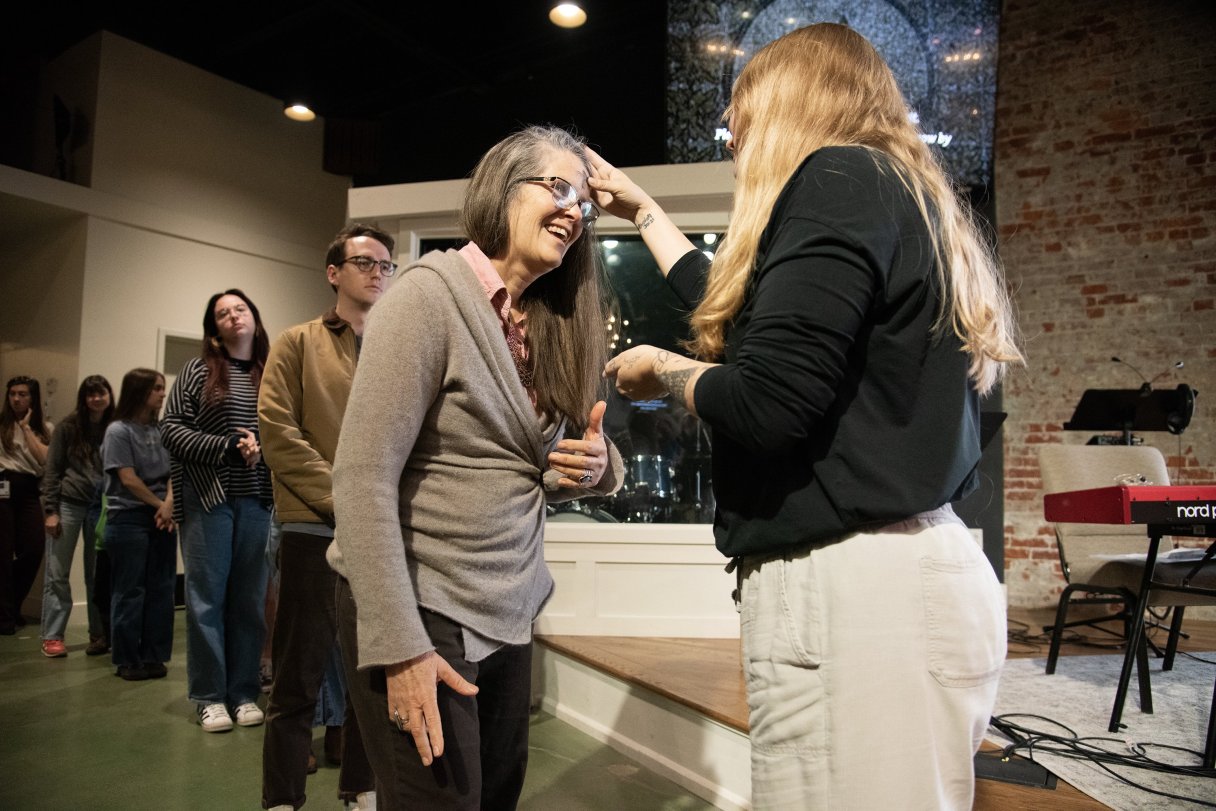
A serpentine line weaved around the dimly lit sanctuary of The Mission Chattanooga Parish on East 12th Street. Near the back, 5-year-old Zoey Baum awaited her turn.
Despite the darkness of the room and the solemnity of the moment, Zoey’s freckle-sprinkled face glowed with anticipation.
In her church dress (made cooler by a diminutive denim jacket), Zoey was the picture of health and youth, with a ponytail of glossy brown curls. Between her crossed denim arms, she clutched a felt doll named Rosetta.
Finally, it was her turn.
Boldly, Zoey stepped toward the Rev. Katrina Payne, who stooped to look into Zoey’s guileless blue eyes, dipped her finger into ashes, and smeared gray slashes in the center of Zoey’s unfurrowed forehead.
Ash Wednesday marks the beginning of Lent
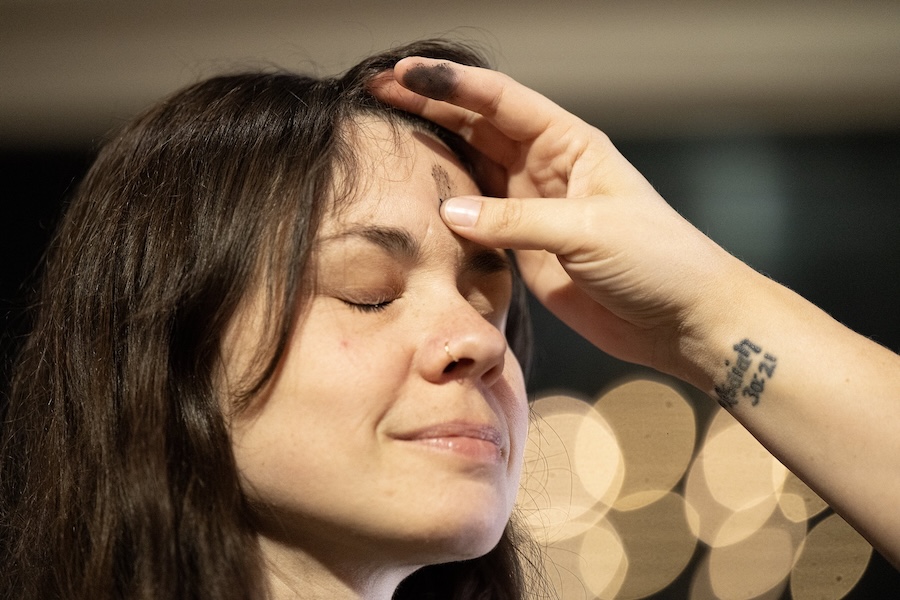
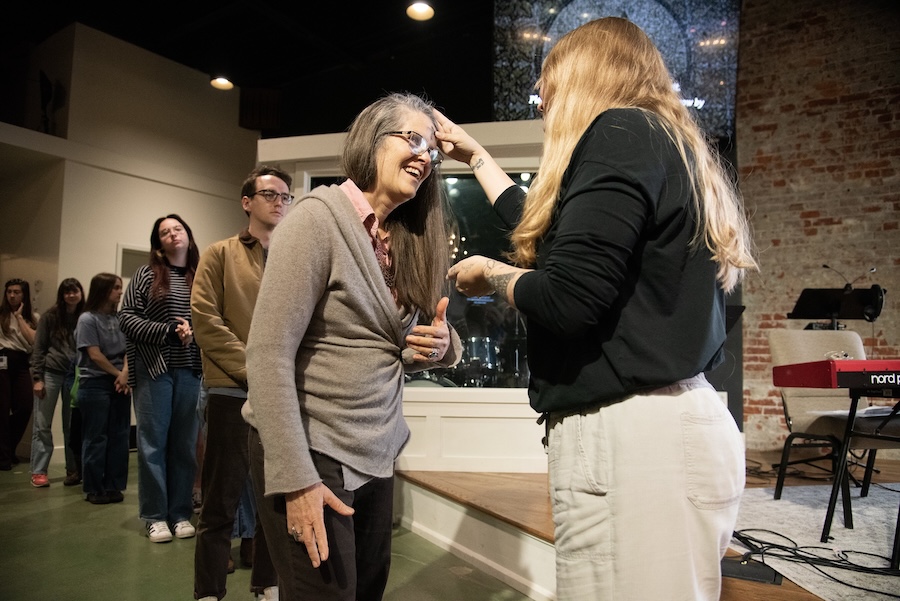

“From dust you came and to dust you will return,” she whispered to the smiling Zoey.
And Zoey bounced away — mortality and all.
Zoey is followed by her older sister Adelyne and their late thirty-something parents, Anna and Brandon Baum.
Like many congregants at The Mission, Zoey and Adelyne’s mom and dad did not grow up observing Ash Wednesday, Lent, or any liturgical moments.
The Baums only found their way to The Mission when their souls needed a sanctuary with salve.
SPIRITUAL FUMES
Anna Baum and her husband moved to Chattanooga to attend Covenant College. Both grew up in Christian homes that did not observe what are called the ancient “high church” practices: liturgy, ritual and sacraments.
While there were no liturgical recitations to memorize, no calendar of holy days to observe, Baum found the rules of her church culture more demanding than the practices of what is called “high church.”
She is not unique.
Each year at The Mission, the line for ashes grows longer — the church has grown roughly 19% annually since the COVID pandemic. As megachurch culture has emphasized spectacle and scale, ancient liturgical practices are quietly offering something different: rhythm, restraint and repentance. From 5-year-olds like Zoey to college students observing Lent for the first time, the growing embrace of Ash Wednesday and Lent — even among communities once wary of ritual — suggests that many Christians are seeking something new from something old.
For Baum, the traditions offered her a way to be more human, more at home in her own skin.
“Growing up as a child in the Presbyterian Church of America,” Baum said, “I thought Lent was just for Catholics.”
(READ MORE: 4 things to know about Ash Wednesday)
While Baum said she was not quite “deconstructing” (the act of critically dismantling previously held beliefs) when she found herself at The Mission, she said she was running on spiritual fumes.
After a lifetime in the church, Baum said, she was wounded by what she considers patriarchal models that undervalued the contribution of women and remained opaque when it came to accountability.
Because of her history, Baum attended The Mission as a kind of last resort — with little hope for a different church experience.
“Before finding my way to The Mission, my faith was more intellectual,” she said. “It was a lot about rules. Don’t do this. Do that. That is what gave me value as a Christian.”
The Rev. Chris Sorensen, founding pastor, said that many of his congregants have a story like Baum’s, and they arrive at The Mission drawn by an even older story.
“The majority of the people here had church for a long time before discovering ‘here,'” Sorensen said. “They walked away from church, but they’re not walking away from Christ. They’re walking away from some egregious behavior done in the name of Christ.”
For Baum, who had heard the Gospel story as long as she could remember, the liturgy helped her hear that story — again — and as if for the first time.
With ears listening to ancient traditions, congregants like Baum still recognize some motifs and symbols of the biblical stories that they grew up on — symbols like ash.
Long before Ash Wednesday became part of the Christian calendar, ashes were a central symbol of biblical texts. Throughout the Old Testament, ashes expressed mourning, humility and human mortality.
While it may seem counterintuitive that a day set aside to contemplate life’s transience with ash-crossed foreheads could be centering, Baum said these sacred traditions were the soothing salve her soul craved.
Sorensen estimates that 90% of his congregation grew up as some version of evangelical. And they arrived at The Mission much like Baum, with wounds and skepticism, almost afraid to hope but still hoping, nonetheless, he said.
“It’s always fun when somebody wants to meet with me,” Sorensen said, “and the first thing out of their mouth is, ‘I need you to know I don’t know if I believe in the church, I don’t know if I believe in God … I don’t even know if I believe in you.'”
“And I say, ‘Well, then why are you meeting with me?’
“They’re still seeking,” he said.
AT THE HOUSE
A few blocks away from The Mission is The House, a ministry on the campus of the University of Tennessee at Chattanooga. Following Ash Wednesday services, the communal hall was full with some students still wearing their ash crosses.
Riley Robinson, 20, grew up in an evangelical non-denominational church and as the child of missionaries to Uganda. Their church practice did not include an observation of Ash Wednesday or Lent.
Still, Robinson has planned a structured Lenten observance.
“I’m fasting on Saturdays from food and any other drink besides water,” Robinson said. “Then, on Sundays, I’m staying off of social media to take a day of rest to center with the Lord.”
There’s Cullen Graves, 20, who grew up in a Church of God Pentecostal tradition in which liturgical and ancient practices were not observed. But Graves said he wants to observe Lent by focusing on emotional patterns — like “being bitter with people.”
“I think something I’m trying to, like, kind of discipline myself in is to not be so hateful toward others,” Graves said.
Lily Rozevink, 19, is using her Lenten season to reduce her “consumption.”
Finally, Graham Kipland, 20, chimed in. This will be his first year to observe any Lenten traditions and he’s been preparing for the season the entire week by deleting his social media apps.
Kipland rattled off a litany of his now deleted, dopamine-fueling social media apps.
“TikTok. Snapchat. Instagram. X. Facebook,” he said. “I deleted them all.”
These students are the exact demographic that “seeker-friendly” churches worked hard to attract.
Although Sorensen can’t deny the almost oxymoronic attraction of ancient traditions to the youngest of demographics, their goal in these observances was never about numbers.
Their real goal? To embody the kingdom of heaven in Chattanooga, Sorensen said.
Sorensen said the contemplation of shared mortality can help people see others as well, no matter the politics or persuasions.
“It humanizes everybody because everyone you meet is on the same journey,” Sorensen said.
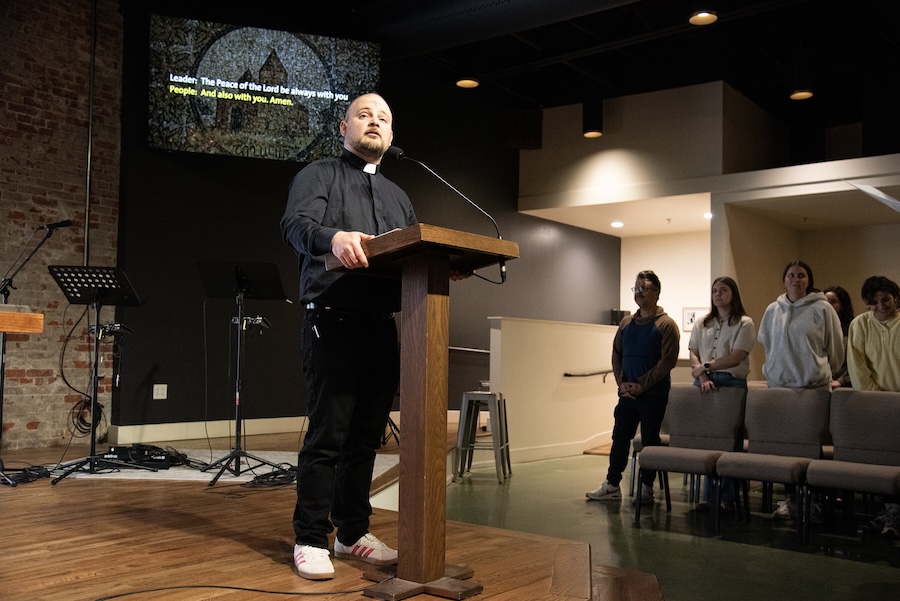
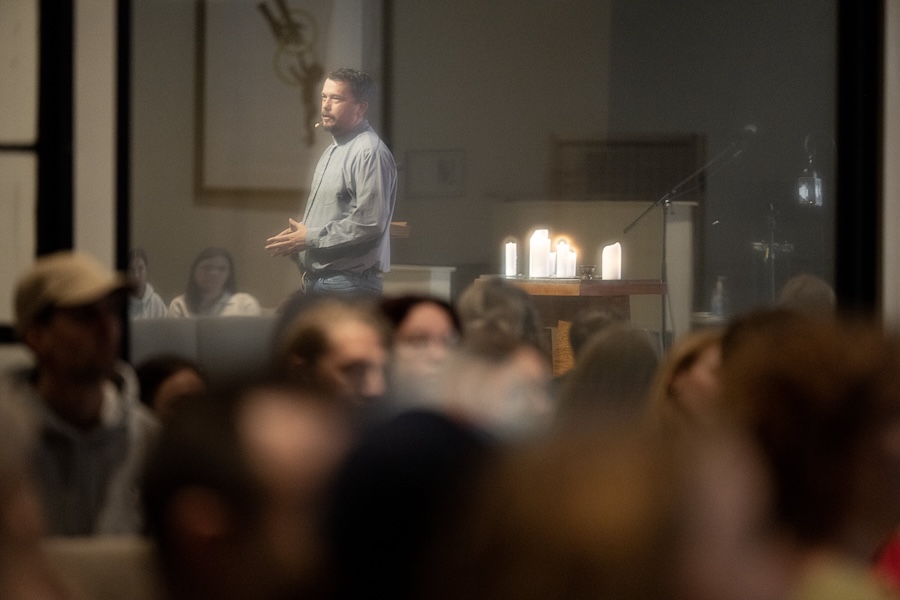
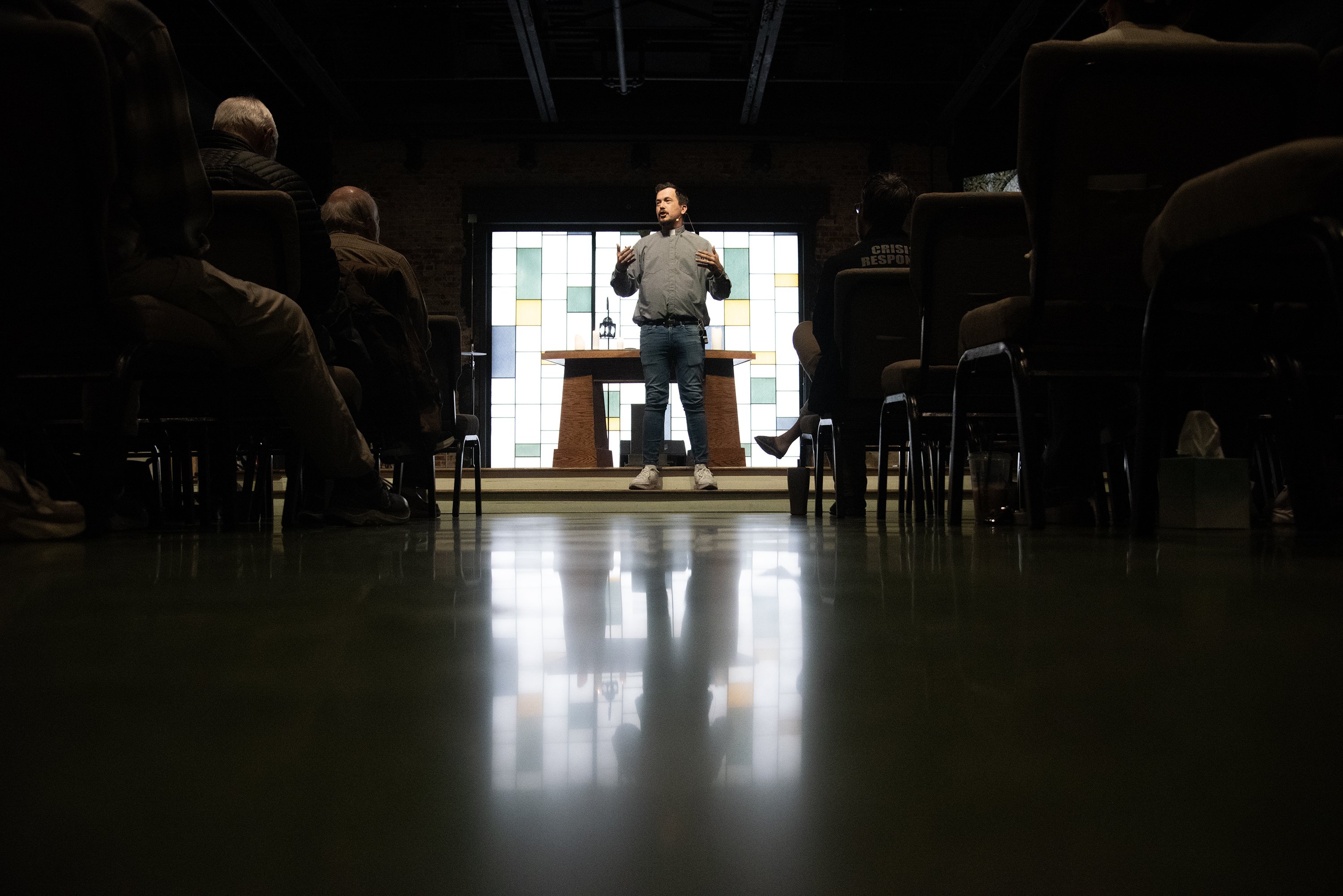
The homily for The Mission’s Ash Wednesday service echoed Sorensen’s thoughts.
“Friends,” said the Rev. William Glass, “The only people that God’s deliverance is for are people… who are dust.”
Like Zoey. Denim jacket. Rosetta clutched tight. Brown curls. Ash cross — and complete ease.
For Anna, Zoey’s mom, and for so many others who arrived at The Mission wounded and worn, the ease Zoey carries so naturally took years for them to find — or find again — or, some are still finding it.
It took wounds and a church plant, a last resort and serpentine lines, unfamiliar rituals that somehow felt like coming home — all of it, just to begin to feel as accepted by God as that bouncing 5-year-old already knows she is.
For Zoey — untouched by fear or condemnation and still so close to the moment of her own creation the words “ashes to ashes, dust to dust” are the harmless words of a nursery rhyme.
Dust holds no dread for Zoey.
She’s young enough to remember (and is living proof) that, in the right hands, beautiful things can be made of dust.