
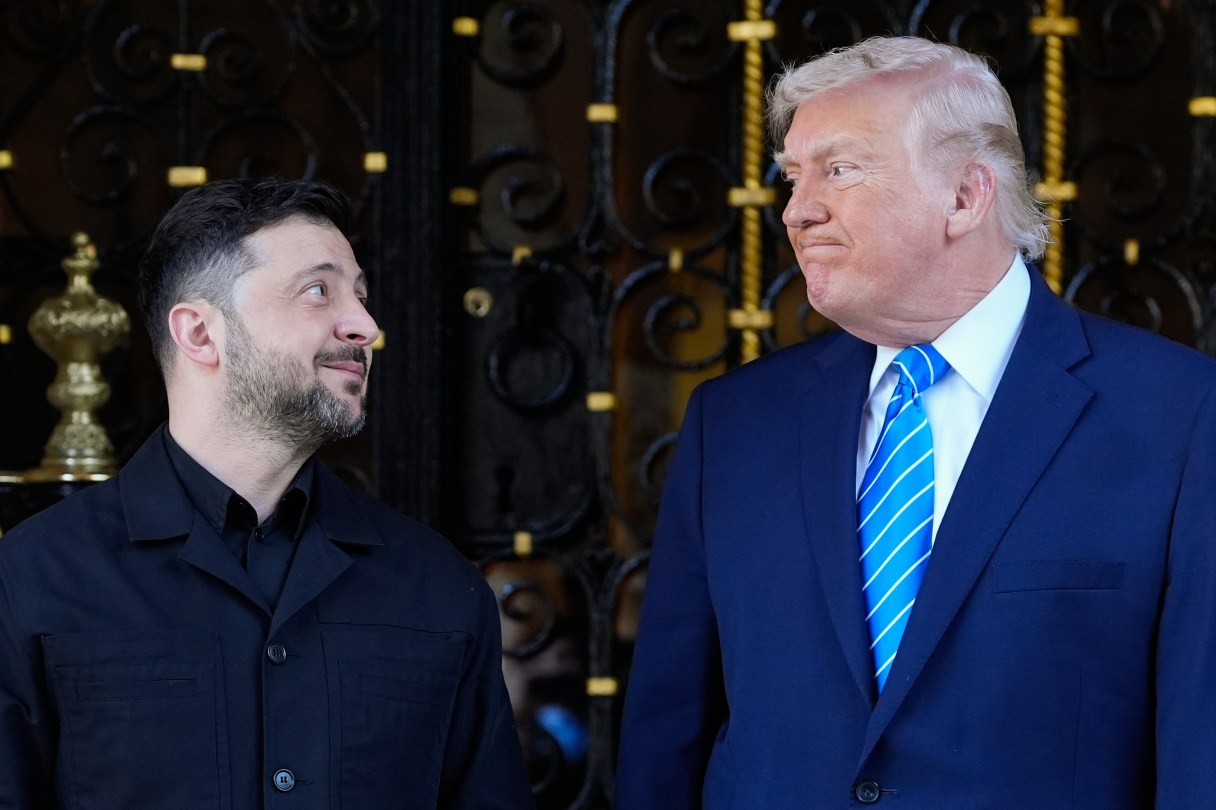
One of the many ironies of Donald Trump’s war against Iran is that only a year ago, most of the president’s critics assumed that any second-term crisis for the American empire would be caused not by reckless war-making but by appeasement and retreat. In particular, the Trumpian push for peace between Russia and Ukraine was cast as the great betrayal, craven and sinister in equal measure, that would yield disaster for Europe and disgrace for the United States.
Yet today, as Trump struggles to find an exit strategy from his Middle Eastern war of choice, his administration’s policy toward Ukraine looks like everything his Iran policy is not: an effective rebalancing for a multipolar world, in which a major rival has been contained and weakened with a reduced American commitment, and our regional allies have actually substituted for our overstretched capacities rather than trying to force us to stretch too far on their behalf.
A lot of Ukraine’s champions would recoil from that description. To the contrary, they would say, our Ukraine policy has been a betrayal, with unjust pressure on Kyiv to make a deal and an unfair retraction of American support. It’s just that Ukrainian heroism and European support have filled the breach, proving along the way that Trump and others were wrong to treat the war effort as foredoomed.
The last part has truth to it. Many observers, myself included, assumed that the failure of the Ukrainian offensive in 2023 portended a future in which Russia would slowly but surely grind Ukrainian forces down. The Trump administration’s push for a negotiated peace reflected, in part, an assumption that Ukraine’s time was running out. Instead, bravery, resilience and the drone war revolution have enabled the Ukrainians to keep the Russians stalemated, to such a degree that the Putin regime looks more unstable and paranoid than at any point since the early days of the war.
But the means of Ukrainian survival, where Europe steps up as the United States steps back, is not a sign of American failure. It’s what successful American adaptation looks like in a world where it’s conspicuously no longer the 1990s. Of all the areas of danger and crisis in the world, Europe’s eastern borderlands are the place where America should be able to rely on our allies as a first line of defense. The fact that Ukraine has held the line with more European support and less direct American aid is proof that this recalibration can succeed — and as such, it’s good news for our empire’s sustainability, not a sign that we’re about to cede global dominance to Brussels or Ottawa or Berlin.