
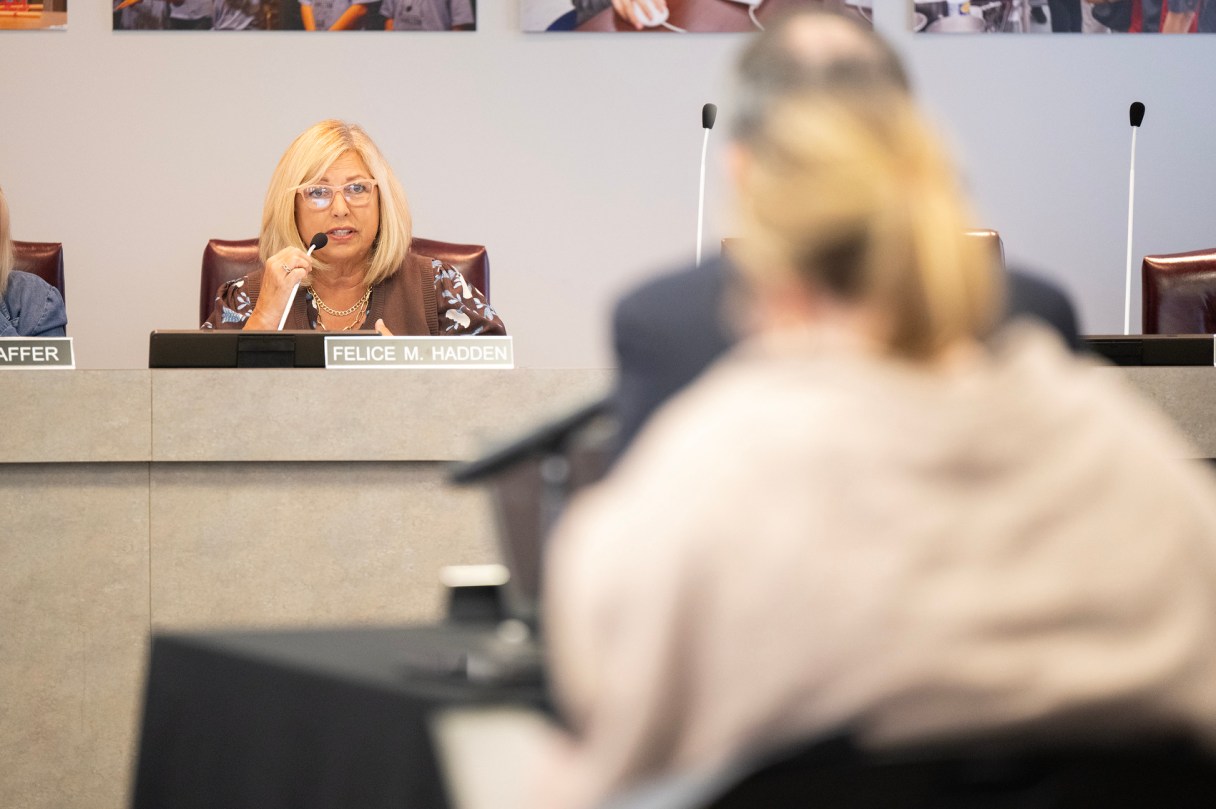
Elementary and middle school students would no longer be assigned a device to take home next school year under a new policy being considered by the Hamilton County Board of Education.
The proposed policy, which is the result of a new state law meant to reduce students’ screen time, sets rules around both device access and usage.
“Technology has its place,” Chief Academic Officer Blake Freeman told school board members Monday. “We’re not trying to take technology away. We’re just having a balanced approach.”
The new state law – sponsored by state Rep. Michele Reneau, R-Hixson – requires school districts that serve kindergarten through fifth grade students to adopt a policy that governs their digital device use.
The policy, which takes effect July 1, must prioritize teacher-led instruction and nonelectronic materials as the main type of instruction for elementary students, as well as prohibit elementary students from accessing social media platforms during the school day. It does not prevent school staff from using devices for instruction or other professional purposes.
(READ MORE: Hamilton County officials break ground on Soddy Daisy Middle renovation)
Currently, the school system implements a “one student to one device” program. Middle and high school students are assigned a device to take home, according to the district website, while elementary students are provided a device that remains at school.
It was a good time to review that policy, Freeman said.
As the district gathered feedback, he said, almost everyone agreed that there needed to be less screen time at school for elementary students. Likewise, the consensus was that high school students needed a device to prepare for college, where most work will be done online.
The point of discussion was middle school, Freeman said. Initially, district officials thought middle school students would be assigned devices with some more restrictions, but it became clear that there was a desire to not continue the one-to-one assignments.
Under the proposed policy, kindergarten through second grades should use devices rarely, and third through fifth grades should use them minimally. Middle schools would have access to classroom sets of devices to support instruction when appropriate, and high school students would be issued a device to take home.
The guiding question, Freeman said, is does the use of this technology meaningfully enhance student learning?
“We are really trying to take into account this balance of what’s right for kids to prepare them for their future and, at the same time, what is the need to increase student engagement in schools,” he said.
(SIGN UP: Get our weekly education newsletter by going to timesfreepress.com/education)
When the policy was first discussed in May, the top concerns raised by school board members were related to no longer assigning middle school students a device. One questioned adding another new thing to ninth grader lives, while another had accessibility concerns for families who don’t have devices at home.
Parents of elementary and middle school students would be allowed to request a device for use at home. The ability to check out a device would be dependent on availability, and families would be required to purchase insurance for the device, with the cost tiered based on eligibility for free or reduced-priced lunch.
Superintendent Justin Robertson said he expects the policy to be budget neutral.
The district still needs devices for students to participate in state testing, Freeman said. Next school year, third through fifth graders will begin taking their state tests online. Tennessee began the transition from paper to digital tests several years ago, starting with high school students.
Based on the policy, Freeman said, the district will create an implementation framework for school, so that when elementary students take state tests, it isn’t the first time they’ve used the technology.
The school board is expected to vote on the policy at its next meeting, June 18.
Contact education reporter Shannon Coan at scoan@timesfreepress.com or 423-757-6396.