
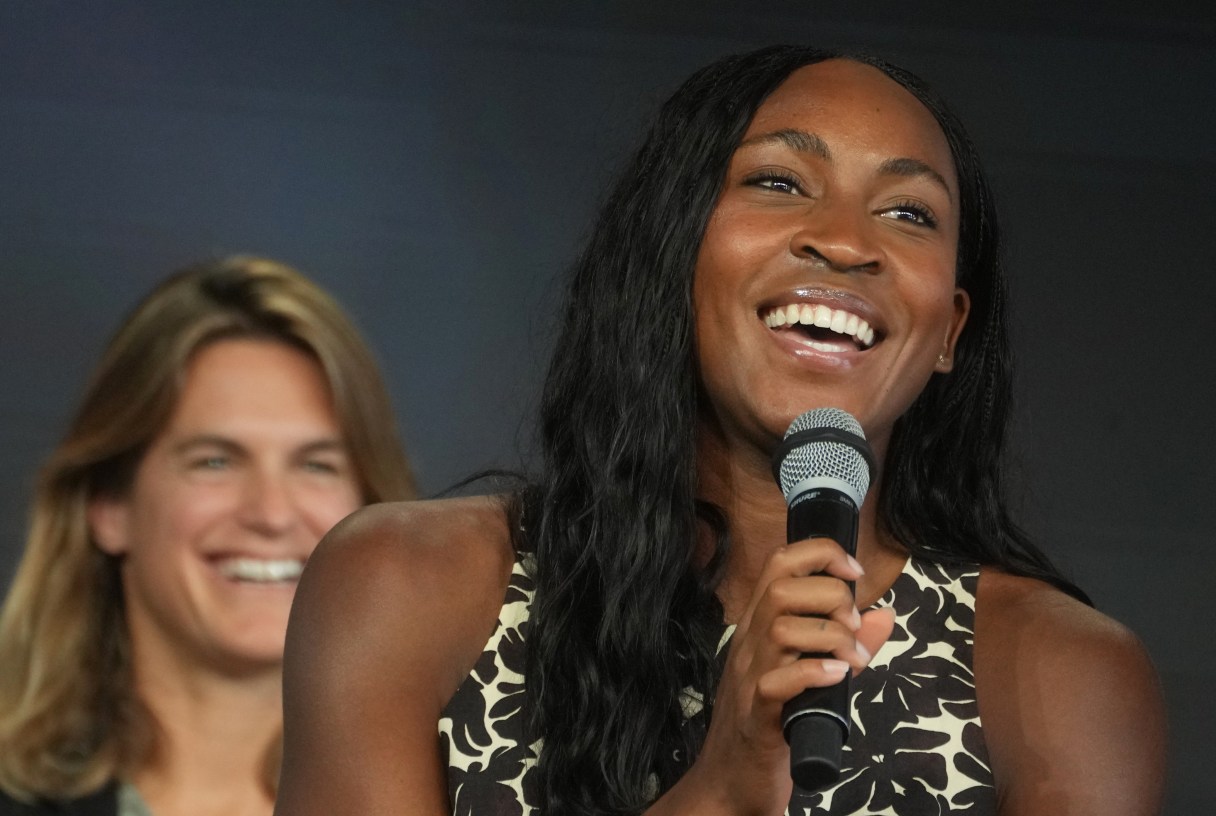
PARIS — Ten questions into her news conference ahead of the French Open as the reigning women’s singles champion at the clay-court Grand Slam tournament, Coco Gauff announced she was done.
“I have to go. Sorry. I’ll see you guys later,” Gauff told reporters as she got up and walked out.
That was about as serious as the protest from top-10 players on the pro tours for tennis got at Roland Garros as their interactions with members of the media were limited to 15 minutes on Friday.
The players announced the limitation due to their displeasure about not getting a bigger share of tournament revenues at the year’s second major championship tournament, where main-draw play starts on Sunday. Aryna Sabalenka, who is No. 1 on the WTA Tour and lost year’s final in Paris to Gauff, had even discussed a boycott of the tournament itself.
“It shows a lot of us are all on the same page and have kind of a collective action other than just having conversations,” Gauff said. “This is the first real point of action we have done.”
Players have criticized French Open organizers for reducing the players’ share of revenue to under 15% — compared to 22% at regular events for women on the WTA Tour and men on the ATP Tour.
The only player who came near to approaching 15 minutes in the question-and-answer sessions was 24-time Grand Slam champion Novak Djokovic, who clocked in at 14 minutes, 48 seconds.
But the Serbian star, who was celebrating his 39th birthday, said he wasn’t officially taking part in the protest. He still voiced an opinion on the subject, though, pointing to the schism between the PGA Tour and the LIV Golf League.
“Golf is a good example of a professional individual global sport that has been through and is still going through very challenging times in terms of the governance and splitting tours and players,” Djokovic said. “Let’s try to be a bit more united and have a unifying voice into finding a better structure and better future for our sport.”
Larry Scott, the former WTA CEO and ex-commissioner of the Pac-12 Conference for college sports in the United States, has been advising the players.
The WTA Tour’s fifth-ranked Jessica Pegula said the players, with Scott’s help, needed to find “a middle ground of what we can do together that’s feasible the week before a Grand Slam. If you try to talk about more extreme circumstances, then all of a sudden people aren’t on board, you can’t get anything to happen.”
Tournament organizers increased the prize money at Roland Garros by about 10%, after the U.S. Open last year raised its purse by 20% and this year’s Australian Open increase its by 16%.
The entire French Open pot was 61.7 million euros ($72 million), up 5.3 million euros from last year, but the players claimed their share of Roland Garros revenue declined from 15.5% in 2024 to 14.9% projected in 2026.
Marta Kostyuk, who enters Roland Garros on an 11-match winning streak after earning clay-court tournament titles elsewhere in France and Spain, wasn’t part of the protest.
“I didn’t decide not to participate. I was just never asked to be in the discussion,” the 15th-ranked Kostyuk said. “I’m still not a top-10 player, so that’s probably the reason. … I’m very happy to be part of the conversation and discussion. I always have something to say.”
Corentin Moutet, a 32nd-ranked Frenchman known for his unconventional style of play, declared he was “not part of any movement.
“It’s an individual sport. If there was actually a movement, we would have known of it earlier,” Moutet said. “We all have our own interests, and my interest at the moment is to play better. … Sports has to be put before everything else.”
Other French players also stayed out of the protest. Although the host country doesn’t currently have any players ranked in the top 10 on either tour, Arthur Fils at No. 19 is the top-ranked Frenchman and Lois Boisson, a semifinalist last year, is the top Frenchwoman at No. 50.