
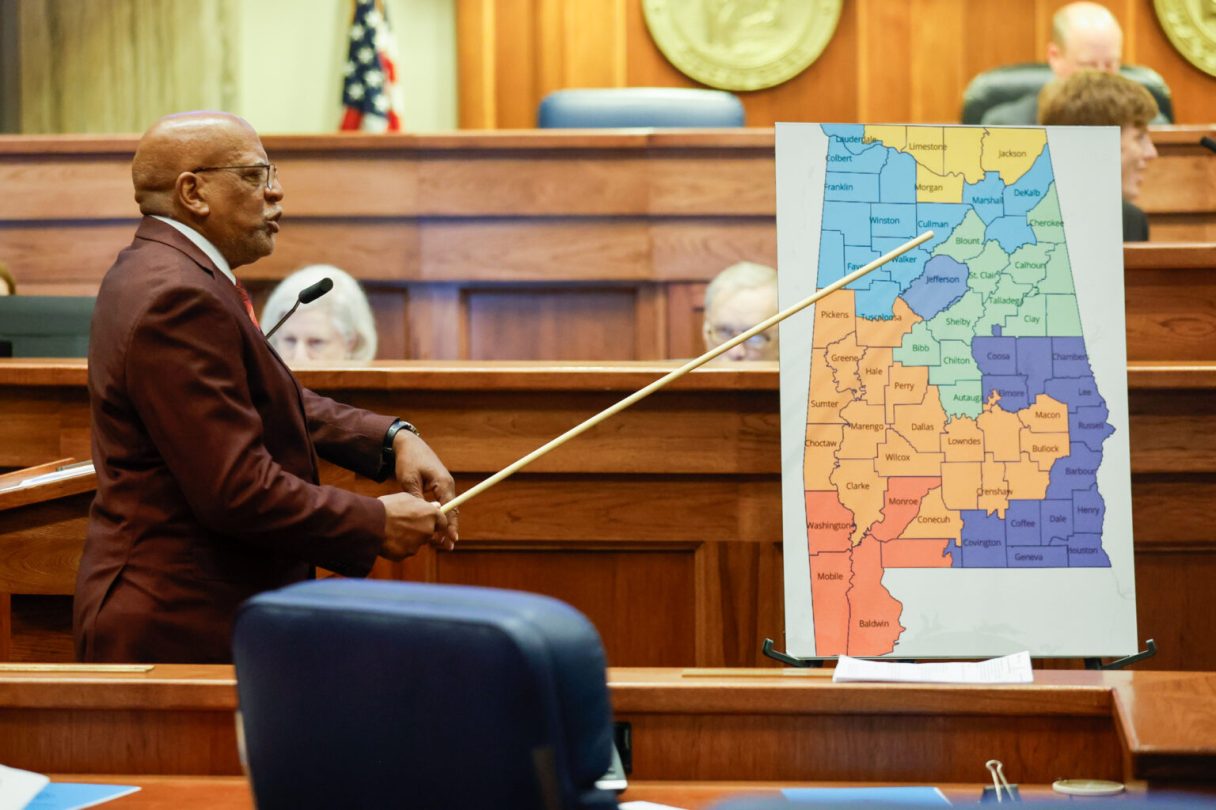
Wednesday’s Supreme Court ruling significantly limiting majority-minority districts should not have an immediate effect on Alabama’s legislative and congressional districts. But that could change in the future.
In a 6-3 decision, in a case called Louisiana v. Callais, Justice Samuel Alito held that a Louisiana congressional map was an unconstitutional racial gerrymander, and ruled that plaintiffs challenging legislative maps for racial discrimination under Section 2 of the 1965 Voting Rights Act had to show intent to discriminate by lawmakers. Under prior case law, plaintiffs had to show the effect of maps was discriminatory.
“The focus of (Section) 2 must be enforcement of the Fifteenth Amendment’s prohibition on intentional racial discrimination,” Alito wrote. “When (Section) 2 is properly interpreted in the way we have outlined, it is sufficiently congruent with and proportional to the Amendment’s prohibition. While that interpretation does not demand a finding of intentional discrimination, it imposes liability only when the circumstances give rise to a strong inference that intentional discrimination occurred.”
Section 2 of the Voting Rights Act limited states from using maps that would dilute the voting power of minority citizens.
Justice Elena Kagan, joined by justices Sonya Sotomayor and Ketanji Brown Jackson, dissented from the court’s opinion. Kagan cited Allen v. Milligan, the 2023 U.S. Supreme Court decision that resulted in Alabama drawing a near-majority Black congressional district due in part to polarized racial voting patterns.