
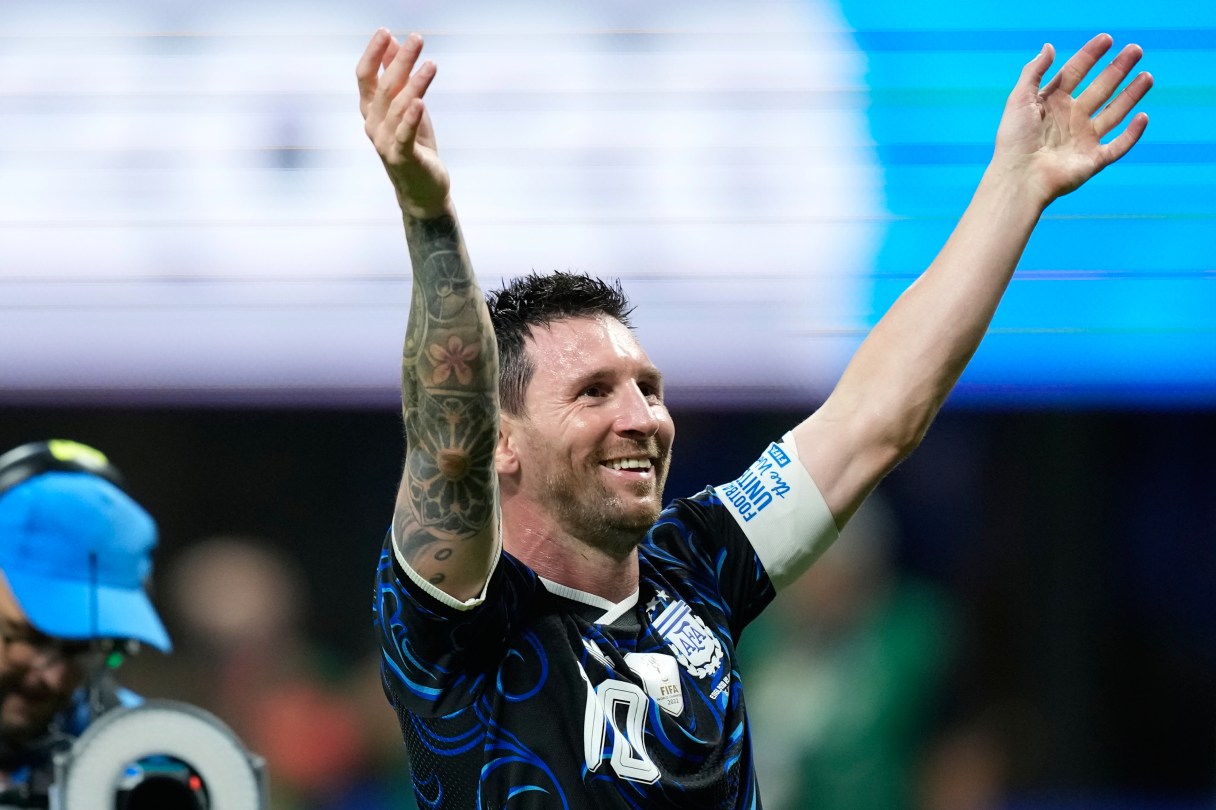
Lionel Messi has a message for detractors of Argentina’s national men’s soccer team: “Nothing was handed to us.”
The superstar striker for La Albiceleste responded to critics who have been bashing the reigning World Cup champions over perceptions of beneficial officiating and favoritism by the sport’s establishment. He said the team’s ability to overturn late-game deficits, most recently the semifinal victory over England, is the result of championship pedigree and nothing more.
After trailing 1-0 going into the 85th minute of Wednesday’s match at Atlanta’s Mercedes-Benz Stadium, Argentina rallied for a 2-1 win over England to reach the World Cup final and extend the quest for the country’s fourth championship in the quadrennial tournament for men’s soccer.
The victory, which led tens of thousands to flood the streets of Buenos Aires in ecstatic celebrations, marked another remarkable comeback that showed the perseverance of a team that is now one win from a back-to-back titles. Argentina faces Spain in Sunday’s final at MetLife Stadium in East Rutherford, New Jersey.
Argentina earlier survived by beating Cape Verde and Switzerland in extra time, and Messi & Co. rallied for an improbable 3-2 victory over Egypt after trailing 2-0 with 11 minutes of regulation time to play. However, both the Swiss and Egyptian coaches criticized the refereeing, and Egypt’s Hossam Hassan went as far as to say his team was the victim of a soccer establishment that favored Messi and Argentina.
The comments fueled criticism sparked by fans who argue the FIFA bracket favored La Albiceleste, along with unfounded allegations on social media claiming the soccer governing body wants Argentina to repeat four years after its triumph in Qatar.
“We’ve been the best over these past four years, either you like it or not, and no matter what anyone says,” Messi said after the win over England.
“Once again, we’ve established ourselves among the top two teams in the world. That proves that everything we’ve done is no fluke and that nothing was handed to us.”
The quarterfinal against Switzerland swung on a call that riled up those who believe Argentina has been favored by World Cup officials.
The Red Crosses had just tied the game at 1-1 on Dan Ndoye’s goal in the 67th minute when Leandro Paredes was shown a yellow card for a tackle on Breel Embolo. However, video showed the Swiss player falling before the Argentina midfielder made contact with him, and because Embolo received a yellow card earlier in the match, he was sent off and Switzerland was left to defend with 10 players.
“We were punished because of a rule that in my opinion is completely unacceptable,” Swiss coach Murat Yakin said after the game. “It’s very painful that we were eliminated that way. I don’t think we deserve that today, and in my opinion, my boys are the real heroes.”
Meanwhile, the Egyptian Football Association had said it “cannot remain silent” after what it believed was unfair and biased officiating in Egypt’s round-of-16 loss against Argentina.
Argentina’s team had not acknowledged the complaints on officiating and FIFA. In previous news conferences, Argentine coach Lionel Scaloni had even advised journalists asking about the matter “not to consume so much social media.”
After the victory over England, the reigning champions fought back.
“Reaching two consecutive World Cup finals is something very few achieve, and this group did it,” Messi said. “If we had lost to England, there would have been people coming out to spout some nonsense, but we didn’t give them the chance.”
Wednesday’s semifinal was the latest chapter in a long-running feud that has transcended the field to encompass British control over the disputed Falkland Islands, which Argentina calls the Malvinas and claims as its sovereign territory.
The British government on Thursday urged FIFA to investigate Argentina’s team after players celebrating their victory over England posed with a banner handed over by fans, reading “Las Malvinas son Argentinas” (“The Malvinas are Argentine”).
Enzo Fernandez acknowledged that his goal celebration, which leveled the score, was aimed at Argentina’s critics. The midfielder who plays professionally for Chelsea in England’s Premier League first cupped his hands to his ears, a gesture interpreted in soccer as a challenge to critics. Then he opened and closed his fingers, as if inviting them to keep talking.
“There was a lot of talk; it was a mix of euphoria and frustration,” Fernandez said.
Scaloni, for his part, stated in the news conference after the semifinal victory that “this talk of ‘help’ will always exist; it doesn’t bother me.”
“With VAR (video assistant referee) today, it’s very difficult to get help; it would have to be glaringly obvious. We knew there was no help.”