
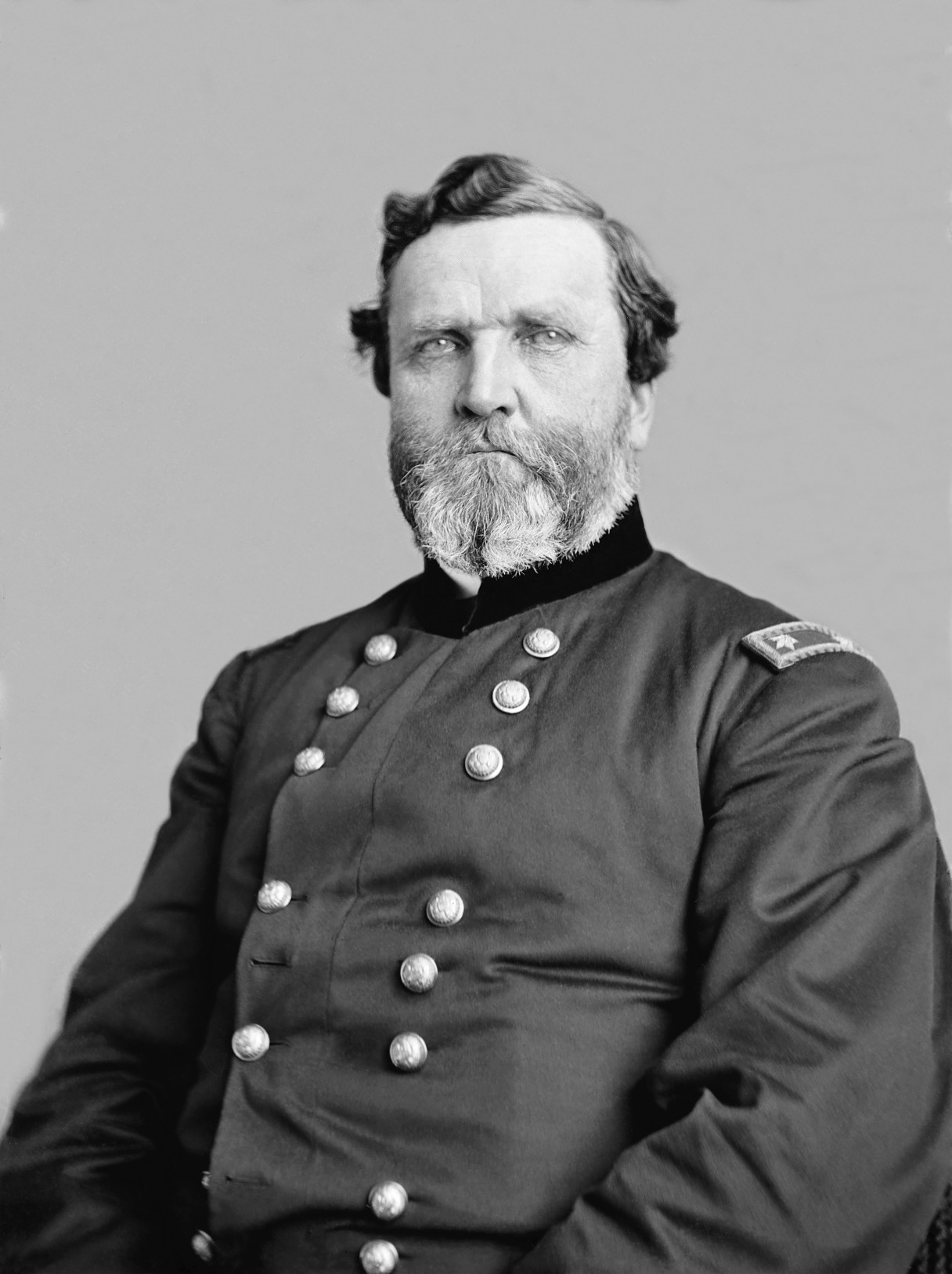
Editor’s note: part of a series on Civil War notables.
Maj. Gen. George H. Thomas was a Union Army commander in the Civil War, best known as the “Rock of Chickamauga.”
Thomas was born on July 31, 1816, in eastern Virginia near the North Carolina line into a prosperous land-owning family. Raised on his family’s plantation, he grew up in the rigidly structured, slave-holding society of the Antebellum South.
Though state law prohibited teaching enslaved people to read, a young George broke these rules on his family’s plantation and taught them how.
He secured an appointment to West Point, graduated 12th in a class of 42 in 1840, and was commissioned as a second lieutenant in the 3rd U.S. Artillery. His military career began in the Second Seminole War in Florida and the Mexican-American War.
Thomas became an instructor at West Point, teaching artillery and cavalry tactics. He subsequently served in the newly formed 2nd U.S. Cavalry, an elite unit patrolling the dangerous Texas frontier against Comanche and Kiowa forces, headed by Lt. Col. Robert E. Lee and Col. Albert Sidney Johnston.
Thomas’s decision to remain with the U.S. after Virginia seceded from the Union caused a profound, largely permanent rupture with his Virginia family. He believed his U.S. Army oath and duty to the national government outweighed allegiance to his home state. Accounts describe family members turning his portrait to the wall, destroying his letters and treating him as if he no longer belonged. His sisters were strongly secessionist and remained estranged from their brother, while his wife, Frances, daughter of a Troy, New York, merchant, was a committed Unionist. (Their marriage was described as warm, stable and childless.)
Thomas entered the Civil War as a regular Army major. The resignations of Southern officers — including the same Robert E. Lee and Albert Sidney Johnston — to join the Confederacy created opportunities for Thomas’s rapid advancement.
Thomas served in the Shenandoah Valley during the early months of the Civil War. His career progressed through assignments at Shiloh, Perryville, a crucial role at Stones River and ultimately Chickamauga.
In September 1863, in Chickamauga, Georgia, Gen. William Rosecrans charged Thomas with the critical task of defending the left of the Union line and Lafayette Road, the vital route back to Chattanooga. On the battle’s opening day, Sept. 19, Thomas’s corps absorbed heavy Confederate attacks. He maintained his stance and counterattacked to regain threatened ground, helping keep the Union left from being driven in and setting the stage for dramatic events of the next day.
On September 20, a series of miscommunications between Rosecrans and his subordinates left a critical gap in the center of the Union line. Confederate Gen. James Longstreet, newly arrived from Lee’s Army of northern Virginia, exploited the opening and ordered his men to pour through, striking the Union forces in the flank and rear. Most of the Union army — including Rosecrans himself — fled the field toward Chattanooga to establish a defensive line.
James Garfield, Rosecrans’s chief of staff (and future U.S. president), suspected that troops under Thomas were still holding. With Rosecrans’s approval, Garfield set out to see for himself, riding six miles across an unsettled battlefield. Some accounts said his horse was shot out from under him and also an orderly was killed during the ride. He found Thomas on Horseshoe Ridge/Snodgrass Hill, pulling together scattered units from across a broken army into a defensive stand.
Finding Thomas’s men holding firm against repeated assaults, Garfield was struck by how resolute the officer was and relayed word back describing Thomas as “standing like a rock.” Hence, the enduring nickname, “the Rock of Chickamauga.” His stand did not reverse the Confederate victory, but prevented the Army of the Cumberland from becoming cut apart or destroyed.
Thomas later led Union forces to a decisive victory at the Battle of Nashville in December 1864, badly damaging the Confederacy’s principal army in the Western Theater. After the war, he commanded the Department of the Cumberland and used federal troops to protect freed people and voting rights amid Ku Klux Klan violence.
President Abraham Lincoln remarked that “it is doubtful whatever this heroism and skill … has ever been surpassed in this world.” Some historians note that Thomas bore partial responsibility for early deployment mistakes, by continually pressuring Rosecrans for reinforcements amid the chaos of battle, that contributed to the gap. Still, Thomas’s afternoon stand remains one of the most heroic defensive actions of the Civil War.
Ulysses Grant and William Sherman held prominent public offices after the war, lived longer and produced influential memoirs. Thomas died unexpectedly of a stroke at his quarters in San Francisco’s Presidio at age 53 and being very private left no accounts to frame his accomplishments for future generations. His battle style was careful, defensive and methodical, vital for holding at Chickamauga and preparing for the crushing Nashville victory, but less suited for popular mythology than audacious offensives or a famous march.
Frank (Mickey) Robbins is a National Park Partners board member. For more on local history, visit Chattahsitoricalassoc.org.