
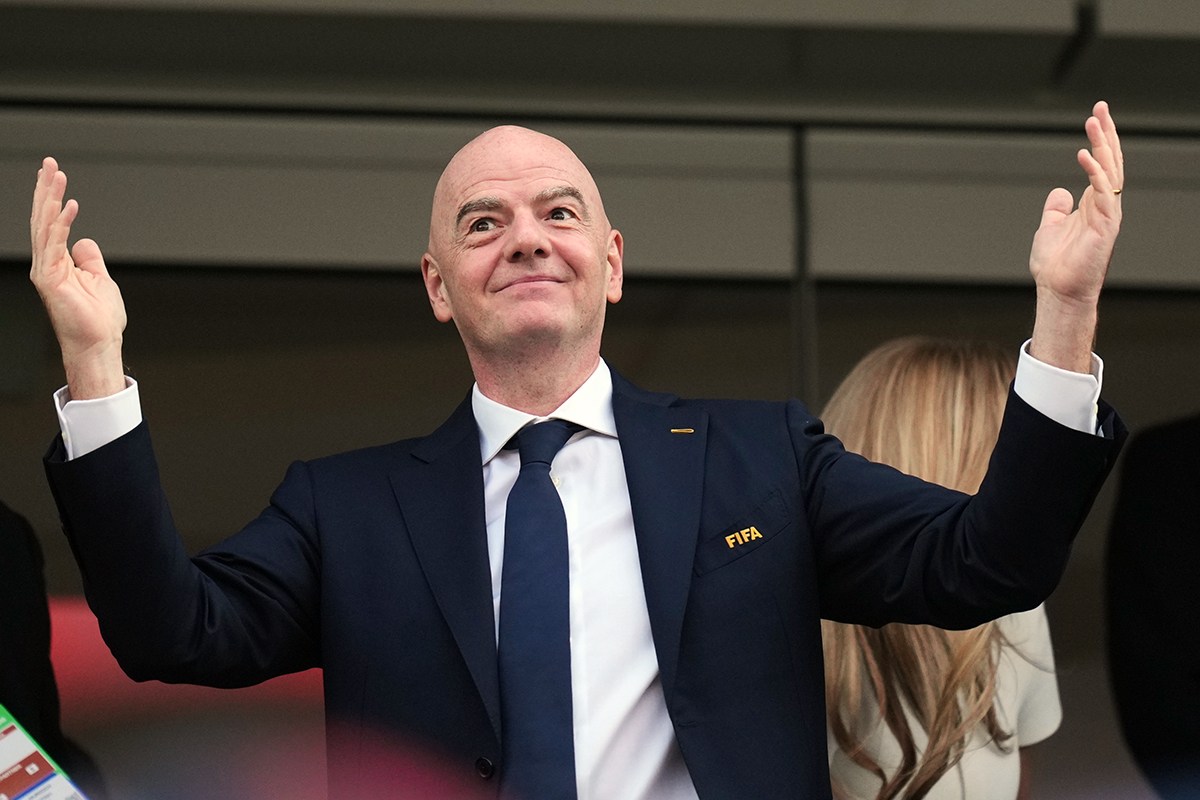
GENEVA — FIFA’s president is abandoning his divisive plan to sell World Cup profits to private equity after receiving pushback from all corners of the soccer world.
Gianni Infantino’s decision came after his senior adviser who sat on a White House panel resigned and Asia’s soccer body joined those from Europe and North America in opposing it.
“Having listened carefully to all the views, it has become clear that the project has created divisions of a nature that, regardless of the level of support, are no longer in the interest of the objective set out in the first place,” Infantino said in a statement released Friday. “Our purpose has always been — and will always be — to unite and improve. As a result, this proposal will not proceed.”
Infantino had proposed creating a $20 billion company to run the World Cup with private investors including the Kushner family, but his plan drew backlash that grew every day since Tuesday’s announcement.
UEFA’s 55 member nations across Europe agreed Thursday to boycott the World Cup and all other FIFA competitions over Infantino’s plan. CONCACAF — the association for teams in North American, Central America and the Caribbean — and the Asian Football Confederation also said they opposed the plan.
“Some things are simply too important to sell,” UEFA said in a statement released Thursday. “The FIFA World Cup belongs to football. It always will. And so long as Europe has a voice, it will never be for sale.”
Infantino’s senior adviser, Carlos Cordeiro, a former Goldman Sachs banker who represented the soccer body on the White House Task Force for the World Cup, resigned Friday and urged other senior staff at FIFA to speak out.
“I cannot stand by while FIFA considers selling a stake in the World Cup,” Cordeiro said in a statement released hours after the international governing body for soccer insisted: “Nobody is selling football.”
Hours later, FIFA chief operating officer Kevin Lamour issued a statement to The Associated Press, saying FIFA staff were deceived by Infantino’s lack of openness in planning the sale over recent months and that the project must not continue.
“It is the project of one person,” Lamour, a longtime colleague of Infantino at both FIFA and European soccer body UEFA, wrote. “Not only must this project not go ahead … but the time has now come for football political leaders to ask themselves the right questions and make the right decisions.”
Infantino has proposed spinning off FIFA’s commercial businesses — including World Cups and Club World Cups for men and women — into a $20 billion subsidiary with 20% owned by private investors.
The “anchor investor,” described by FIFA, is a New York-based investment firm created by Joshua Kushner, the younger brother of U.S. President Donald Trump’s son-in-law, Jared Kushner.
The next FIFA competition is the Women’s Under-20 World Cup starting Sept. 5 in Poland, which UEFA members had said they would boycott.
The misstep could prove costly for Infantino, particularly after the interventions by Lamour and Cordeiro.
Reelected unopposed in 2019 and 2023, Infantino is allowed one more four-year term under FIFA statutes. The deadline for the next presidential contest is Nov. 18, exactly four months ahead of the vote in Rabat, Morocco, where FIFA has its African headquarters.
Coming off this summer’s 48-team World Cup in North America, Infantino’s job seemed secured despite long-term unease with his style and previous attempts to force through unpopular projects, but his status could become more tenuous with the failed private equity proposal.