When asked to contribute my thoughts on what is next for Moccasin Bend, I imagined a director attempting to pitch a film that starts in the present day with no sense of what transpired beforehand.
Therefore, I’ve taken the liberty of crafting something of a screenplay to bring us all up to speed. Ready for the trailer?
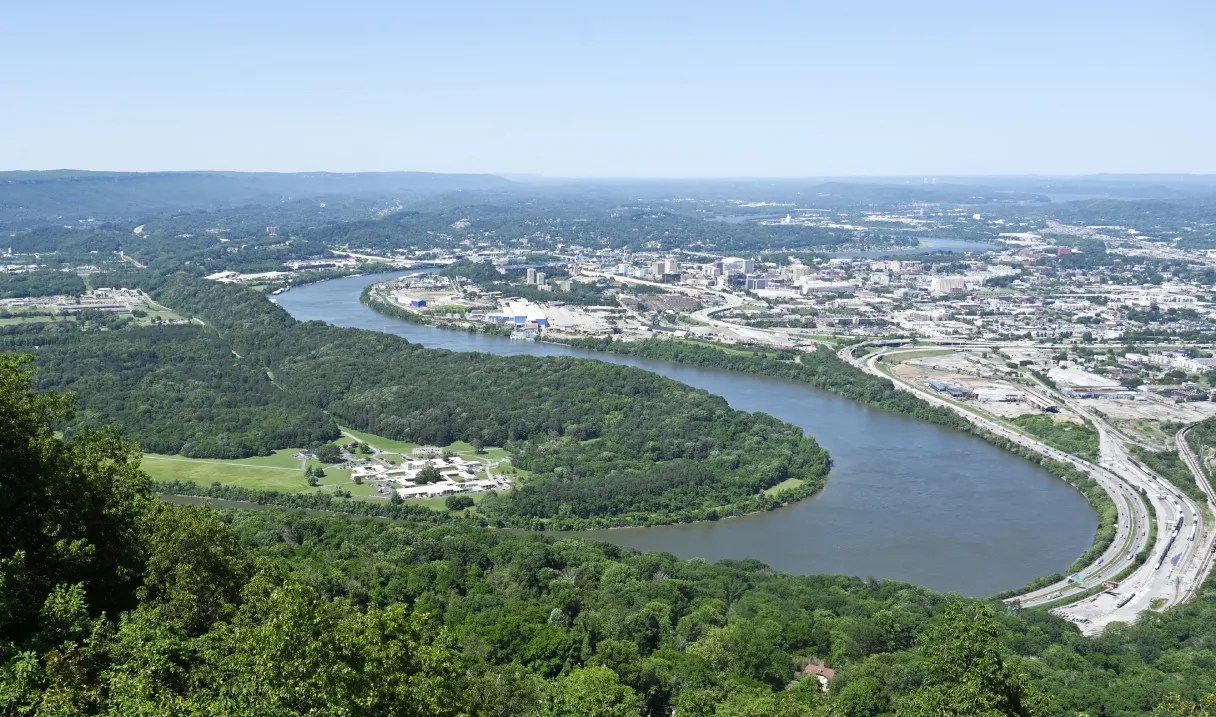
“Our story begins when the Ice Age ends and the glaciers recede. Nomadic Paleo-Indians hunting mastodon find refuge in places where the plains and the river and the mountains meet. One such landscape is formed when a raging river takes a sharp turn at the base of a steep mountain in modern-day Chattanooga.
“Every aspect of the human condition is revealed over the next 12,000 years in this epic tale of how the land and its people shape each other. Tragedy, hope, resilience, despair … a film for the ages.”
Intrigued? Grab your popcorn and settle in.
Seasonal encampments of early Paleo-Indians give way to established villages during the Archaic period as thousands of years pass. Fires and flooding are constant dangers, and simple structures are destroyed and rebuilt, time and again. Generations of ancestors are buried by Woodland Period inhabitants and subsequent Mississippian-era mound building cultures.
Spanish explorers arrive in the 1500s, bringing violence and disease to native lands. The Coosa population on Moccasin Bend is decimated, forcing survivors to migrate south. The magnetic pull of this place where the plains and the river and the mountains meet attracts the Cherokee, and their nation thrives in this region until the American Indian Removal Act of 1830. Most of the Cherokee and other remaining indigenous peoples are forcibly removed from their homeland and marched west along the Trail of Tears.
From tragedy and suffering come glimpses of hope as the story continues. An enslaved African-American makes a daring escape from a Moccasin Bend plantation by canoe, following the north star to freedom and becoming a conductor on the Underground Railroad. Twenty years later, pontoon boats full of U.S. Army soldiers float silently down the river, cloaked in darkness, in a surprise attack that will reopen the supply line on Moccasin Bend and save Union forces from being starved into surrender during the Civil War.
Interest in Moccasin Bend during the 1900s runs the gamut from preservation to exploitation. Various attempts to protect the land as a park fail while rampant looting of grave sites persists. Tennessee’s governor fails to close the deal for a Moccasin Bend National Park in 1953 and later authorizes the Moccasin Bend Mental Health Institute to be built in 1961. The door for more regrettable land use decisions is now wide open, as evidenced by the police firing range; the waste-water treatment facility; and more.
The outlook for saving any indigenous resources is growing bleak until the Moccasin Bend Task Force, authorized in 1982 to recommend the highest and best use of the remaining land, calls for preservation. Archaeological surveys confirm continuous habitation for 12,000 years, and Moccasin Bend is designated a National Historic Landmark.
Commitments are made to the National Park Service to relocate the city, county and state-run “nonconforming uses” within the landmark, which include the firing range and the mental institute. The National Park Service accepts the deal, and the 800-acre Moccasin Bend national archaeological district is created in 2004.
End scene, credits roll. Viewers leave the theater on a high note, imagining the nonconforming uses are soon relocated as agreed upon and the site is fully interpreted as a national treasure. Visitors and residents alike are fascinated by the layers of history, attracted as generations before them to a place where the plains and the river and the mountains meet.
Alas, that is not the case today. The past 20 years alone offer a sequel’s worth of political theater, and amid false starts and broken promises, the nonconforming uses remain. The recent mental hospital relocation announcement followed by the unexplained retraction from Tennessee’s lame duck governor is an unfortunate plot twist, but an incredible opportunity exists for his successor.
What if our new governor is the first one with enough moxie and sense to grasp the full potential of Moccasin Bend and make it a reality. Imagine this happening in their first term and they’re remembered forever as a hero instead of yet another Tennessee leader who fails to meet the moment. I’d pay good money to see that movie.
Tricia King Mims is executive director of National Park Partners