
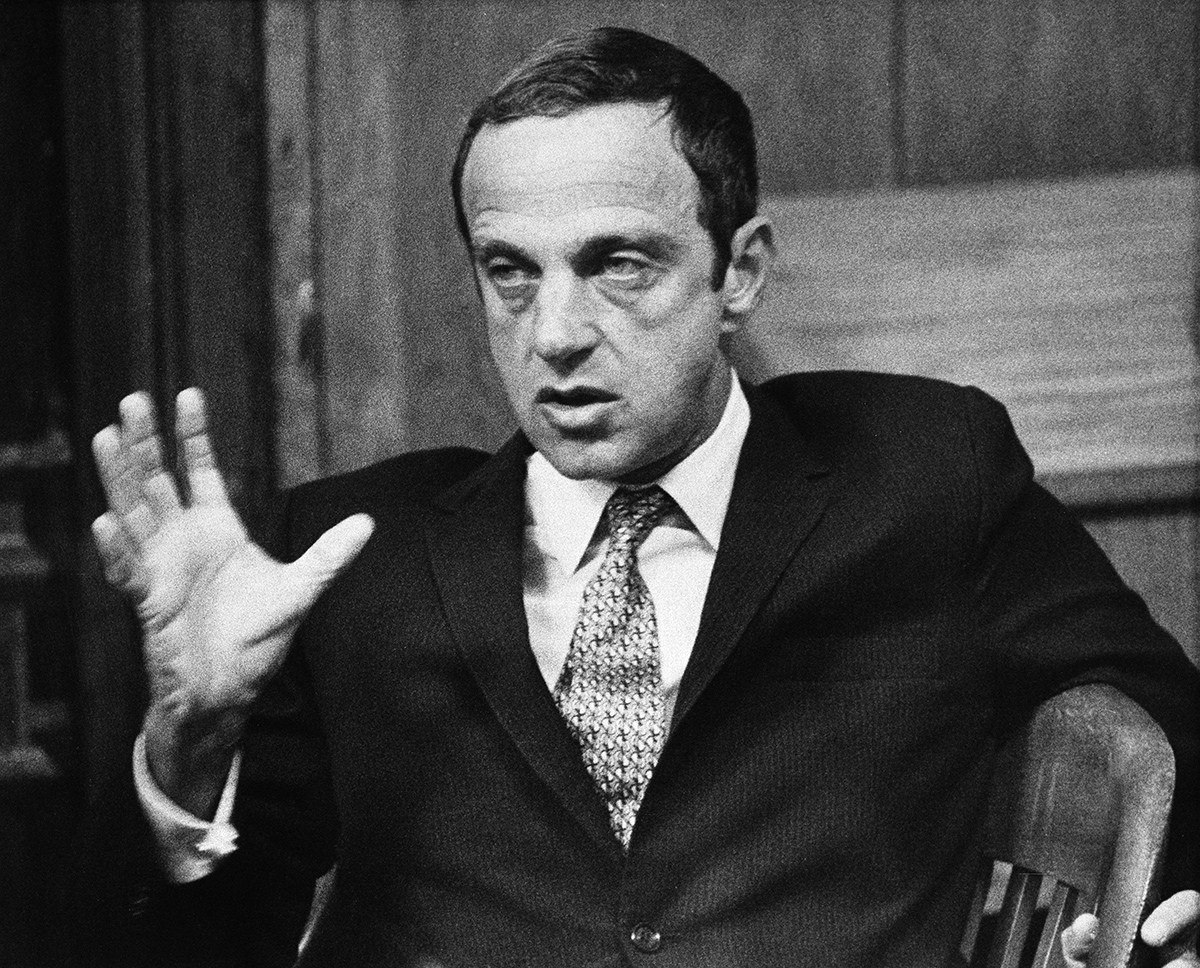
Near the beginning of “Where’s My Roy Cohn?” the new documentary about the lawyer and power broker who mentored Donald Trump, an interviewee says, “Roy Cohn’s contempt for people, his contempt for the law, was so evident on his face that if you were in his presence, you knew you were in the presence of evil.” He wasn’t being hyperbolic.
The film will likely be of wide interest because of how Cohn helps explain Trump. You see the glee Cohn derived from being an exception to the rules he enforced on weaker people. From him, Trump learned how, when he was in trouble, to change the subject by acting outrageously, to never apologize and always stay on the offense. When the Justice Department claimed that apartment buildings owned by the Trump family were discriminating against black renters, it was Cohn’s idea to countersue the Justice Department for $100 million.
The film’s title comes from something Trump said when he was frustrated with then Attorney General Jeff Sessions. Cohn was Trump’s template for what a lawyer is supposed to be. (In Attorney General Bill Barr, he seems to have found someone who satisfies him.)
What I found most striking about “Where’s My Roy Cohn?” wasn’t its insights into the thuggish president, whose particular brand of malevolence has been theorized to death. It was its reminders of just how decadent, in every sense, New York society used to be. Cohn was manifestly despicable, but he was embraced, rather than shunned, by New York elites. For a time, he had a sham engagement to Barbara Walters. He hung out with famed artist Andy Warhol and was a regular at the oft-mythologized nightclub Studio 54.
To understand the milieu Cohn moved in is, I think, to understand at least some of the generation gap among elites over what’s sometimes called “cancel culture” or “call-out culture” or even just “political correctness.” If you are under 35 or 40, it’s probably hard to grasp just how much depravity used to be tolerated in fancy circles.