
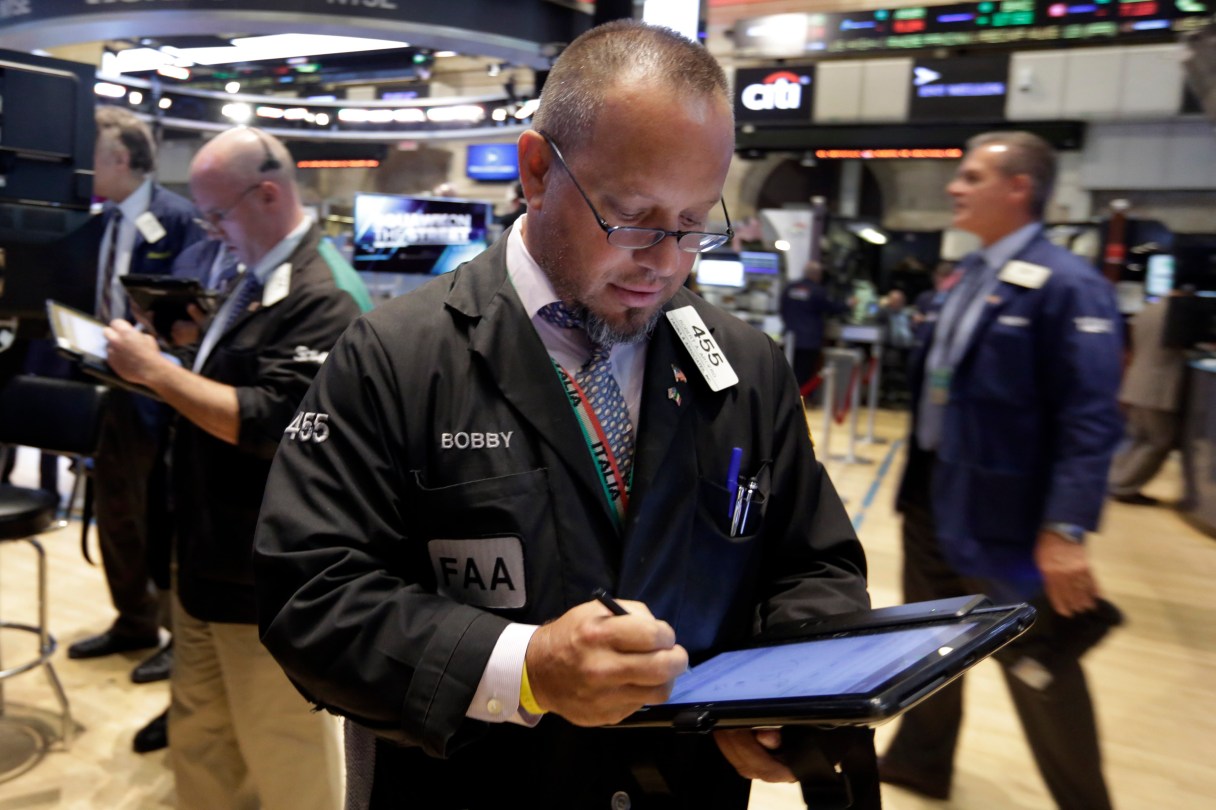
NEW YORK (AP) – Global markets steadied on Thursday as China’s central bank eased fears that the country’s currency would continue its slide. Major indexes in the U.S. wobbled between slight gains and losses in early trading then headed higher in the afternoon.
KEEPING SCORE: The Standard & Poor’s 500 index was up five points, or 0.2 percent, at 2,091 as of 2:45 p.m. Eastern time. The Dow Jones industrial average rose 62 points, or 0.4 percent, to 17,465, and the Nasdaq composite climbed 20 points, or 0.4 percent, to 5,065.
WHAT’S GOING ON: “This week it has really been all about China’s move and trying to interpret what its broader impact might be,” said Stephen Freedman, senior investment strategist at UBS Wealth Management. “Now it seems cooler heads are prevailing. People are saying, ‘Maybe this might not be as big of a deal as feared.'”
CHINA: Officials from China’s central bank defended recent moves to loosen the government’s grip on its currency, saying that the yuan will eventually rebound from its recent fall. There is “no basis for persistent and substantial devaluation,” said a deputy central bank governor, Zhang Xiaohui. The yuan is close to “market levels” after two days of sharp drops, Zhang said.
Beijing’s surprise devaluation of its currency on Tuesday shook markets around the world, sinking stocks, commodities and currencies.
PHEW: “I think the central bankers have given people a reason to believe they’re not that worried,” said Jason Pride, director of investment strategy at Glenmede, a money management firm. “That’s why we’re seeing some recovery today.”
BIG DATA: Cisco Systems surged after posting quarterly results that topped analysts’ expectations after the market closed on Wednesday. The tech company credited rising revenue from selling data-center servers and its collaboration with other businesses. Cisco’s stock gained $1.11, or 4 percent, to $29.01.
MISSED: The department-store chain Kohl’s turned in quarterly sales and earnings that fell short of estimates. The news knocked its stock down $5.52, or 9 percent, to $55.99, the biggest loss in the S&P 500 index.
ASIA’S SCORECARD: Major Asian benchmarks finished higher after a two-day slump. Japan’s Nikkei 225 rose 1 percent, and South Korea’s Kospi gained 0.4 percent. In China, Hong Kong’s Hang Seng climbed 0.4 percent, while the Shanghai Composite Index on the mainland added 1.8 percent.
ACROSS THE POND: In Europe, Germany’s DAX gained 0.8 percent and France’s CAC-40 climbed 1.2 percent The FTSE 100 index of leading British shares finished with a tiny loss.
BONDS: U.S. government bonds sank, lifting the yield on the 10-year Treasury note up to 2.19 percent from 2.15 percent late Wednesday.
CRUDE OIL: Benchmark U.S. crude fell $1.07 to close at $42.23 a barrel on the New York Mercantile Exchange, hitting new six-year lows. Brent crude, the international benchmark, fell 44 cents to close at $49.22 a barrel in London.
METALS: Gold fell $8 to settle at $1,115.60 an ounce, while silver sank 8 cents to $15.40 an ounce. Copper picked up a fraction of a penny to $2.35 a pound.