
Tuesday, November 10, 2026Nov 10

Nobel winner’s army defense blasted in Myanmar genocide case

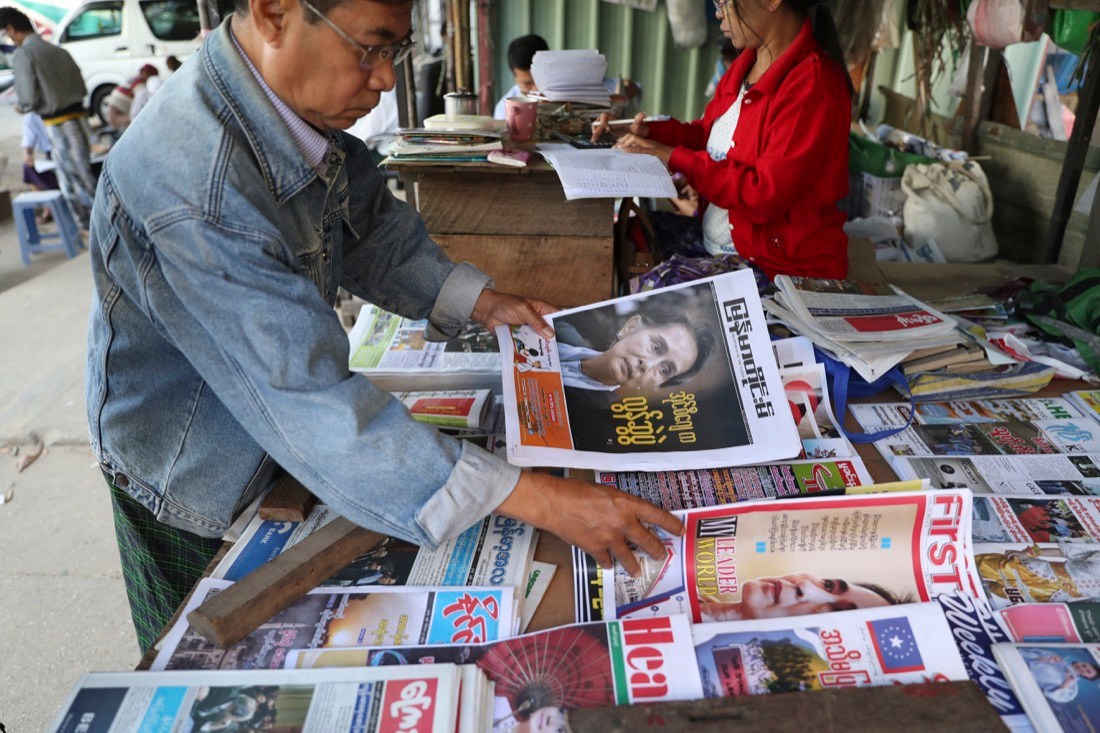
A man looks through newspapers with front pages leading with Myanmar leader Aung San Suu Kyi at the International Court of Justice hearing, near a roadside journal shop Thursday, Dec. 12, 2019, in Yangon, Myanmar. Suu Kyi testified to the court that the exodus of hundreds of thousands of Rohingya Muslims to neighboring Bangladesh was the unfortunate result of a battle with insurgents. She denied that the army had killed civilians, raped women and torched houses. (AP Photo/Thein Zaw)
A man looks through newspapers with front pages leading with Myanmar leader Aung San Suu Kyi at the International Court of Justice hearing, near a roadside journal shop Thursday, Dec. 12, 2019, in Yangon, Myanmar. Suu Kyi testified to the court that the exodus of hundreds of thousands of Rohingya Muslims to neighboring Bangladesh was the unfortunate result of a battle with insurgents. She denied that the army had killed civilians, raped women and torched houses. (AP Photo/Thein Zaw) A man looks through newspapers with front pages leading with Myanmar leader Aung San Suu Kyi at the International Court of Justice hearing, near a roadside journal shop Thursday, Dec. 12, 2019, in Yangon, Myanmar. Suu Kyi testified to the court that the exodus of hundreds of thousands of Rohingya Muslims to neighboring Bangladesh was the unfortunate result of a battle with insurgents. She denied that the army had killed civilians, raped women and torched houses. (AP Photo/Thein Zaw)

THE HAGUE, Netherlands (AP) – Lawyers seeking to halt what they allege is ongoing genocide in Myanmar have slammed leader Aung San Suu Kyi’s defense of her country’s armed forces, saying Thursday that the Nobel Peace Prize winner and former pro-democracy icon chose to ignore “unspeakable” crimes targeting Muslim civilians.

The United Nation’s top court is conducting emergency legal proceedings to determine if military personnel committed genocide against Myanmar’s Rohingya minority in 2017. The African nation of Gambia, acting on behalf of a large group of Muslim countries, requested the International Court of Justice hearings and alleges that human rights violations against the Rohingya continue.

With maps, satellite imagery and graphic photos, Myanmar’s accusers have detailed what they insist is a deliberate campaign of ethnic cleansing and genocide – including the killing of civilians, raping of women and torching of houses – that forced more than 700,000 Rohingya to flee to neighboring Bangladesh.

Gambia wants the U.N. court to take “all measures within its power to prevent all acts that amount to or contribute to the crime of genocide.”

The U.N. court proceedings in The Hague produced the astonishing spectacle on Wednesday of Suu Kyi, who was awarded the 1991 Nobel Peace Prize for championing democracy and rights under Myanmar’s then-ruling junta, defending the army that kept her under house arrest for some 15 years.