
More Info
For more information on Blood Assurance, to find specific locations or to schedule a time to donate, visit bloodassurance.org.
In the three days after the shootings on July 16, 1,600 people offered up their veins for blood donations at Blood Assurance locations across Chattanooga and Georgia.
When disaster strikes, people are willing to put aside a fear of needles and willing to make the trip to the blood bank’s nearest location, said Blood Assurance’s Charlie Callari, vice president of marketing and donations. Last summer, he witnessed this camaraderie and willingness to help firsthand.
But nearly eight months later, donations have waned, and the blood supply at Blood Assurance is below a two-day supply for certain blood types, instead of the ideal five-day supply, he said.
For a nonprofit like Blood Assurance – which has 75 hospitals spanning from Tennessee to Virginia relying on the blood supply it obtains from 15 locations across the region – consistent supply is not just a wish, it’s a need.
“When something happens – a big event – we automatically get overwhelmed with people who want to help,” Callari said. “People all of a sudden overcome their fears because they want to help. And we always get responses from those new donors that say, ‘Oh, it wasn’t bad.’
“Fortunately, we don’t have that very often, but people rise to the challenge. The problem is, we need people to rise to the challenge every day.”
On average, someone in the U.S. needs a blood transfusion every two seconds, he said.
“Need never goes away,” he added.
The process
With donation centers downtown on Third Street and in Hixson, Cleveland, East Brainerd, as well as Fort Oglethorpe and Dalton, Ga., the process of donating is simple, said Callari.
First-time donors often don’t know that the actual donation only takes about 10 minutes, he said.
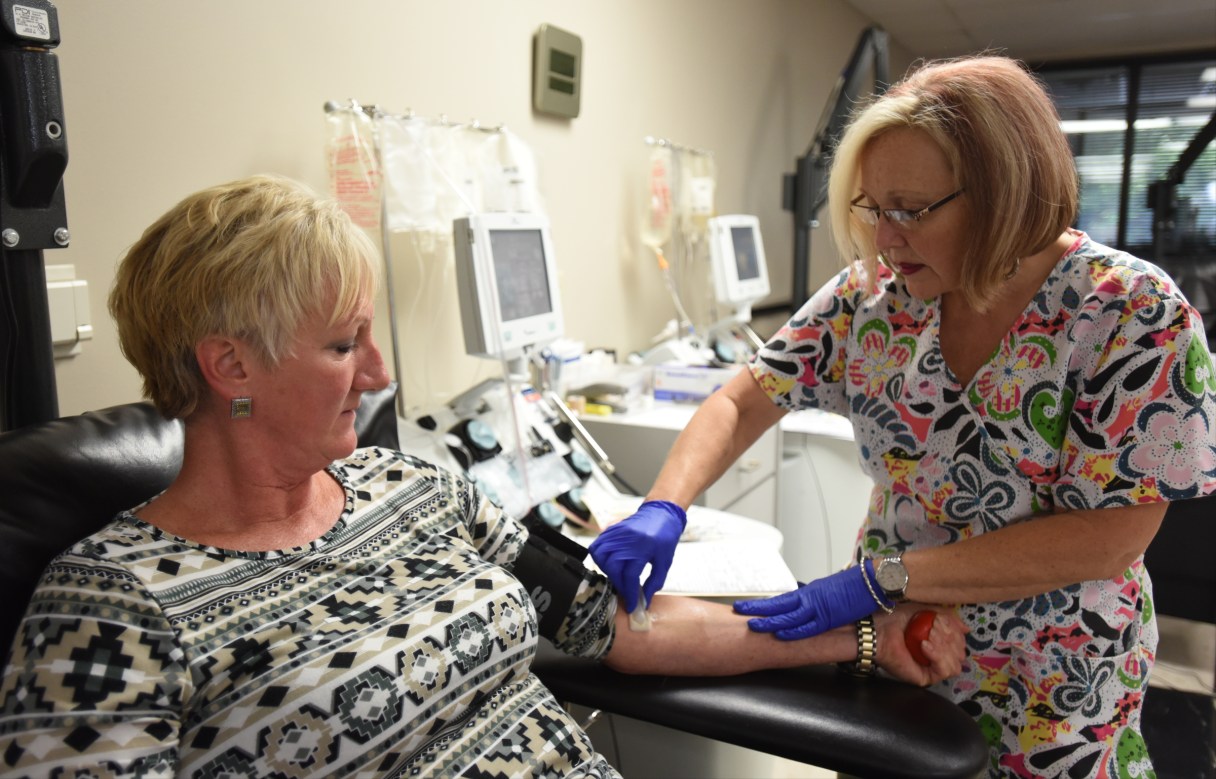
Before the needle prick and donation, donors are given a mini-physical to test iron levels and blood pressure, followed by a series of simple questions about their lifestyle and health. Then, they’re seated in a comfortable chair with access to a TV and the Internet while they give blood.
Before they leave, donors are given a drink, snack and shirt or other token of appreciation.
“And every time you volunteer to donate, you are saving three lives. Just for those minutes of volunteerism,” said Callari.