
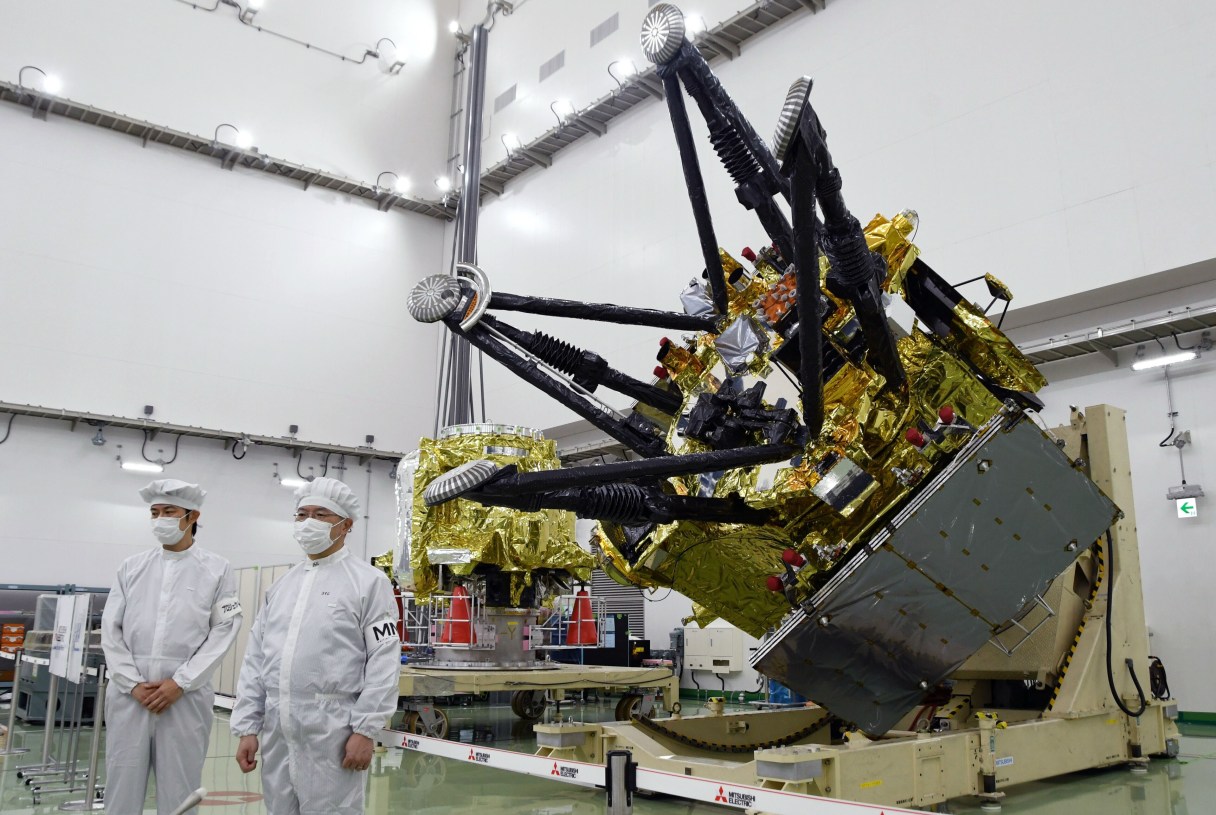
On Oct. 19, Japan launched one of the most unique spaceflight missions of the year. Its target is the small, potato-shaped moons of Mars. If all goes as planned, the robotic spacecraft will scoop up a bit of soil from one of them and bring it home.
Mars has two moons. That’s twice as many moons as Earth, but it’s rookie numbers next to the gas giants. Jupiter has more than 100 moons, and Saturn more than 280. We’ve sent spacecraft to visit plenty of our solar system’s moons, and the Huygens probe even landed on Saturn’s moon, Titan, in 2005. But we’ve never brought a piece of one back.
Compared with our own moon, Mars’ moons are tiny. Deimos is a measly 9 miles by 7 miles by 6.8 miles, and Phobos is only slightly larger at 17 miles by 14 miles by 11 miles. Our moon is more than 150 times wider than Phobos and nearly 7 million times as massive and has enough mass to pull itself into a sphere. Phobos and Deimos don’t, so they’re lumpy and irregular, more like asteroids than moons. In fact, they might be asteroids that wandered too close and got trapped by Mars’ gravity. Or they could be debris flung into orbit when something big slammed into Mars. Scientists aren’t really sure where they came from.
Settling that question is the first goal of the mission, called MMX, or Martian Moons eXploration. The second goal is to learn about a Mars that is long gone, one with a thick atmosphere and liquid water on its surface. Our own moon holds a record of Earth’s early history, and Phobos may do the same for Mars. It could explain how a world that once had thick air and flowing water became the cold, dry Red Planet we see today as well as how Earth has managed to keep its water and atmosphere.
With support from NASA, the European Space Agency and the French and German space agencies, MMX is the largest international collaboration ever led by the Japan Aerospace Exploration Agency (JAXA).