
Read more
Chattanooga is lowest cost city for business startups
Jared Spool and Leslie Jensen-Inman set out to raise $21,700 through Kickstarter to help launch a post-secondary school.
They hit their goal in just four hours and ended up raising $133,767 for Center Centre last year. A success story, for sure.
But that’s not the case for many crowdfunding campaigns. And those that do succeed have nailed down their strategy and marketing tactics before they seize on a digital initiative, according to Jensen-Inman and other Chattanooga business leaders versed in crowdfunding, during the third installment of Experience Talks, sponsored by the Small Business Development Center and Co.Lab.
“Today, projects that end up being successful are relatively mature,” said George Yu, whose company Variable Inc. met or exceeded its funding goals on Kickstarter three times.
The point of many campaigns isn’t singular. Sure, creators need money. But a successful campaign is also about validation, which helps with future funding, Yu said.
“The campaigns are about raising awareness as much as they are about raising capital,” Jensen-Inman said. “Obviously, $22,000 isn’t enough to start a school.”
Much of the work it takes to lock down a successful campaign comes before the online pitch goes live, speakers stressed during Wednesday’s talk at Camp House – which itself is an example of a successful crowdfunding campaign.
In summer of 2014, the coffee shop approached Causeway to spearhead its campaign for moving into its new location. It raised $24,000 through the Chattanooga nonprofit organization, which helps people find support for local projects that improve the city. Dollar-wise it was Causeway’s most successful campaign, said Abby Garrison, the organization’s executive director.
“They were organized, they had a team behind them,” Garrison said.
Center Centre, which offers a curriculum in user-experience design, spent at least six months preparing for its campaign, Jensen-Inman said. She and Spool studied other Kickstarter pitches to see what they liked and disliked, in order to hone their own campaign. They built relationships with media. They researched vendors to determine which would be sure to deliver promptly to campaign backers.
“Pre-planning is the most important part,” Jensen-Inman said.
To be sure, Kickstarter is not the only crowdfunding platform. Niche platforms exist: Medstartr for the health care set, for example. “Go where your target audience feels most comfortable,” Jensen-Inman suggested.
And choose a moderate fundraising goal, so that you meet it and don’t wind up having to explain your failure to investors, according to Rick Hitchcock of Chambliss Startup Group.
Contact Mitra Malek at mmalek@timesfreepress.com. Follow her on Twitter @MitraMalek.
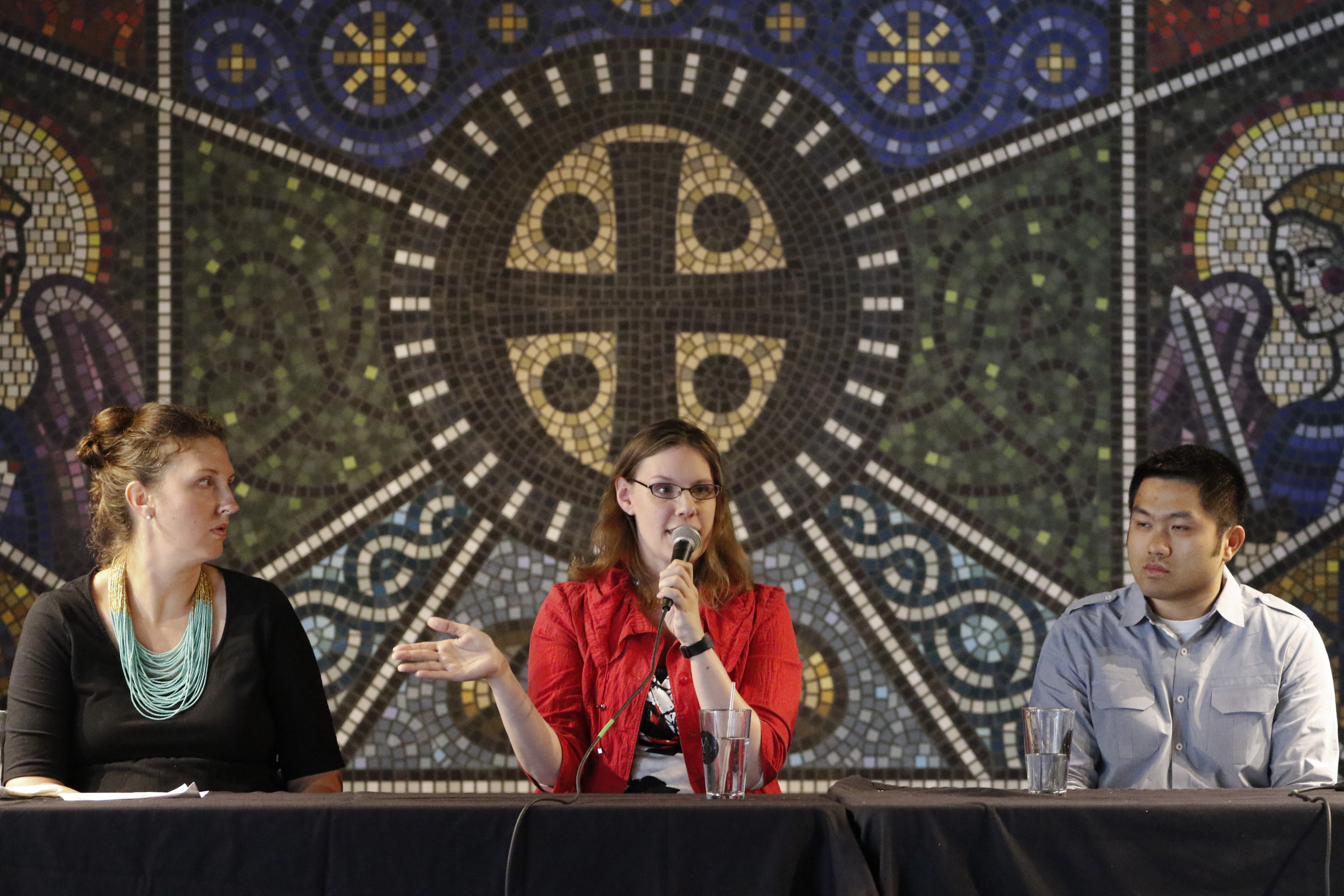 Staff Photo by Dan Henry / The Chattanooga Times Free Press- 9/23/15. Abby Garrison, Leslie Jensen and George Yu, from left, speak at the Camp House during the Experience Talks program hosted by the Small Business Development Center on Wednesday, September 23, 2015.