
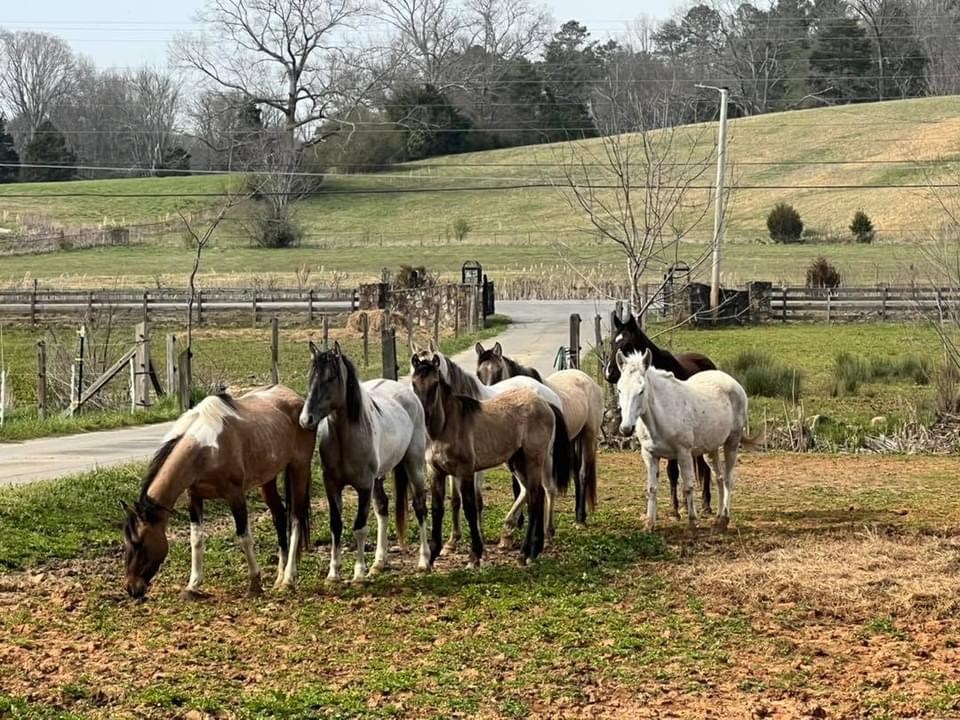
Catoosa County, Georgia, residents last week might have seen a herd of six horses and a mule making their way down the roads near Ringgold.
It took about five hours and a community effort, but the horses were finally rounded up and taken to Serendipity Farm & Rescue, said Tonja Wilkes, the nonprofit’s founder. In a phone interview, she said the horses weren’t in good shape.
“Owning a horse is not like owning a dog,” Wilkes said, and she hopes more education on horse care – one of her nonprofit’s goals – will avoid situations like that. Many horse owners have been hit hard financially during the pandemic, and Wilkes said rising feed and fuel prices have made it hard to be a horse owner.
Wilkes said she does a lot of work with horses and their caretakers, but her heart is with underserved children. Horses can heal people, she said, so her nonprofit works with horses and people who need a second chance and offers birthday parties to foster care and other children in hardship for no charge.
The roundup started near Apison, Tennessee, on the Catoosa-Hamilton County line and ended down Salem Valley Road in Catoosa County. The horses were nearly hit by passing traffic several times in the process, she said, until two trainers on horseback “well versed in roundups” helped get them on trailers and to the rescue farm.
Horses have a hierarchical dynamic like wolves, Wilkes said, and the first thing the roundup crew did was identify who was on the top rung in the herd dynamics. That can be a male stallion, as it was in this case, but can also be an alpha mare or a younger male colt who’s bullied the stallion out of the leadership role, she said.
The trainers would usually charge $1,400 for their work, but Wilkes said they cut their fee in this instance.
The horses had some health issues but were to be returned to their owner. As of Monday, one of the horses had been returned. The others were not cooperating.
“Our goal here is not to yank horses away from people it’s to educate, so the horses don’t get the short end of the stick,” Wilkes said.
Horse owners need to know how healthy manure looks, and how to identify a smelly hoof – symptoms that can be treated early to avoid more serious illnesses, she said.
Wilkes said Serendipity Farm & Rescue is accepting donations to defray costs for what’s been dubbed the “Serendipity Seven,” and the nonprofit’s other work. Wilkes said the organization relies on donations and doesn’t get any government support for its work.
“I just hope people learn to reach out before they’re over their head,” she said.
Vicki Scoggins, who lives in LaFayette and owns seven horses, followed the situation on social media. She agreed horse ownership is expensive.
When they received the report of the roaming horses last Tuesday, Catoosa County Sheriff’s Office deputies went door to door trying to find the owner. Scoggins said she would expect people to know their neighbors’ horses, but the area has been developing recently.
“Salem Valley Road has some farms, and it’s gotten pretty residential, and Apison has some farms, so they’ve got acreage. I would think you’d know what your neighbor’s horses look like. It’s not expansive fields, it’s a pretty close area,” Scoggins said. “They’ll be maybe a 20-acre farm, and right next to it a $500,000 house. So they’re gonna know.”
READ MORE: Rezoning approved for two proposed Catoosa developments
Some people don’t check on horses every day when they have food, but Scoggins said during the winter, she has to buy four or five rolls of hay a month – at $40 a roll. Scoggins also has heard of people who let their horses roam before the grass comes in because they can’t afford food.
Contact Andrew Wilkins at awilkins@timesfreepress.com or 423-757-6659. Follow him on Twitter @tweetatwilkins.