


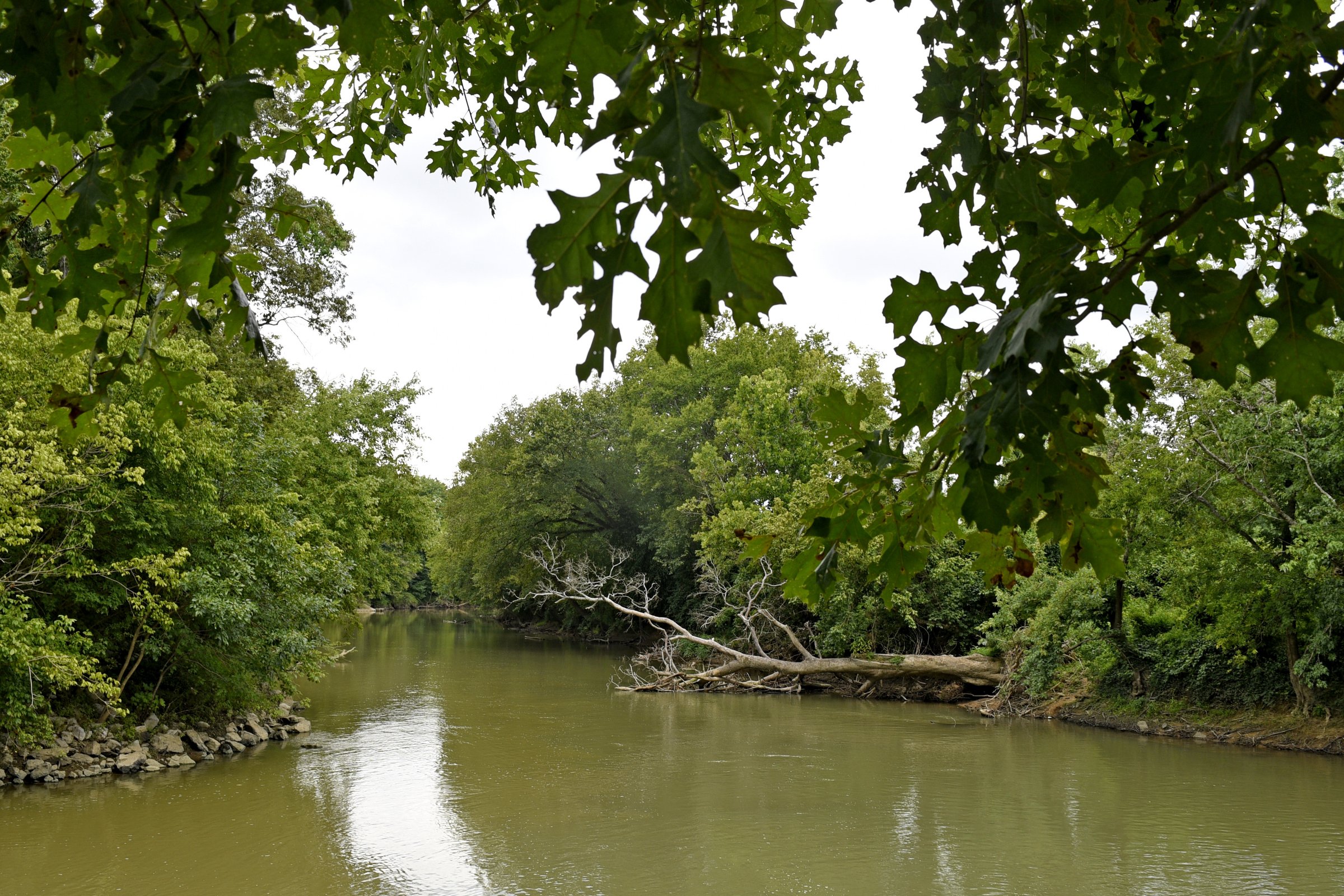
 Staff Photo by Robin Rudd/ A fallen tree extends into the water as South Chickamauga Creek winds its way between East Ridge’s Camp Jordan Park and Brown Acres Golf Club on July 19, 2019. Public comments are being taken on the Interstate-75/Interstate-24 “Split” project’s wetland impact. The point in the creek here is less than a mile upstream from the project site.
State officials say the $132.5 million project to rebuild Tennessee’s Interstate 75/Interstate 24 “split” will have consequences for streams and wetlands around the interchange, and they are asking for public input on the contractor’s plans to minimize that impact.
The general area involved consists of the land within the Y-shaped footprint of the current interchange, plus areas along the east side of I-75 North where construction passes the Welcome Center at East Ridge’s Exit 1 just north of the Georgia line, according to public notice documents.
Spring Creek, an unnamed tributary of Spring Creek on the west side of I-75, South Chickamauga Creek and eight unnamed wetlands in the area are the environmental features involved.
In 2012, the U.S. Army Corps of Engineers approved the state’s request for the roadwork and seven alternative approaches were analyzed, documents state. Of those, the one in place now “provides for the smallest environmental footprint,” documents state.
A revision of that approach reduced the original 12.18 acres of permanent wetland impact to 9.38 acres. The work temporarily will impact another 2.23 acres of five wetlands, and two stream crossings resulting in about 580 linear feet of permanent impact.
Reducing the impact
Project designers sought several ways to reduce environmental impacts.
The contractor’s design seeks to minimize impacts on stream and aquatic species with bridges over South Chickamauga Creek and Spring Creek that do not enter the water. The old bridge at Spring Creek, which now has piers in the water, will be removed and replaced with the new design that uses a single span with no supporting piers. Where the bridge is to be widened over I-75 at South Chickamauga Creek, the design was modified to minimize wetland impacts there, as well.
In the eight wetland sites in the project area, crews will “restore the wetlands by removing and stockpiling the natural topsoil prior to construction, restoring natural contours and spreading native topsoil to pre-construction elevations at the end of construction, seeding with native riparian seed mix, planting of native trees, and installation of permanent signage to protect these restored areas.”
To keep erosion and the release of sediment to a minimum, only 50 acres of land will be disturbed at a time “and all in-water construction activities would be completed in the dry and separated from flowing water by using temporary cofferdams, cribs, or stream diversion as appropriate,” documents state.
According to TDEC, the contractor on the state project will compensate for unavoidable wetland impact through mitigating design and by buying 28.4 wetland bank credits from the Sequatchie Valley Wetland Mitigation Bank.
Macon, Georgia, resident Karl Wagner created the Sequatchie Valley Wetland Mitigation Bank with farmland near Whitwell, Tennessee, he converted into wetlands back around 2011.
By meeting requirements of the wetland bank credit program, Wagner’s wetlands provide mitigation credits for projects such as the split where unavoidable wetland damage can’t be helped, he said. The purchase of credits reimburses wetland bank sponsors such as Wagner for their investment in recreating and preserving wetlands and loss of farmland production.
The 28.4 credits purchased for the split will cost in the neighborhood of $1 million, an expense that is part of the state’s contract.
HOW TO COMMENT
U.S. Army Corps of Engineers comment period: Aug. 21 to Sept. 21, 2019Address comments to:Nashville District Corps of Engineers, Regulatory Division3701 Bell Road, Nashville, Tennessee 37214Any comments received will be considered by the U.S. Army Corps of Engineers to determine whether to issue, modify, condition, or deny a permit for this proposal. To make this decision, comments are used to assess impacts on endangered species, historic properties, water quality, general environmental effects, and the other public interest factors listed above. Comments are used in the preparation of an Environmental Assessment and/or an Environmental Impact Statement pursuant to National Environmental Policy Act, known also as NEPA. Comments are also used to determine the need for a public hearing and to determine the overall public interest of the proposed activity.Source: U.S. Army Corps of Engineers, Tennessee Valley Authority
BY THE NUMBERS
Estimated daily traffic volumeInterstate 752019: 101,2602039: 127,360Interstate 242021: 118,4102041: 146,100Source: Tennessee Department of Transportation, U.S. Department of Transportation
IF YOU GO
What: Informational session and public hearing on the environmental impact of the I-75/I-24 interchange projectWho: Tennessee Department of Environment and Conservation and members of the publicWhen: Sept. 19• Information session: 5:30-6:30 p.m.• Public hearing: 6:30-7:30 p.m.Where: East Ridge High School, 4320 Bennett RoadComment in writing: Written comments will be accepted after the hearing until Sept. 29:Division of Water Resources312 Rosa L. Parks Avenue, 11th floorNashville, TN 37243
A long time coming
The split redo has been a few decades in the making.
The interchange at I-75 and I-24 – built in the late 1950s and early 1960s – has been the subject of improvement ideas since it notched its first 10 years of existence.
A fix finally arose in 2017 with former Gov. Bill Haslam’s IMPROVE Act, as part of infrastructure investments for 101 individual projects in 40 Tennessee counties. The contract for the work was awarded in December 2018. Construction is expected to be finished by summer 2021.
More than 100,000 vehicles a day traverse the split, which is known for its daily backups, outdated merge lanes, frequent crashes and big-rig rollovers. And it’s aging and suffering from wear and tear.
On April 1, a piece of concrete railing on the I-75 South overpass at the split fell onto the lanes below after a suspected impact from a oversize vehicle. One person was injured by the falling concrete when his car crashed into it.
Wagner says he believes in the project and is looking forward to improvements.
“I come through there every couple of weeks,” he said, “and man, that’s a traffic jam twice a day.
“It’s just a crazy design,” he said.
The public notice and upcoming hearing are “part of the permit process for the Design-Build I-75/I-24 interchange modification project,” TDOT spokeswoman Jennifer Flynn said last week. The “design-build” project delivery method, something new for Tennessee, combines all or some portions of the design and construction phases of a project into a single contract.
Flynn said the state agency can’t discuss specifics of the permit, public information sessions or hearing because TDOT is the applicant on behalf of C.W. Matthews.
What’s happening now
Meanwhile, crews in coming days will continue surveying operations throughout the project area and trucks will be hauling materials to the site, TDOT said. Occasional lane closures are possible, but only between 9 p.m. and 6 a.m., for now.
Plans by the contractor – Marietta, Georgia-based C.W. Matthews Contracting Co. – are the subject of a joint U.S. Army Corps of Engineers/Tennessee Valley Authority public notice and public comment period.
Public comment is open until Sept. 21.
Separately, the Tennessee Department of Environment and Conservation will host a public hearing at East Ridge High School on Sept. 19 to answer questions and take comments on environmental impacts. TDEC will accept written comments through Sept. 29.
Contact Ben Benton at bbenton@timesfreepress.com or 423-757-6569. Follow him on Twitter @BenBenton or at www.facebook.com/benbenton1.