
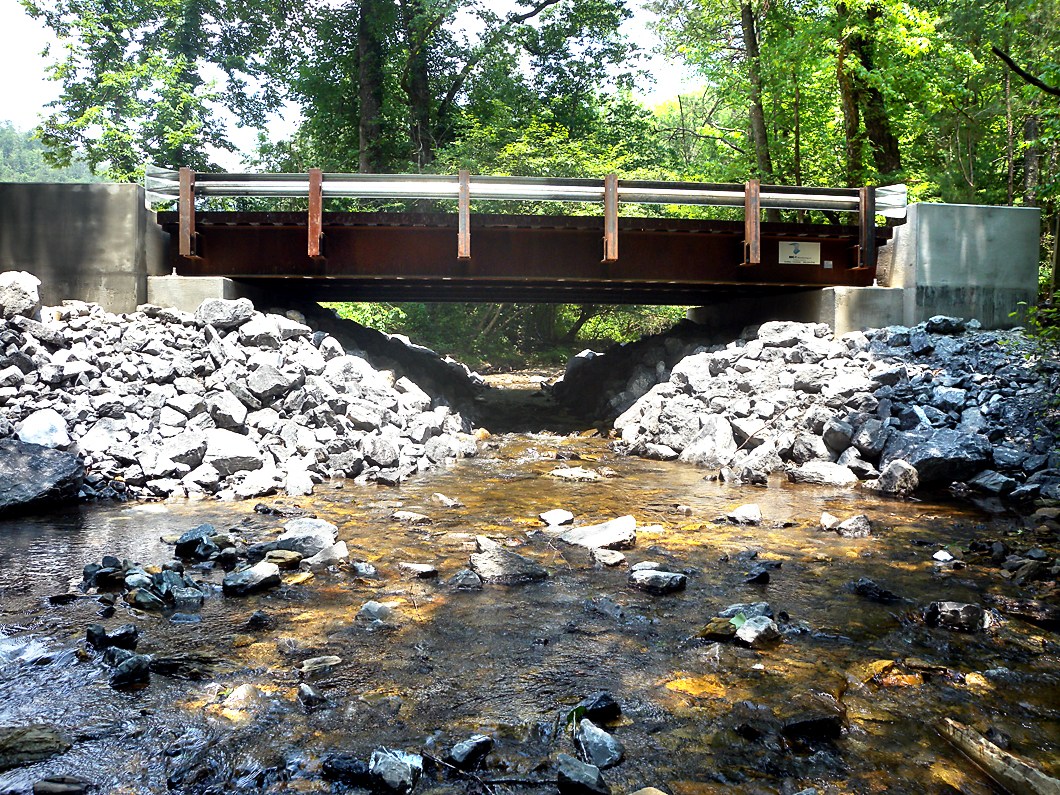
As far as endangered and threatened fish were concerned, four steel pipes forming a culvert over Holly Creek in Murray County, Ga., were “truly was a bridge to nowhere.”
Sherry Crawley and Katie Owens, both with the Georgia Nature Conservancy, said the culvert has prevented fish from moving freely throughout the most biologically intact tributary of the Conasauga watershed for 32 years.
Now, thanks to some partnering among officials with the Nature Conservancy, Murray County and the U.S. Fish and Wildlife Service, a new free-span bridge has been built by a Cleveland company – the Simpson Bridge Co.
“The culverts were too small. When it rained hard, it formed a deep pool on the downside making what’s called a perched culvert. Most of the listed species in the watershed are small, and they can’t jump up over rocks. So once these culverts became perched, basically all high passage (back upstream) was stopped,” Owens said.
Owens says the work gives the aquatic life and fish – especially the endangered ones – access to breeding, spawning and habitat refuge areas eight miles upstream into pristine areas of Dill Creek.
SPECIES AT RISK* Coosa moccasinshell (Medionidus parvulus)* Southern pigtoe (Pleurobema georgianum)* Alabama moccasinshell (Medionidus acutissimus)* Fine-lined pocketbook (Lampsilis altilis)* Blue shiner (Cyprinella caerulea)* Conasauga blue burrowing crayfish (Cambarus cymatilis)* Six species of sport fish, including troutSource: The Nature Conservancy
Murray County Manager Tom Starnes said it helps save future county taxpayer dollars, too.
“In the past, when we’ve had heavy rainfall, those culverts would wash out, breaking that roadway apart completely,” Starnes said, noting the road provides access to a recreational area and several private residences.
“This was a proactive measure (for the fish), but we were also trying to enhance that crossing from a traffic standpoint,” he said.
Owens said the Nature Conservancy received a $25,000 grant from FishAmerica Foundation. That money, combined with $69,000 from the U.S. Fish and Wildlife Service and $67,939 in matching and in-kind costs from Murray County, funded the project.
Jerry Simpson, with Simpson Bridge Co. Inc., said setting in the pre-fabricated bridge – a 40-foot span – on CCC Camp Road took about two months.
It’s a weathering steel bridge, meaning it’s not intended to be painted, he said.
“It’s a high-yield strength steel. When rust forms on it, it makes a dense oxide on the outside of the steel that seals the steel. They came up with a good bridge, and it’s a structure that goes well with the surroundings,” Simpson said.
The road’s bridge approach work and the bridge paving was done by Murray County using county workers and equipment.
“I think Murray County deserves a good deal of credit,” Simpson said. “Like any city or county, they’re having a difficult time making ends meet. They originally started planning for the structure four or five years ago, and they were persistent in finding and arranging funding.”
CCC Camp Road provides public access to the Chattahoochee National Forest and is a vital public artery in Northwest Georgia, Crawley said.
Dill Creek flows to Holly Creek, the most biologically intact tributary of the Conasauga River and an area where the Conservancy is working to improve water quality on many fronts, she said.
In addition to threatened and endangered fish, a wide range of mussel species and the extremely rare Conasauga blue burrowing crayfish, now known to exist only in the Holly Creek watershed, also will benefit from the new bridge, Crawley said.
BRIDGE FOR FISH – PAM
Continue reading by following these links to related stories:
Article: Fishing for the future