
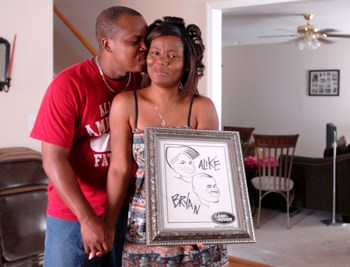
Matthew Purvis can’t shake the image of his dead grandmother, drowned by Hurricane Katrina’s floods.
It was 32 days after she died in her Louisiana home when Purvis found her. He had to wait until the water receded to check on her in St. Bernard Parish, just south of New Orleans.
“I’m not a soldier, but that’s the closest thing to war I’ll ever experience,” said Purvis, who now lives in Red Bank.
Then an officer in the New Orleans Police Department, he was forced to stay in the submerged city. He didn’t know if his wife, who had fled to relatives, was alive until three days after the storm, when he received a text message that she was OK.
When they saw each other again, they immediately decided it was time to leave the bayou behind.
Purvis and others who came to the Chattanooga area in their flight from Katrina – which hit five years ago today – say they still are haunted by memories of corpses floating in the water-filled streets of New Orleans, of the sobs that accompanied the nightly newscasts, of panicked phone calls from relatives stuck in the devastation.
They call it “the storm” and, with steady hands and shaky voices, they recall the days the rains started. They’ve left the “if only’s” behind in the flooded streets.
Most say more or less the same thing: “It was heartbreaking, but I’m stronger for it.”
Sitting in her Brainerd home, Alike Verrett thumbs through a stack of photographs taken at her New Orleans house three weeks after Katrina hit.
The photos show her home holding 18 inches of water, mold four feet high on the walls. She pauses on one that shows her front door, crisscrossed by a spray-painted orange “X,” a message to rescue workers that the house was condemned.
To Verrett, the X is a sign of comfort.
“I like this because it means that they would have come to rescue us or help us if we had needed it,” she says.
“It’ll never be the same. It’s been five years, and there are houses that people haven’t even touched,” Verrett said.
CHAOS BEFORE THE STORM
The days before the storm were “total chaos” as a half-million people tried to leave the city, said Purvis, now a corporal with the Hamilton County Sheriff’s Office. While his wife stayed with family outside the city, he braved the storm in a four-story police station that swayed a foot on every surge of Katrina’s 125 mph winds.
Verrett, 35, left the day before the storm made landfall. Her husband, two children, parents, aunt and uncle left for a Shreveport hotel to “wait it out.”
“I had only one suitcase packed for four people, and it just turned into another way of living,” Verrett said.
Verrett’s family caravaned to Shreveport and Baton Rouge in bumper-to-bumper traffic. Every stretch of the trip took twice as long as it should have because of the traffic.
Then, a friend of her husband recommended a job in Chattanooga and a chance to start over.
After a brief stay in the Louisiana cities, Verrett, her husband and children made the drive to Chattanooga and started a new life. Now she lives in a two-story brick house and the only reminders of her days in New Orleans are the photos held together with rubber bands.
Sonia Burks, 49, also left the day before the storm. She packed her 5-year-old twin daughters’ school uniforms because they were set to start school the next week and she was certain they would be back in time.
“We all had that denial personality because for years and years we never got hit,” Burks said. “We were going around saying, ‘I know I need to walk through this and do this, but it’s not really going to hit.'”
Burks went to Dallas and Tuscaloosa, Ala., before getting word of helpful programs in Chattanooga. She said two of her sisters decided to weather the storm in their New Orleans homes but ended up in the Louisiana Superdome with thousands of other refugees.
Talking to them on the phone, Burks said they told her human excrement was everywhere and, no matter how hard they tried, they couldn’t get clean.
CHATTANOOGA BLESSINGS
Todd Womack worked for Mayor Ron Littlefield in 2005 and was in charge of programs to help the displaced Katrina victims. More than 50 evacuees either drove to Chattanooga or flew here in an airplane hired by former Vice President and Tennessee native Al Gore, Womack said.
There were so many donations of clothing, toiletries and food given by Chattanoogans, the Chattanooga Housing Authority and several warehouses opened spaces so survivors could pick out clothing and necessities, Womack said.
“I think that outpouring is what makes Chattanooga unique,” said Womack, now chief of staff for U.S. Sen. Bob Corker, R-Tenn. “It’s the heart and soul of our community.”
Randy Parker with the Chattanooga Fire Department said Katrina was a learning experience for Chattanooga officials.
Though there were emergency measures in place, officials had to learn quickly how to deal with evacuees who arrived with nothing but the clothes on their backs, Parker said.
CHATTANOOGA BOUND
Different reasons brought Purvis, Burks and Verrett to Chattanooga, but the three describe the city and its people as “a blessing.”
The people in Chattanooga brought Purvis back to his faith, he said.
“The storm made me a Christian again,” Purvis said. “Everything happens for a reason. God didn’t send the hurricane to get me to Chattanooga, but it’s a godsend that I did end up here.”
Purvis visited Chattanooga when he was 12 and liked it so much, he and his wife decided to come back after Katrina.
Verrett likes the school system, the people and the changing seasons of Chattanooga, even though she didn’t want to leave New Orleans.
“I’m the baby girl of the family,” Verrett said. “My family and New Orleans were all I knew.”
Verrett studies sociology at Chattanooga State Community College and works at T.C. Thompson Children’s Hospital in the neonatal intensive care unit and the emergency room. Even before Katrina hit, she wanted to go into a field where she could help people, and Chattanooga offered the right combination of classes and employment to meet those goals.
Burks returned to New Orleans a few weeks after the storm to collect her belongings. She lived in an apartment complex on an undamaged street, so her problem was getting her and her daughters’ belongings back to Chattanooga without being able to afford a trailer.
“God told me whatever I couldn’t fit in my car, I didn’t need at the time,” Burks said.
Because of several Federal Emergency Management Agency programs and the help of Chattanooga government officials, Burks said she was able to get new furniture, groceries and toiletries while she was getting settled.
“God promised to rebuild my life, and he absolutely followed through,” Burks said.
Only a few have been back to visit family, friends and the life they left behind. Mostly they look forward.
Burks said the damaged tourist areas of the city have been rebuilt more quickly than the residential neighborhoods.
“Rent there now is outrageous,” Burks said. “They’re charging more to live there because there are less places to stay.”
Purvis’ second-story condo didn’t flood, so all his belongings were saved. Verrett only saved some photos, children’s toys and “anything that could be dipped in bleach.”
Through faith, FEMA and the kindness of Chattanooga, they survived. And, as if it were yesterday instead of five years ago, they can recount every moment they cried, every moment they worried and every moment they faced uncertainty.
“It’s a part of me now,” Purvis said. “In a way, I’m glad I had to go through [Hurricane Katrina].”
Continue reading by following these links to related stories:
Article: Life since Katrina: 3 stories of survival