
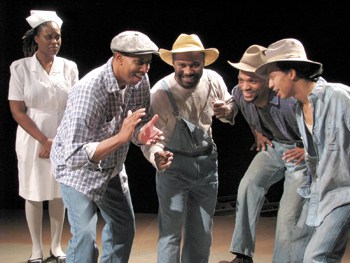

IF YOU GO* What: “Miss Evers’ Boys.”* When: 8 p.m. today, Saturday, and Feb. 26-27; 4 p.m. Sunday and Feb. 28; 2:30 p.m. Feb. 27.* Where: Ripple Theatre, 3264 Brainerd Road.* Admission: $16 adults, $13 groups, $10 students.* Phone: 242-5156.* Web site: www.destinyentertainment.org.STAGE TO TV”Miss Evers’ Boys” was first presented as a 1992 stage play. It was made into a 1997 HBO movie starring Laurence Fishburne and Alfre Woodard. The film garnered 11 Emmy Award nominations, winning for Outstanding Made for Television Movie, Outstanding Lead Actress in a Miniseries or Movie (Woodard), Outstanding Editing for a Miniseries or Movie — Single Camera Production, and Outstanding Cinematography for a Miniseries or Special. It also was nominated for two Golden Globe Awards, winning one.
LaFrederick Thirkill hopes the play “Miss Evers’ Boys” will help theater audiences differentiate between a folk tale and the truth.
The Destiny Theatre Company production, which opens tonight at Ripple Theatre, tells the story of the noncurative experiment known as Tuskegee Syphilis Experiment, which was conducted on 399 blacks between 1932 and 1972.
“It’s an important part of our nation’s history, of African-American history,” said Thirkill, the play’s director. “It’s a story that has been misunderstood by many people. It’s nice to be able to learn and know actual story vs. the folk tale.”
The drama by David Feldshuh, which is being produced in conjunction with Black History Month, focuses on the lives of four tenant farmers who represent many others in the study.
The study that prompted the play began when it was noticed there were a high number of syphilis cases in Alabama’s Macon County in the 1930s, according to Thirkill. The original intent, he said, was to try to treat the sick patients and arrest what threatened to be an outbreak.
When the effects of the Great Depression worsened, the government had to stop a lot of treatment programs, he said. However, doctors still wanted to study how the disease affected the races and continued the study.
When penicillin became the standard therapy for syphilis by 1947, study researchers prevented their patients from participating. That continued until the end of the study 25 years later.
The play is told from the vantage point of Eunice Evers, a fictional nurse who is aware of the treatment of the men, and through flashbacks.
The director said the play has drama, comedy, comedy through irony, period music and choreography from Dawn Axam.
“It’s nicely written,” Thirkill said, “and any audience would appreciate the story and the way the playwright has stayed true to the story.”
The director said he taught the seven actors in the play about the facts in the story and asked them to do further research to enhance their roles.
“This is an excellent cast, a very talented cast from Chattanooga,” he said. “These are veteran actors who are committed to making sure they represent the true story.”