
In the 1980s and ’90s, refugees fleeing war-torn villages from Vietnam and the former Soviet Union made the Scenic City their home.
More recently, Burundians, Iraqis and Cubans have trickled into Chattanooga, starting new beginnings with the help of the local Bridge Refugee and Sponsorship Services, churches and individuals.
PDF: 2009 Global trends
Chattanooga is one of many American cities that has welcomed refugees from more than 20 years. But while more than 100,000 refugees were resettled around the world last year, more than 40 million people are unable to live in their home countries because of conflict and persecution — the highest number since the mid-1990s, according to a United Nations report.

Humanitarian crises and the prevailing political climate in a number of countries have prevented the return of refugees, according to the latest “Global Trends” report of the UN High Commissioner for Refugees.
Today nations around the world observe World Refugee Day, a tradition that started in Africa, the continent with the most refugees, to call attention to the subject.
Resettling in a new country is challenging; learning English, adapting to a new culture and finding work aren’t easy. The Times Free Press spoke with three refugees who have made successful transitions to life in America.
Fulfilling childhood dream
As his family was escorted out of their Bosnian village, Mirza Muretcehajic remembers walking by a bus station and seeing a person who had just been executed laying face down.
Farther up the road was a home and a barn on fire. He still remembers hearing the horse inside it neighing in terror.
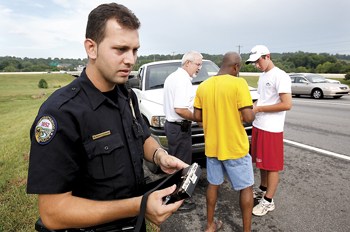
His childhood war experiences are what shaped him to become the Chattanooga police officer he is today.
“I think, based on what I’ve seen in my life, going through the war and all that, people are forced upon so many injustices you just want to go out there and be fair to everybody,” said the 28-year-old father of two.
Mr. Muretcehajic came to the United States as a 12-year-old refugee from Bosnia in 1994, fleeing a country where Muslim Bosnian men, including his father, were killed. Entire villages were burned down.
As a child, he always dreamed of becoming a police officer. Back then, he was fascinated with the flashing lights and the idea of chasing people.
As he grew older and became a leader in the local Bosnian community, he realized there were many other reasons to fulfill that dream.
He became a naturalized U.S. citizen in 2006. The next day, he turned in his application to go through 20 weeks of police training.
But his greatest accomplishment — although his job is high up on the list — is his family, he said.
“My mom, bless her heart, she did an amazing job raising us. There were times she worked two jobs, but stayed involved in our lives,” he said. “But not having a father figure and having to see other friends and their dads, it was hard. … One wish of mine was to have a family, and that’s been the greatest success.”
As he spoke, his wife Mirsa, also a refugee, spoke Bosnian to their 2-year-old daughter Sara in the background.
Never too late to learn
Vera Bucharova knows that no matter where you come from or how old you are, learning English and perseverance are keys to success in the United States.
“First, you have to learn English, then you go from there because if you don’t know English you can’t get a decent job,” said the 53-year-old electroencephalographic, or EEG, technician at Parkridge Medical Center.
More than 20 years ago she fled communist Czechoslovakia with her 3- and 6-year-old daughters and ex-husband, carrying only a suitcase filled with two weeks’ worth of clothes meant to appear adequate for a summer vacation.
“We decided, for their future, we had to do something,” she said.
They were willing to even risk prison time and an orphanage for her daughters if they were caught.
Ms. Bucharova came to the United States as a political refugee in December 1988.
“We actually escaped Czechoslovakia because my ex-husband was a member of the Communist Party, and one day he decided he didn’t want to be a member of the Communist Party,” she said, still with a slight Czech accent.
In their fight to gain asylum, they spent three nights sleeping in their car in Belgrade, Yugoslavia, and lived in a refugee camp for three months.
“When we found out we were coming to the U.S., it was like a big stone fell off your body,” she said. “We were very happy that we didn’t have to go back.”
Once in the United States, she started working baby-sitting jobs for $1 an hour and cleaning houses, but with the help of a neurologist who served as her mentor, she started learning medical technology in 1993. Within three years, she became certified as an EEG technician.
WHO IS A REFUGEE?* A person who is unable or unwilling to return to his or her country of nationality because of persecution or a well-founded fear of persecution on account of race, religion, nationality, membership in a particular social group, or political opinion.Source: U.S. Department of Homeland SecurityNUMBER OF RESETTLED REFUGEES (2009)* United States: 74,602* Tennessee: 1,583* Chattanooga: 91Source: U.S. Department of Homeland Security, Bridge Refugee Services in ChattanoogaBY THE NUMBERS: 2009* 43.3 million forcibly displaced people worldwide* 15.2 million of those are refugees* 27.1 million are internally displaced people* Developing countries were host to four-fifths of the world’s refugees* 19 countries reported the admission of 112,400 resettled refugeesSource: United Nations High Commissioner for Refugees, 2009 annual “Global Trends” report.
Building a new home
When Muharem Blazevic was told he could pay off his new car in five years, the Bosnian refugee said he only needed two because he wouldn’t be in the United States for much longer than that.
But as his children went to school and started building a new life, he realized his new home was Chattanooga and not the Bosnia he left in 1993.
“I don’t have anything in Bosnia. They burned everything, my house, they killed my (mother), they killed relatives,” said the 57-year-old business owner.
Mr. Blazevic, his wife and two children, 13 and 8, escaped the ethnic cleansing by Serb extremists all across northern Bosnia-Herzegovina which forced more than 2 million people to flee their home, according to the UN.
He remembers arriving in Chattanooga, not knowing where he was.
“It was already dark. I see a lot of trees and said, ‘Where are we?'” he recalls.
But seven days later he was working for an insulation company on Brainerd Road.
“The sponsor gave me a bicycle and I’m going to my job with bicycle. Everybody, my friends, American people, come with car and they park their car, I’m parking my bicycle,” he recalled. “I think, ‘Can I have sometime maybe a car?'”
Not only did he save enough money to buy a used car, within two years he had moved out of his two-bedroom apartment and purchased a three-bedroom home.
He worked the same job for six years until he fell 12 feet off a ladder while installing a roof and broke his back. Since he wasn’t able to work anymore, Mr. Blazevic saw the opportunity to open the first store in Chattanooga that catered to Bosnians and others from the former Yugoslavian region.
Ten years, later Balkan Foods on Ringgold Road offers an international clientele Croatian and Bosnian products as well as fresh Bosnian and European bread his wife Enisa bakes every morning before he opens his doors at 7:30 a.m.
“We lose everything in Bosnia, but we …” he paused to look
for the words in English … “but we have to start a new life.”