
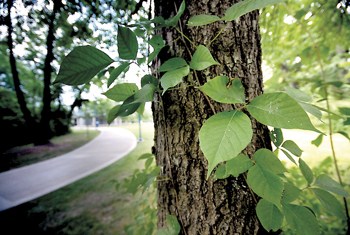

Ringgold, Ga., resident Ben Friberg said he has been hospitalized on several occasions after coming in contact with poison ivy.
“I used to get it so bad it was in my eyes, ears, mouth, nose, fingers, lips, armpits, between my toes, etc.,” said Mr. Friberg, 32. “I would rather go through 10 days of any torture than the state it puts me in.”
Poison ivy and its equally itchy cousin, poison oak, routinely send people to hospitals, doctors’ offices and pharmacies seeking relief from nasty rashes and painful itching.
Most people are sensitive to the plants’ oily sap, called urushiol, according to the National Institutes of Health website, nim.nih.gov. The sap is in the plants’ roots, stems and leaves and causes rashes and itching. Self-care measures such as wet compresses and anti-itch creams can help soothe the skin and reduce inflammation, experts say.
But worse problems also can appear if the plants are burned. Airborne sap-coated soot can get into the eyes, nose, throat and respiratory system.
KNOWING THE ENEMY
The best way to avoid the effects of the plants is to learn what poison ivy and poison oak look like, said Tom Stebbins, University of Tennessee Agriculture Extension agent.
With poison ivy, a three-leaf plant that grows on a vine, “look for a hairy vine and mark it with a flag to make it easy to identify in the winter,” when it will stand out from the other, leafless vegetation, Mr. Stebbins said.
Poison oak, a three-leaf shrublike plant that resembles oak leaves, is easier to destroy than poison ivy, he said.
“You can kill it this time of year because you can easily see it on the ground,” he said. “Kill it with Roundup or other poison ivy/kudzu killer.”
Never burn poison ivy or poison oak, Mr. Stebbins said.
“The oil will spread when burned. Firefighters get it quite a bit that way,” he said.
Dr. David Lounsberry, an Erlanger family medical physician, said he’s seeing about the same number of patients this year with rashes caused by the plants as he has seen in the past spring and summer seasons.
“Sometimes I see people with one tiny little bump and they’re freaking out because it might get worse,” he said, “and I see others who had it much worse and waited to come in because they thought it would go away.”
SCENIC CITY IVY
Poison ivy is much more prevalent in the Chattanooga area than poison oak, he said.
“Once you get the rash, it can’t spread,” Dr. Lounsberry said. “It’s only the oil itself that causes the rash, and you can get it off clothing that was exposed to the plant.”
Dr. Lounsberry recommends seeing a physician if there is a history of severe reaction.
“It’s particularly important to have it treated if it is around the eyes and mouth or the face in general,” he said. “It should also be treated if you have it around the genitals, and I’ve seen that as a result of going to the bathroom in the woods.”
Heather Wagner, owner of Garden Vignettes, an urban garden center in downtown Chattanooga, suggested that gardeners should rinse all tools that were exposed to poison ivy/oak.
“There’s always a chance of getting it from the oil that’s on the tools,” she said. “The oil has been known to be potent after being there for five years.”
Continue reading by following these links to related stories:
Article: This year yielding a bumper crop of poison ivy