
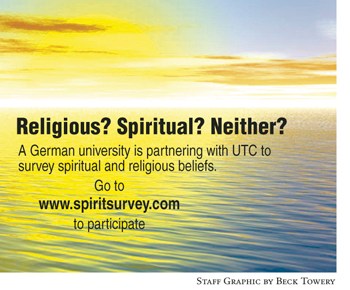

Are you spiritual or religious or both or neither? Inquiring minds want to know.
A study based in the southeastern United States and in Germany is seeking participants to take an anonymous survey about their faith – or lack thereof – and expand on their answers by telling their stories.
The project, called “‘Being Spiritual’ in Germany and the U.S.A.,” is being led in the United States by a team headed by University of Tennessee at Chattanooga psychology professor Ralph Hood.
The local study is in conjunction with the Center for Biographical Studies in Contemporary Religion at Bielefeld University in Bielefeld, Germany.
Chattanooga makes an ideal area in which to base the project in the United States because it requires “an intensive geographic area where religion is very strong,” Hood said. “In Europe, religion is much less strong, much more secular. Chattanooga clearly is four corners and five churches.”
However, that doesn’t mean the study is only seeking religious people, Hood said.
Most people in the Southeast will fall into the category of being both religious and spiritual, he said, but perhaps as many as 30 percent of people in the region say they’re spiritual but not religious. Some small groups would characterize themselves as neither religious nor spiritual, or religious but not spiritual, he said.
Christopher F. Silver, a UTC adjunct faculty member and doctoral student who is the project’s research supervisor, said the study is looking for input from the “average everyday Joe” to “define what spirituality is and how [such people] identify with it.”
“There is quite a bit of literature on the field of spirituality,” he said. “What is missing is to allow people to define it.”
Hood said he thinks people, in general, begin to recognize there is unity among religious traditions once they get beyond the specifics of a particular faith or denomination and see the actual common ground.
“Beliefs can become sources of conflict,” he said. “We should look at the values expressed in the beliefs.”
Hood said the survey needs at least 600 participants each in the United States and in Germany, but he said the more participants the better.
The local research team, which includes seven UTC undergraduate and graduate students, has a “very difficult” task because it must deliberately seek out samples not already represented in the study in order to be statistically sound, he said.
They need to sample, for instance, Buddhists, Hindus and more sectarian forms of Christians because such sampling is usually heavily biased in Protestant Christians, he said.
Silver said the fact the survey is web-based is economically good for the research team, but he said the team must be certain the survey isn’t overly weighted by people taking it online. That, in itself, could be seen as biased against a population not adept at using computers.
“The big challenge is finding older participants willing to take it,” he said. “It takes 30 to 45 minutes, and older people may have trouble learning how to use the computer or not have that kind of time. It’s been one of our difficulties.”
To facilitate the interest of a slightly older crowd, Hood said, the group is looking for people to whom they can mail the survey or for people who can take the survey at churches.
Hood will present a paper on the early findings in October, he said, and a book on the final results eventually will be published in Germany and the United States. Silver said anyone who takes the survey online will automatically receive the overall results.
Contact Clint Cooper at ccooper@timesfreepress.com or 423-757-6497.
Click here to vote in our daily poll: Will you take part in the spiritual study conducted by UTC?