
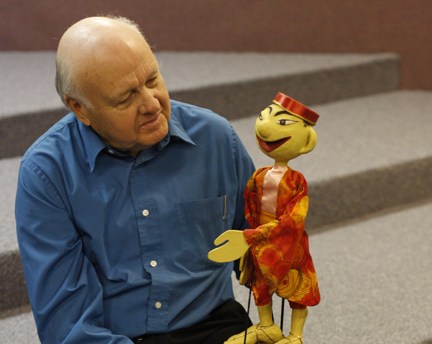
To Fred Arnold, the greatest hurdle puppetry has had to overcome as an art form is that so few people consider it worthy of that distinction. He has worked his whole life, especially during the last 30 years, to convince them otherwise.
From designing the sets and composing the music to writing the scripts and crafting hundreds of puppets, Arnold, 80, has had a hand in every aspect of the seven plays he created since 1980. That year, he and his team of volunteer puppeteers began performing at the Oak Street Playhouse in First-Centenary United Methodist Church.
Although his characters have papier-mâché heads, Styrofoam bodies and dowel-rod limbs draped in colorful costumes, Arnold said his plays aren’t just for younger audiences.
“People think of puppets and think they are for children because that’s our culture in the United States,” Arnold said. “The thing I’ve tried to emphasize is that this is puppet theater, not a puppet show.
“The adults who have come have enjoyed it as an adult, and the children have enjoyed it on their level.”
On Oct. 3, after reaching thousands through his shows there, Arnold ended his plays’ 30-year run at the Oak Street Playhouse. That evening’s performance of his adaptation of Hans Christian Andersen’s “The Little Mermaid” was the last time any of his works would be performed in the 100-seat theater.
In 2006, following a production of his favorite work, an adaptation of Maurice Maeterlinck’s play “The Blue Bird,” Arnold stepped down as director of the company. Longtime cast member Mike Sayne took over directorial duty through this year, while Arnold took on the role of consultant and “director emeritus.”
Arnold said the decision to retire his repertoire was made for a number of reasons, including the difficulty of area schools over the last several years to fund field trips to view shows.
While it’s sad to see the end of an era, it’s better to depart gracefully on a high note than fade away slowly, said Michael Tulloss, the playhouse’s managing producer and longtime volunteer puppeteer.
“We all recognize the truth in that it’s better to stop a program while people still have fond memories of doing it and we have enough people to do it (than) wait until there’s no funding at all to do that sort of thing,” Tulloss said.
“While we recognize that in our heads, you’re still thinking that there are kids out there who haven’t seen it yet, and you want to do it for them.”
While the Oak Street Playhouse will no longer host Arnold’s plays, his 30-year run at the theater is just the latest chapter of a lifelong association with the arts.
Even as a child, Arnold said, he was fascinated by the theater and would put on plays for the neighborhood. Later, he studied as an art major at the University of Chattanooga.
In 1953, Arnold began teaching in Chattanooga city schools, for which he would eventually serve as art coordinator and, later, curriculum specialist in art.
While teaching, Arnold met fellow educator Bill Carson, with whom he founded and directed Carnival Productions. Together, they put on short performances adapted from children’s classics such as “The Wizard of Oz” and “Jack and the Beanstalk.”
As an appreciator of many artistic media, Arnold said he was drawn to puppetry because it offered an opportunity to be creatively engaged in many areas at once.
“We have a saying that we put on our fliers sometimes that, ‘Puppetry is a synthesis of all the arts,’ ” Arnold said. “You’re getting everything involved when you do puppetry.”
From 1959 to 1973, Arnold created original puppet works that were more elaborate, if still short, to be performed at the Plum Nelly Art Show on Lookout Mountain. He also crafted puppets for the TV show “Chickaroonie,” which aired on WDEF-TV in the ’50s.
In the late ’60s, Arnold created plays that were produced at the Cadek Marionette Theatre in the Cadek Conservatory at UC. Arnold later adapted two of these plays, “The Little Mermaid” and “The Nightingale,” for use at the Oak Street Playhouse, where the puppets were controlled by rods instead of strings.
THE PLAYS* “The Emperor’s New Clothes” – An all-mice cast re-enacts Hans Christian Andersen’s tale of a monarch discovering it’s better to hear the truth than mere flattery.* “The Nightingale” – A Chinese emperor learns, through a series of adventures, that the real thing is always better than a carbon copy. Based on a Hans Christian Andersen story.* “The Ratcatcher’s Daughter” – An adaptation of a story by Laurence Housman, this production follows the theme of good triumphing over evil, played out in the tale of a wily ratcatcher and his beautiful daughter.* “The Blue Bird” – Based on Nobel Prize-winning playwright Maurice Maeterlinck’s story about two children’s search for true happiness.* “The Little Mermaid” – Hans Christian Andersen’s tale of a mermaid’s sacrifice for the love of a prince.* “An Americat in Paris” – Original play by Fred Arnold about an Alabama alley cat’s search for culture abroad only to discover everything he needs is at home.* “Odie’s Magic Carpet” – The second play by Fred Arnold featuring a dreamy shoe salesman’s adventure in Arabia that teaches him that real miracles are not necessarily found in exotic places but in ordinary things we take for granted.
Arnold said he created 400 to 500 puppets throughout his career. Some of these have been exhibited in displays as far away as the Atlanta Puppetry Guild and the Smithsonian Institution.
Following the final performance at the Oak Street Playhouse, about 250 puppets were brought out of storage. On Oct. 9, cast members and other volunteers were offered a chance to choose a puppet to keep, with the remaining puppets to be offered for sale the next day. Some of the puppets were set aside for a future exhibit at the Oak Street Playhouse.
Although many puppets were bought individually, only one play, “The Blue Bird,” was sold in its entirety, sets, scripts, puppets and all, Arnold said.
Puppeteer and theater educator Colleen Laliberte bought “The Blue Bird,” which was her first puppeteering experience when she joined the troupe in the ’80s.
Laliberte said Arnold is “an international treasure,” and when she heard this year would mark the end of his plays’ theatrical run, she was determined at least one work would remain intact.
“I just panicked, because (puppets) were already being promised to different people, and I was like, ‘How can you separate them from each other?’ ” she said. “I was saying, ‘Somebody needs to buy a show.’ It was like standing on the shore saying, ‘Someone needs to jump in and save that person.’ “
Arnold said he will hold a workshop with Laliberte, during which he will instruct her in basic puppet craftsmanship, such as how to make new heads and enact repairs on older puppets.
“The Blue Bird” is in good hands, Arnold said.
“That’s the most important show we’ve done, and if there’s anyone in Chattanooga who can do this, [Colleen] and her husband, Ray Laliberte, can,” he said. “She may be able to revive it and carry it on.”
Having purchased the play, Laliberte intends to do just that. Next fall, she hopes to put on a production of either “The Blue Bird” or a new, as-yet-untitled piece, probably at the Mountain Arts Community Center.
Among his cast, Arnold is notoriously shy about taking personal credit for his body of work. Although he hasn’t actually kept any of the puppets for himself, he’s happy they’ve found new homes.
“I felt very good that people wanted them,” he said. “People were coming up to me (at the sale) and telling me how much it meant to them to have this through the years. That was a good feeling.”