
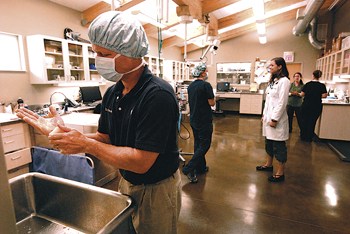
When Dr. Tai Federico considered building a new animal hospital, his first thoughts were not only expansion, but going green and making it as environmentally friendly as possible.
Riverview Animal Hospital, which moved to its new location on North Market Street at the end of August, soon should be getting its Leadership in Energy and Environmental Design certification.
“As a business person, it just makes sense to make this as ‘green’ as possible,” Federico said. “The lifespan of the building is more than that of my career, which will hopefully go for at least another 30 years. And the improvements we’ve made should more than pay for themselves.”
The new 10,000-square-foot facility better meets the needs of clients and patients with eight examination rooms compared to three in the old 2,000-square-foot clinic. Surgery rooms also were expanded from one to two. Federico is sole proprietor of the facility and has three additional associate veterinarians working in the complex.
“We were very space-restrained there,” Federico said of his former location on Dorchester Road. “This is a big step up from the old place.”
Frederico purchased the 1.5-acre lot on North Market Street two years ago, tore down the existing structure and began construction of the complex. The location includes two buildings, one for daily operations and another for dog boarding. It has 64 kennels broken into two units so that heat and air can be turned off when one unit is not in use.
Going greenRiverview Animal Hospital soon should be getting its LEED certification at a new facility complete with environmentally friendly elements including:* Geothermal heating and cooling system with one mile of pipe and 10 (300-foot) wells that circulate water to the system at a constant temperature.* Shower installed in staff bathroom to allow for cleanup after biking to work.* Windows placed high on walls so that eaves provide shade in summer and allow sun in winter when sun is higher in sky, creating solar gain.* Zoned heating/cooling system in two separate dog kennel buildings that can be closed when one building is not occupied.* R30 Styrofoam insulation bound by Tectum (natural fiber product).* Walls are constructed of 2- by 6-foot boards (rather than 2- by 4-foot boards) to allow for more sprayed foam insulation.* LED track lighting and incandescent lighting throughout, except in surgery rooms and in microscopes.
“I’d been thinking about how I could make my practice more green for about 10 years, though,” Federico said. “It’s the most patriotic thing I can do. A lot of the trouble we see today is due to the outdated energy model we have.”
LEED consultant Thomas Palmer said that when deciding what elements needed to be installed in order to get LEED certification for the building, he and Federico concentrated on the highest-performing envelope possible. A building envelope includes all components of a structure which enclose conditioned space.
“We took simple but necessary steps in controlling heat and lighting,” Palmer said.
The systems that were installed, including a geothermal heat system, don’t work as hard, requiring less energy, he said.
“And we used a lot more insulation than builders typically put in a system. The roof is made of a structural insulated panel that can span long distances, and it’s made of a product that contains its own insulation. We used a light metal roofing to reflect heat, too,” Palmer said.
He said the structure “is going to be one of the highest-performing buildings in the city. In the LEED scale, a typical (non-LEED certified) building would be zero, but this one will be 50 to 60 percent more efficient, so it should get all 10 points on the scale.”
Cost for the new animal hospital was $2 million, but Federico said going green didn’t add too much to the investment.
“I may have spent an extra $30,000 on heating and cooling, but most LEED stuff is not much more. It may have added 5 percent to the total project,” he said.
Frederico applied and received grants for the construction, such as $55,000 from Greenspaces, a local organization that provides resources on environmentally responsible building and design.
“This is the first animal hospital to go green, and there’s no doubt they’ll be certified,” said Jeff Cannon, Greenspaces co-director, adding he’s impressed with the number of facilities that have chosen to work toward LEED certification. Greenspaces is now working with 36 buildings, some new, others being rehabilitated, to become more environmentally friendly.
“When we started four years ago, we had to beg and cajole. Now people are lining up on their own,” Cannon said.