
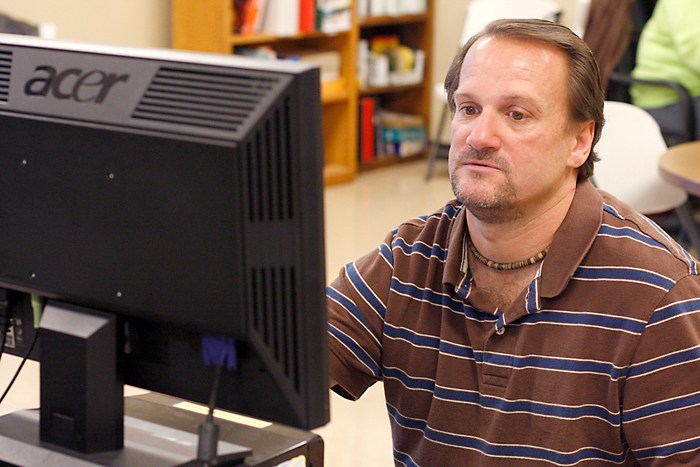
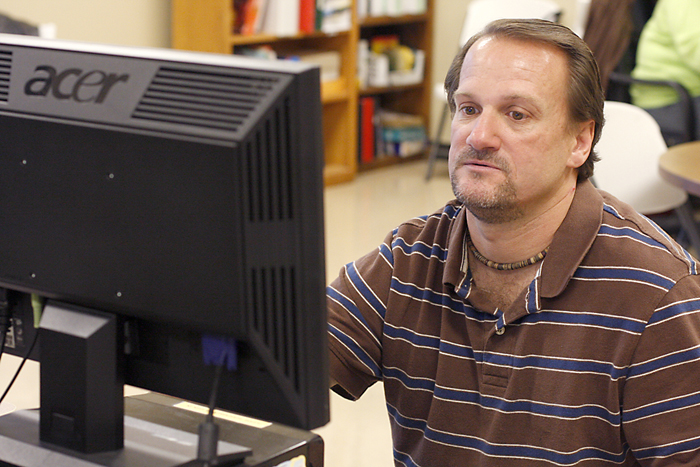
 At the AIM Center, Jeff Hardy browses his university website, Ashford University, as he talks about having an apartment to in which to live. Hardy received assistance to rent an apartment through the Shelter Plus program,which is going to receive $2.23 million in HUD funding this month.
After living in Chattanooga-area homeless shelters for nearly six months, Jeff Hardy was able to get an apartment and enroll in school thanks to a program that provides housing and support to help people rebuild their lives.
An infusion of federal funding announced recently means that at least 16 more families in Chattanooga will be able to get the same kind of help that Hardy received through the Shelter Plus Care program.
“It gave me a home,” said Hardy, 41, who has bipolar disorder. “That gave me a chance to get my head together.”
Shelter Plus Care is one of 14 programs in Chattanooga to receive a share of $2.23 million in HUD funding announced this month. The money is intended to help secure permanent shelter for the estimated 600 local people who are homeless on any given night.
Nationwide, HUD allocated $1.4 billion to social service agencies for existing programs to end homelessness. That’s up from $1.37 billion allocated last year, HUD Secretary Shaun Donovan said in a telephone news conference this month.
“The cost of doing nothing, the cost of allowing them to continue to live on the streets or in shelters is not only the cost of housing them in a shelter, but it’s the enormous cost in emergency rooms, in jails, in a whole range of very expensive emergency crisis-type costs as opposed to what (the $1.4 billion) we’re proposing,” Donovan said.
Hardy is among 133 people in the regional Shelter Plus Care program.
“Getting out of a shelter and into a home helps to get things in perspective,” Hardy said. “I’ve actually been able to go back to school.”
FAST FACTS* At least $7.3 million is spent annually in the Chattanooga region on emergency and transitional services, shelter and housing for the homeless.* The bulk of the money comes from the federal, state, county and city governments.* About $3.18 million is contributed through philanthropic sources.Source: Chattanooga Homeless Coalition
Donovan said nearly two-thirds of the HUD funding announced this month provides transitional and permanent housing. The remainder provides support services including case management, job training and drug and alcohol treatment.
The traditional method of getting people ready for housing is for them to attend drug rehab or mental health classes before giving them a home.
That works for some people, but research shows that people are more successful when they have stable housing and services together, said Mary Simons, executive director of the Chattanooga Homeless Coalition.
“The traditional method is good, but the ‘housing first’ model is better,” Simons said.
Even with the additional HUD money, there aren’t enough vouchers to help everyone in need, said Gina Turley, the AIM Center’s consumer housing specialist/peer specialist.
The AIM Center is one of several social service agencies that provide rehabilitation services to formerly homeless people in the Shelter Plus Care Program. That helps meet federal requirements for a dollar-for-dollar match in social services.
“I don’t have anything and I’m trying to get a voucher for someone who lives in a tent,” Turley said.
About 70 people are on the waiting list for Shelter Plus Care housing vouchers, according to the Chattanooga Homeless Coalition. The program helps people again become stable members of society.
BY THE NUMBERSFourteen Chattanooga area projects will share in $2.23 million from HUD this year to help end homelessness:* $34,240: Community Voice Mail, 2010* $100,558: Homeless Management Information Systems, 2010* $211,254: Family Way* $105,874: Family Housing and Learning Center* $94,827: Homeless Employment and Lifeskills Training Program)* $138,6649: Mitchell Home* $90,873: Supplemental Assistance for Facilities to Assist the Homeless* $81,528: Shelter Plus Care-Family* $36,000: Shelter Plus Care-Individual* $322,080: Shelter Plus Care Collaborative* $201,936: Shelter Plus Care Program* $240,504: Shelter Plus Care Program* $549,435: Supportive Housing Program* $27,978: Transitional Housing SHPTotal: $2,236,336Source: HUD
“It helps them rebuild their lives,” said Turley. “You can’t do much until you have housing, a place to get cleaned up and rest, then you can work on keeping doctors’ appointments and finding a job.”
It takes time to get a voucher. HUD considers the voucher permanent housing, so it’s the client’s voucher until he no longer needs it — which could be years, Turley said.
After living in shelters from December 2008 to April 2009, Hardy got a Shelter Plus Care voucher through the AIM Center and found his apartment.
“Now I’ve got somewhere where I can study. And I’m not constantly interrupted and told I have to leave,” he said.
Simons said chronic homelessness has been reduced 85 percent in the Chattanooga area since 1983, adding that Shelter Plus Care is among several programs responsible for the improvement.
Funding emergency shelters is the second-highest expense in caring for homeless people listed in the Chattanooga Homeless Coalition’s Blueprint to End Homelessness.
About $1.51 million is spent on emergency shelters, compared to $1.8 million on transitional housing, but those figures don’t include spending on indigent emergency care at hospitals and other needs that the community accrues as a result of homelessness.
Unless homeless people are enrolled in a program, the only options they have for care are the most expensive places, said Simons.
“If you or I have a cold, we go to the doctor’s office, but a person who is homeless often goes to the emergency room,” she said.
Shelter Plus ensures housing needs and services are met, Simons said.
“It gives stability in housing,” she said. “It is closing the door to homelessness.”