
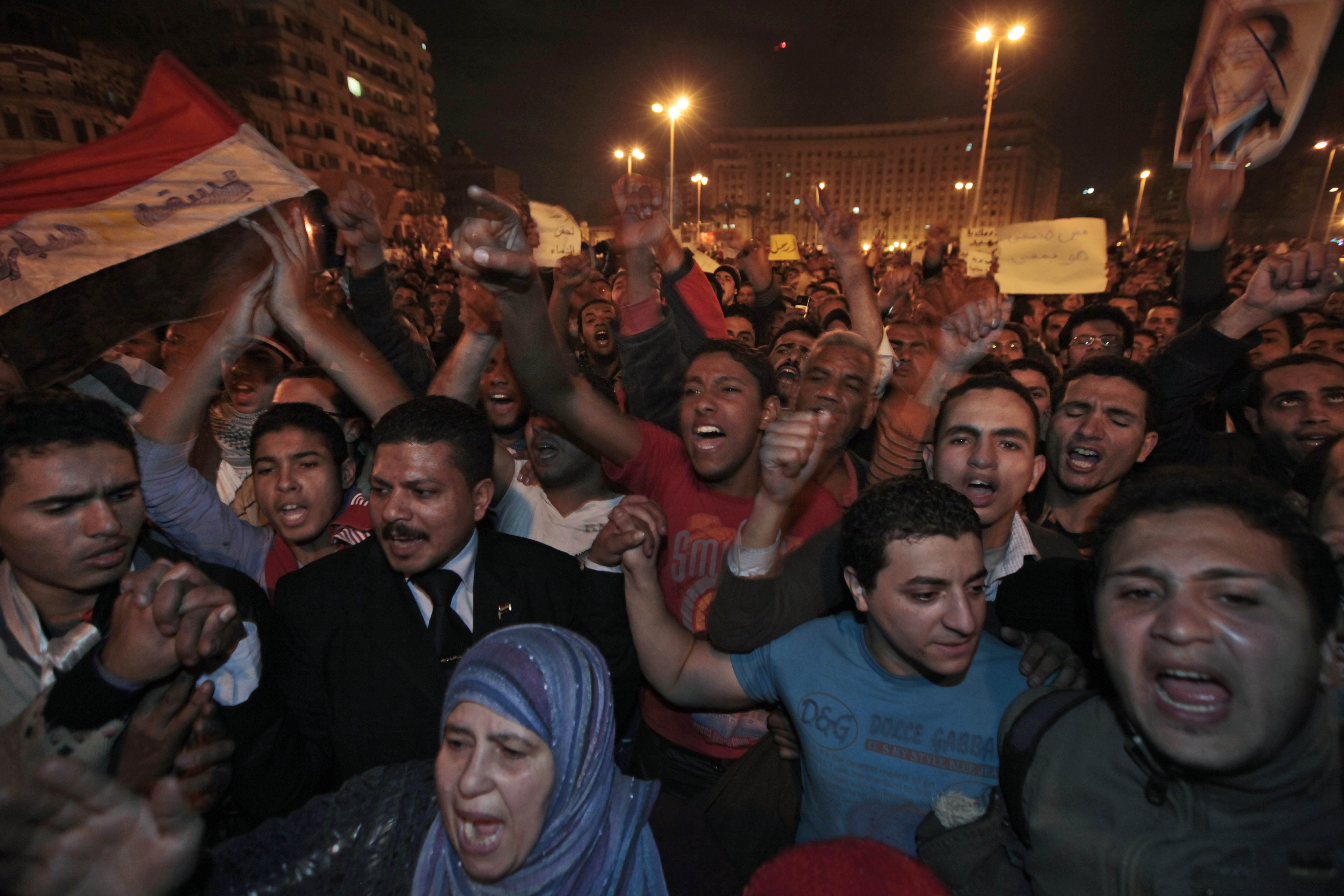
 Protesters chant slogans during a demonstration in Tahrir square in downtown Cairo, Egypt, Sunday, Jan. 30, 2011. (AP Photo/Lefteris Pitarakis)
About Sarah GrebowskiA 2005 graduate of Girls Preparatory School, Grebowski attended Boston College and graduated with a major in international studies and Islamic civilizations and society. She currently lives in Cairo. Grebowski occasionally contributes to the Times Free Press and writes a blog, Cairo Comment, at http://grebowski.blogspot.com. Follow her on Twitter at @grebowskisarah.
For Egyptians, the revolution far from over. This is what struck me most being in Tahrir Square on Tuesday night as violent clashes erupted between protesters and riot police, eerily reminiscent of the uprising in January and February. Five months later, emotions are still raw. The pace of change in Egypt has failed to satisfy many, and when push came to shove, protesters and security forces locked themselves into a familiar showdown for legitimacy and authority, as manifested in control of symbolic Tahrir.
I was in downtown Cairo when rumors spread about tear gas and rubber bullets in Tahrir Square. When I arrived around 11:30 p.m., I saw scenes almost identical to the those of January. Protesters and riot police were playing their cat-and-mouse game. The protesters would tear up sidewalks in the square and throw the chunks of pavement at police, charging and forcing them to retreat. Police would then counter with a barrage of suffocating tear gas to disperse the crowd. This continued until about 1:30 a.m., when the police suddenly pulled back and abandoned the square.
The incident was disorienting. Why had ongoing sit-ins in more remote parts of downtown Cairo moved back to Tahrir? What exactly were Egyptians fighting for? Why had the police confronted protesters and resorted to the same tired tactics that lost them the crucial battles of Jan. 25 and 28?
Families of those killed in the Jan. 25.revolution (as it is referred to here, at least) have been staging demonstrations and sit-ins since last Friday in front of the official state television building in Cairo. They were demanding justice, which has eluded them thanks to the postponement of key trials of former regime officials and the general intactness of Mubarak’s authoritarian machine. Although Mubarak and his closest circle of advisers are in jail, the vast majority of bureaucrats, police officers, military officer, and even ministers have not been removed, much less tried for corruption and human rights abuses.