
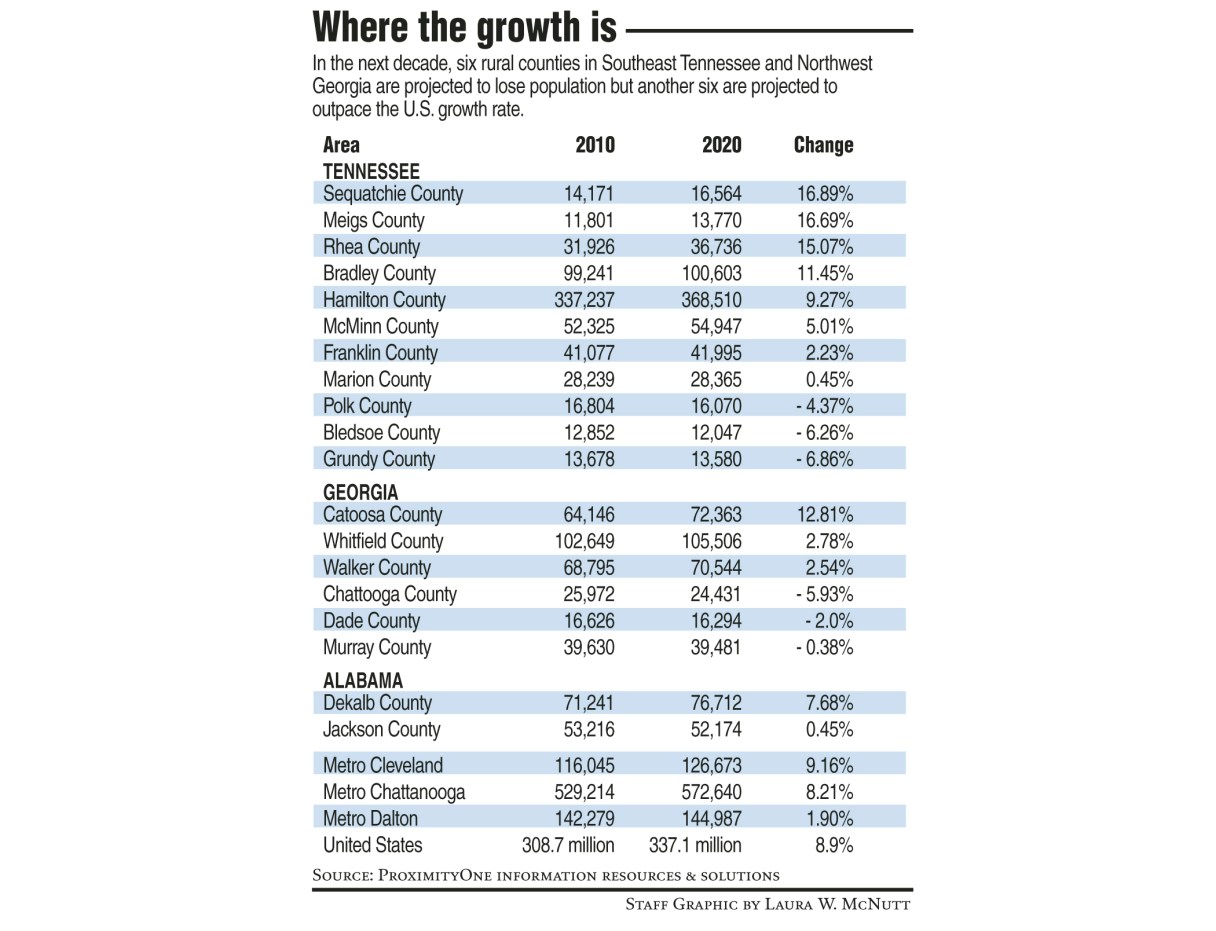
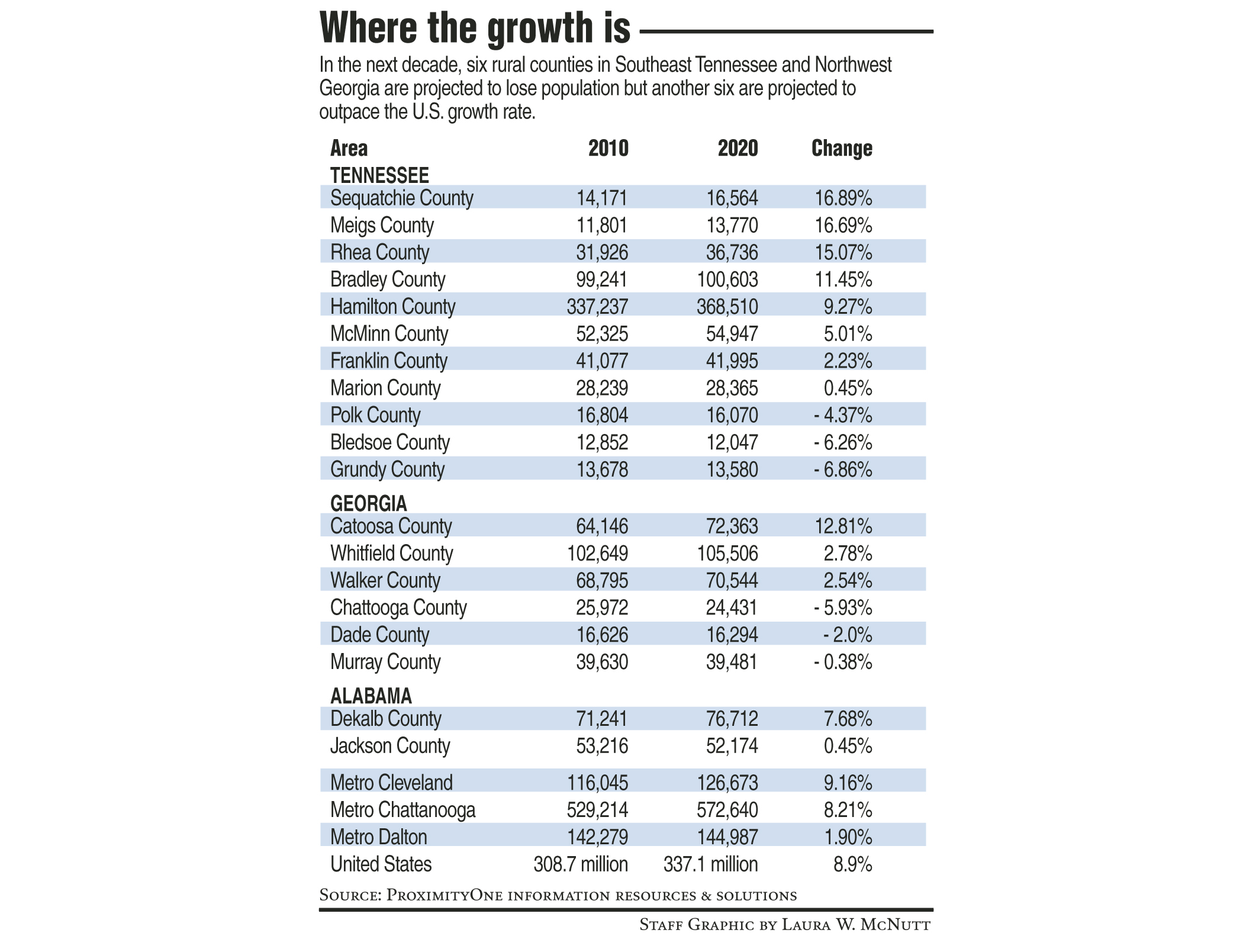
For all the success in landing Tennessee’s biggest new investments and job generators in Hamilton and Bradley counties during the past three years, the growth of the Chattanooga-area region still will be spotty in the next decade, according to new population projections by a Virginia consulting firm.
A half-dozen rural counties around Chattanooga are expected to lose population between now and 2020. An equal number are projected to boast above-average growth, however.
“The economic slowdown and the migration of people and businesses to metropolitan counties mean there tends to be fewer jobs in many outlying rural counties,” said Warren Glimpse, founder and president of ProximityOne, an Alexandria, Va.-based research company that studies demographic shifts. “Where there are fewer jobs, population growth tends to slow or, in some places, actually decline.”
In the 19-county, tri-state area in and around Chattanooga, ProximityOne forecasts the number of residents will decline from 2010 to 2020 in Polk, Bledsoe and Grundy counties in Tennessee and in Murray, Dade and Chattooga counties in Georgia.
Conversely, the addition of billion-dollar investments from Volkswagen and Wacker Chemical and the 1,600-plus jobs from Amazon.com in Hamilton and Bradley counties should lift the growth of the region’s biggest counties above the projected nationwide growth pace. By 2020, metro Chattanooga should add an estimated 43,426 people and metro Cleveland should grow by 10,628 residents.
“Population follows jobs,” University of Georgia demographer Doug Bachtel said.
Grundy County, where one of every seven workers was unemployed last month, is projected to suffer the biggest percentage loss of population of any county in the region, losing nearly 7 percent of its residents in the current decade, according to the ProximityOne forecast.
“People in Grundy County love it here, and they hate to have to go off the mountain,” said Ray Banks, owner of Monteagle Sewanee Realtors and former president of the Monteagle Area Chamber of Commerce. “But getting a good-paying job is a real challenge here for many, so some have had to move since the timber and housing industries have cut back.”
Banks and other rural county officials, however, hope that the scenic and low-cost appeal of their counties for retirees and vacationers, among others, could prove the ProximityOne estimates wrong.
“I think the projection that we are going to lose population is way off,” Dade County Commission Chairman Ted Rumley said. “We’re in hard times, but we’ll bounce back.”
Jason Winters, sole commissioner for Chattooga County, said the recession cut both jobs and household formations in and around Summerville, Ga.
“But we have a lot of attributes being close to Cloudland Canyon and the natural beauty of our county,” Winters said. “I don’t think our population is going to go down. We’re between Atlanta and Chattanooga, which are both growing cities.”
Winters said the county also could pick up more residents through the expansion of the Hays State Prison in Trion, Ga.
While remote counties could lose population, ProximityOne sees the fastest growth in counties that neighbor Chattanooga’s Hamilton County.
The fastest percentage population growth in the region during the decade is projected in Sequatchie County.
“Since Highway 111 made access from Dunlap to Chattanooga much easier and quicker, our growth has accelerated,” said Richard Smith, a Dunlap real estate agent since 2004. “The housing market here, like everywhere, has slowed down. But I think with our low cost of living and proximity to Chattanooga, we’ll continue to be attractive for both workers and retirees wanted to relocate.”