
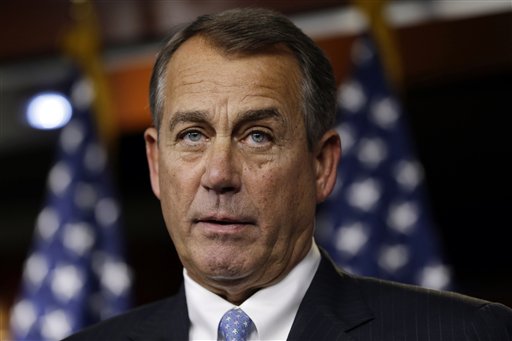
 House Speaker Rep. John Boehner, R-Ohio, speaks to the media about the fiscal cliff at the U.S. Capitol in Washington, on Thursday, Dec. 20, 2012.
House Speaker John Boehner’s sharp turnaround in the “fiscal cliff” negotiations – opting for a badly rigged tax increase only on millionaires, but sustaining their generous cuts in inheritance taxes – was designed mainly to try to force President Obama in a corner. Even if it were to have passed a House vote by majority Republicans Thursday evening — and it wasn’t clear that would happen as this was written — it won’t work because it dodges the larger debt and revenue problems that this entire back-to-the-wall negotiation was intended to help resolve. There’s just no point in adopting a short-term Plan B to kick the deficit can down the road, and into the thuggery of political extortion.
Boehner surely knows this. His plan would produce just $300 billion in new revenue over the next 10 years — the standard measure used for computing long-term deficit reduction. That is far less than the $800 billion Boehner had previously agreed to for revenue increases as part of a larger debt-reduction package. Beyond that, Boehner has yet to specify any of the vague spending cuts he is supposed to be offering.
By contrast, Obama’s latest proposal in the fiscal negotiations — including extension of the Bush tax cuts for nearly 99 percent of Americans — would generate $1 trillion in new revenue over the next decade, and his spending cuts would amount to $930 billion. The latter is up by more than 50 percent from the $600 billion in spending cuts that he had previously proposed. That’s partly because Obama agreed to slow Social Security increases by shifting to the so-called chained Consumer Price Index for pegging consumer inflation rates. Most Democrats reasonably oppose that concession. It invokes a slower inflation index in Social Security payments, and runs counter to promises by Democrats — and, previously, Obama — to leave Social Security intact.
Another Obama concession would expand renewal of the Bush tax cuts to families with annual household income of up to $400,000, rather than the $250,000 cut-off he long used to meet his promise of rescinding Bush-era tax cuts for the top 2 percent of earners.
For both financial and sound policy reasons, Senate Democrats had rightly declared that Boehner’s Plan B would be dead on arrival in the Senate. Even if the Senate were to pass it, Obama had promised to veto it. Why Boehner broke off what were proving to be constructive negotiations, in favor of his shift to a futile unilateral Plan B, remains unclear. He says he just wants to extend the Bush tax cuts for all Americans under the millionaire level of annual income, but he now insists on leaving everything else regarding deficit control and spending reductions undone.