
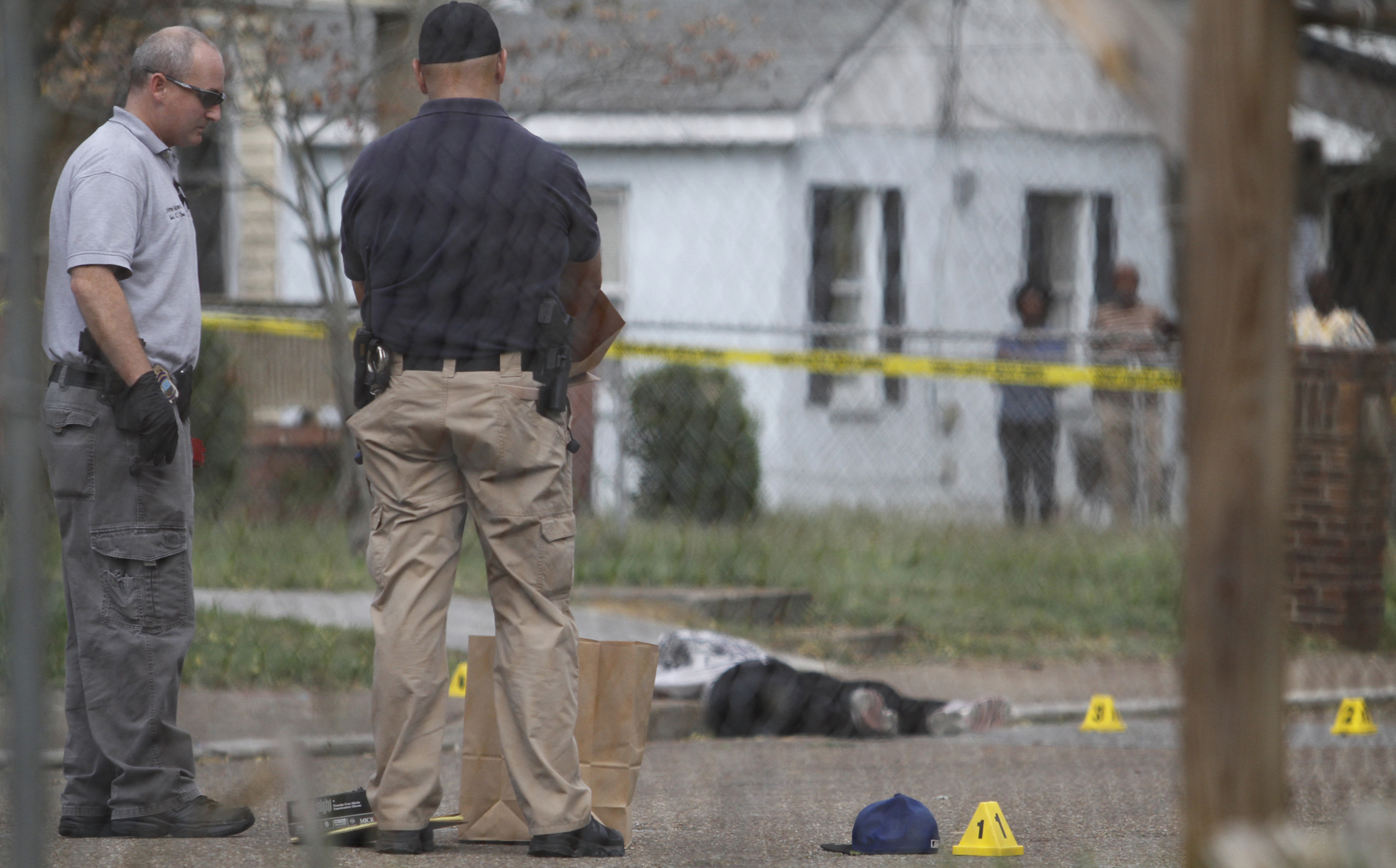
 Police officers gather evidence markers near the body of a victim of a gang shooting July 6 on Rawlings Street.
Staff File Photo by Jake Daniels
Comprehensive gang assessmentThe Comprehensive Gang Assessment was developed following a protocol set by the Office of Juvenile Justice and Delinquency Prevention in the U.S. Justice Department.The report’s authors tapped records from the federal census, law enforcement agencies, UTC’s Center for Social and Applied Research and the Ochs Center for Metropolitan Studies. They also reviewed media and other published reports and conducted individual interviews to build a picture of gang numbers, participation and impacts in Chattanooga.As part of the report, the Center for Social and Applied Research conducted extensive surveys in 13 Hamilton County schools. They sent questionnaires to 6,721 students and 4,000 school employees, held several focus groups for employees and parents and reviewed school disciplinary data for 2010-12.The Ochs Center held 15 focus groups, surveyed community leaders and interviewed more than 450 people, from law enforcement to gang members, for the study segments on community perception and the community resources now active in preventing or combating gangs.
There’s been talk for years about what to do about gang violence.
But on Friday, after six months of research, the Ochs Center for Metropolitan Studies and the University of Tennessee at Chattanooga issued the most detailed study on gangs in Chattanooga’s history. Members of the city’s anti-gang task force steering committee reviewed highlights of the study and 19 recommendations.
Among the findings of the Comprehensive Gang Assessment:
• Most gangs are entrenched in certain neighborhoods where there is high unemployment and poverty and where most households are headed by women.