
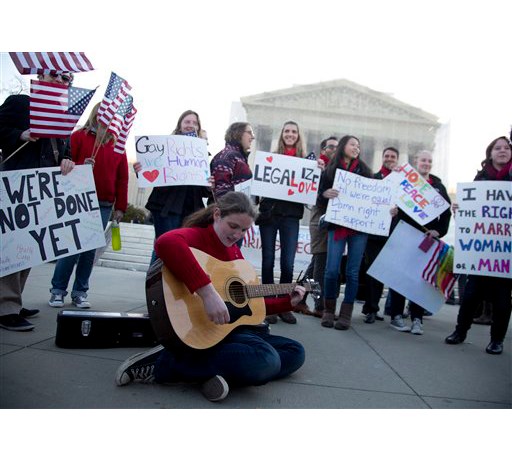
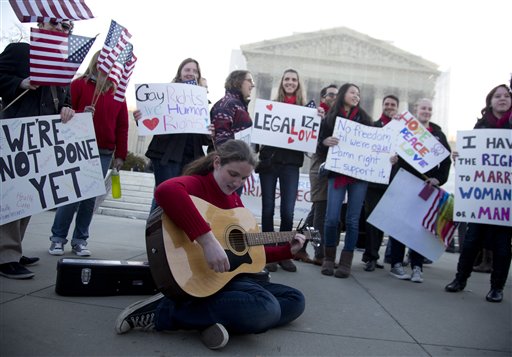
 Rebecca Winchell of Columbia, Md. sings Wednesday in front of the Supreme Court in Washington. In the second of back-to-back gay marriage case, the Supreme Court is turning to a constitutional challenge to the law that prevents legally married gay Americans from collecting federal benefits generally available to straight married couples.
FAST FACTSAll Southern states, including Tennessee, Alabama, Georgia and North Carolina, have constitutional bans on gay marriage. In 2004, Georgia was among 13 states to ban same-sex marriage after Massachusetts legalized the practice, according to the Pew Research Center. In 2006, Alabama and Tennessee followed suit.America’s legal view of gay marriage varies state to state.• Connecticut, Iowa, Maine, Maryland, Massachusetts, New Hampshire, New York, Vermont, Washington and the District of Columbia issue marriage licenses to same-sex couples.• Colorado, Delaware, Hawaii, Illinois, New Jersey, Rhode Island allow civil unions, providing spousal rights to same-sex couples. Four of these states (Colorado, Delaware, Hawaii and Illinois) also have statutes or constitutional provisions limiting marriage to relationships between a man and a woman.• Thirty states have constitutional bans on same-sex marriage.• Five states have statutory bans on same-sex marriage without civil unions.• California, Nevada, Oregon, Washington grant nearly all state-level spousal rights to unmarried couples (domestic partnerships).• Hawaii, Maine, Wisconsin and the District of Columbia provide some state-level spousal rights to unmarried couples (domestic partnerships).Source: National Conference on State Legislatures”This nation was founded on separation of church and state and all the arguments against LGBT marriage rights are on a religious level, and they shouldn’t be upheld by the nation or the states. I also think we as American citizens are promised life, liberty and the pursuit of happiness, and for some of these religious arguments to keep us as second-rate citizens is unconstitutional.”- Keeli Monroe, 23, president of Spectrum, the gay-straight alliance at the University of Tennessee at Chattanooga”I think for those of us who live in the South that have, not just laws against same-sex marriage, but constitutional amendments that ban all forms of relationship recognition, this Supreme Court action that they will take is of great interest. The hope is that they will rule in both cases a very broad ruling that would solidify our right to marry the person that we love. However, we need to be prepared for the fact that the court may issue a ruling that may not be favorable to us or issue a vary narrow ruling that has a limited impact on couples in Georgia and Tennessee.”- Jeff Graham, executive director at Georgia Equality, a nonprofit group that lobbies for the rights of LGBT persons to marry”I think that the decision the court makes, if it says that natural marriage violates the constitution, will go down as one of the three or four landmark decisions that shaped the future of America like Brown v. Board of Education and Roe v. Wade. For those who support the historic definition, the best outcome that could be expected is for the Supreme Court to leave the definition of marriage up to the individual states.”- David Fowler, president of Family Action Council of Tennessee
WASHINGTON – Concluding two days of intense debate, the Supreme Court signaled Wednesday it could give a boost to same-sex marriage by striking down the federal law that denies legally married gay spouses a wide range of benefits offered to other couples.
As the court wrapped up its remarkable arguments over gay marriage in America, a majority of the justices indicated they will invalidate part of the federal Defense of Marriage Act — if they can get past procedural problems similar to those that appeared to mark Tuesday’s case over California’s ban on same-sex marriage.
Since the federal law was enacted in 1996, nine states and the District of Columbia have made it legal for gays and lesbians to marry. Same-sex unions also were legal in California for nearly five months in 2008 before the Proposition 8 ban.
Justice Anthony Kennedy, often the decisive vote in close cases, joined the four more-liberal justices in raising questions Wednesday about a provision that defines marriage as the union of a man and a woman for purposes of federal law.