
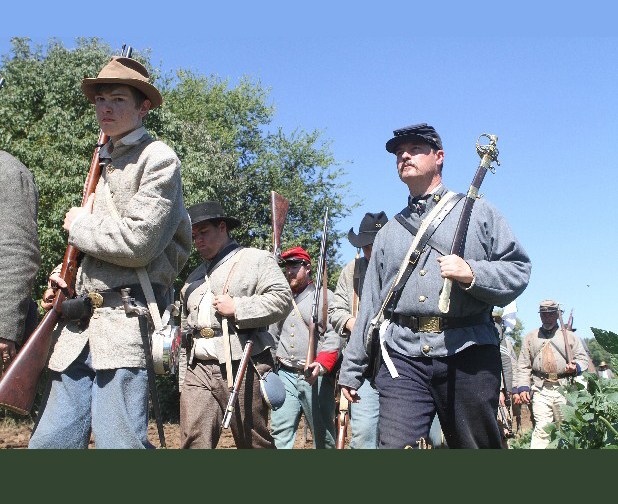
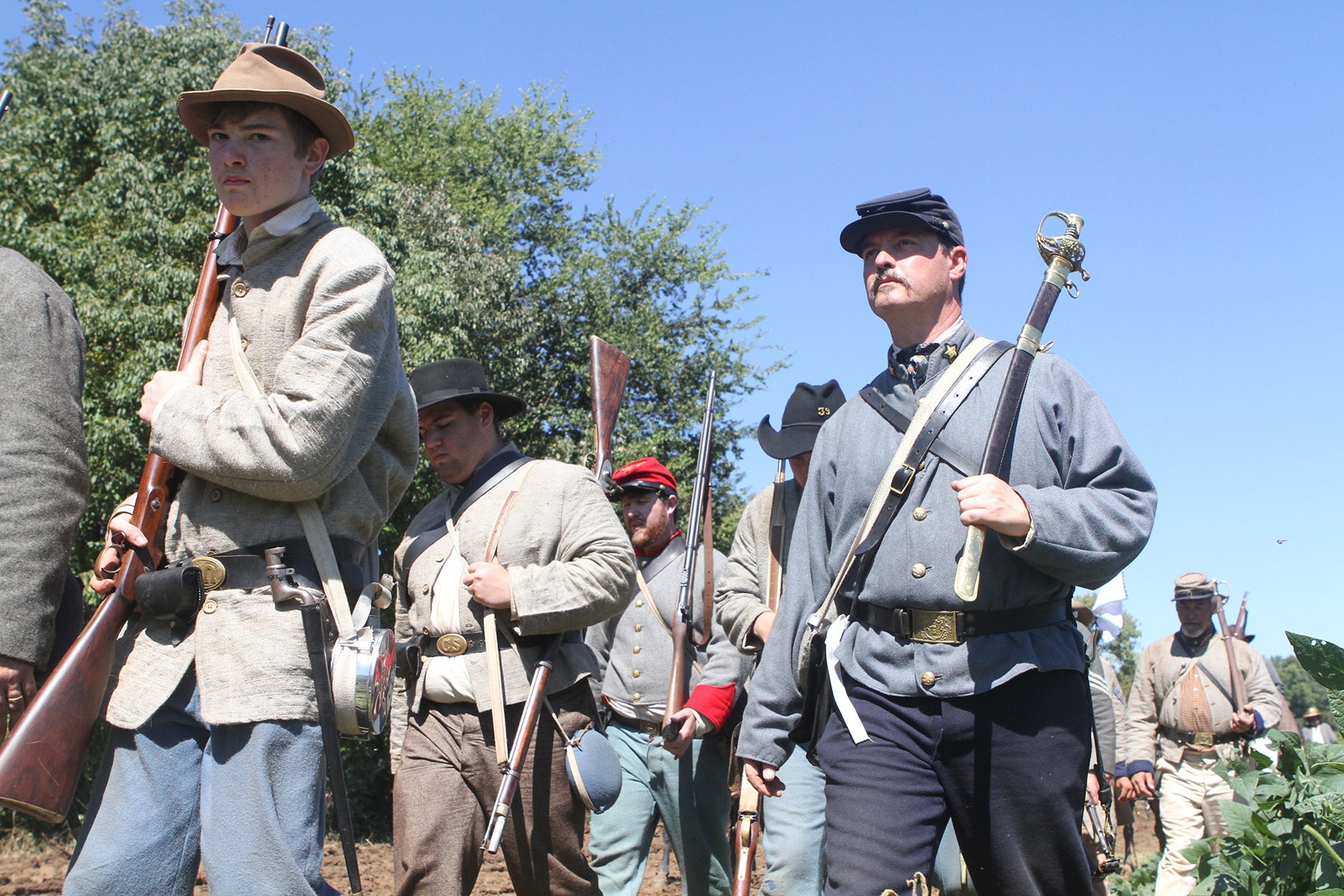
 Confederate reenactors march toward battle at the final day of the Blue Gray Alliance and Walker County Reenactment of the Battle of Chickamauga, held on the battle’s 150th anniversary, at Mountain Cove Farms on Sunday in Chickamauga, Ga.
The cannons are silent now.
They are silent today as they were 150 years ago when the battered Union army retreated back into Chattanooga from the Chickamauga Battlefield, giving the South its last major victory of the Civil War.
But those three dusty, dry days of blood in Chickamauga during 1863 would soon turn to wet, cold days of starvation and desperation in Chattanooga. Rather than follow the Union forces into the city and crush them as he’d been tasked, Braxton Bragg — whose own Confederate forces had lost 20,000 men and 10 generals either to death or injury — opted instead to occupy the ridge and mountain tops surrounding Chattanooga and lay siege to the city. His new goal was to stave and weaken the Union here.
That bitter autumn 150 years ago, with blood, hunger and days of burning furniture and door jambs to stay warm, would shape Chattanooga into the diverse, middle-class, tough and determined city that it would become.
East Tennessee, long a Union-leaning island of the South, offered quiet help with a “cracker line” to ease the hunger, as well as way-stations for escaped slaves. Many of those self-liberated slaves fled here as federal troops occupied and finally decisively won the city. A number of the freedmen stayed here to become workers, first for the Union and then for the businesses and foundries that were fired up again and expanded after the war’s end.