
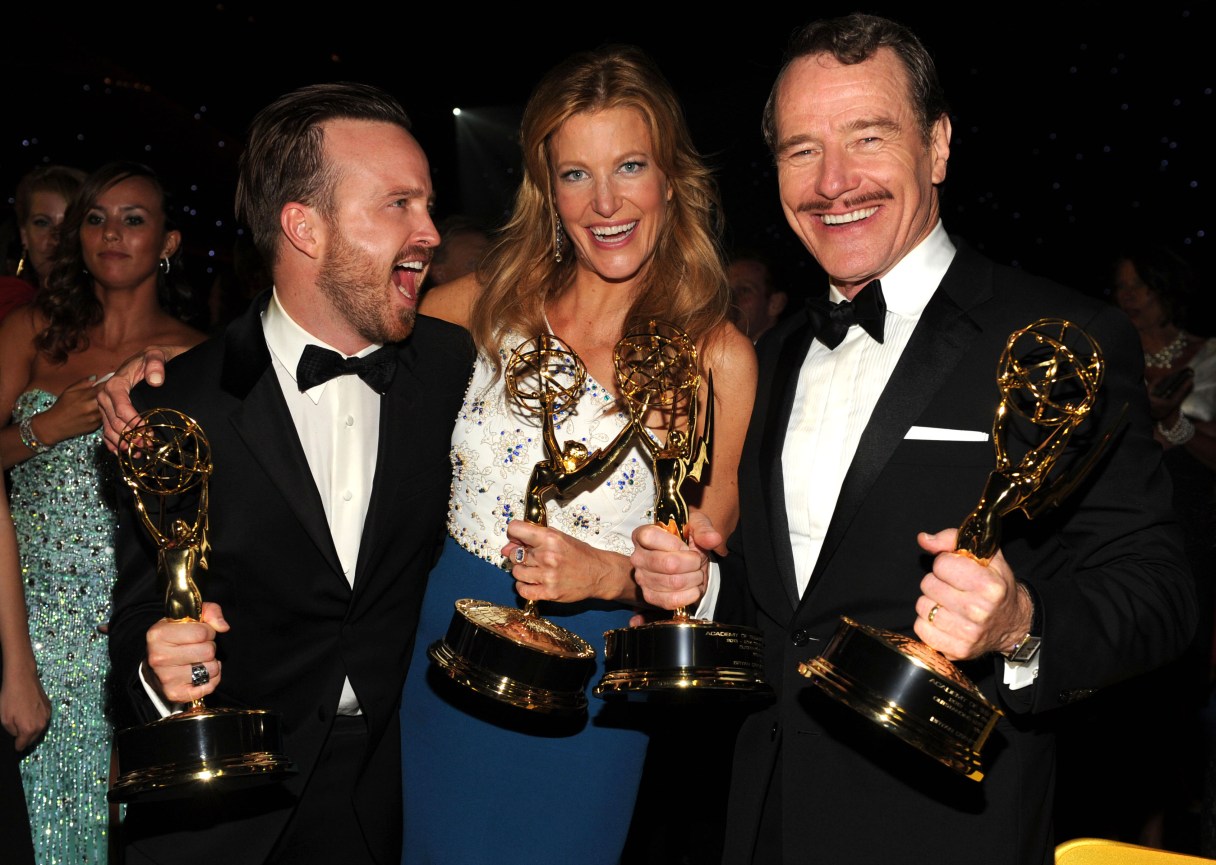
NEW YORK (AP) – There was something embarrassing about the rash of repeat treating on Monday’s Emmycast. It might have left viewers wondering if they had stumbled on a rerun of last year’s show, or the one before that. Or maybe an awards show equivalent of “Groundhog Day.”
Count ’em up: Bryan Cranston’s fourth best-drama Emmy for “Breaking Bad,” his co-star Aaron Paul’s third supporting-actor trophy, and the second best-drama salute for the show. There was a fourth statuette for Jim Parsons (“The Big Bang Theory”), the third in a row for Julia Louis-Dreyfus (“Veep”), the fifth straight for “Modern Family.”
Nothing against these winners, especially the honors-showered “Breaking Bad,” the finest drama series in recent television history. But repeat recognition can become wretched excess. Monday’s Emmycast might have left viewers wondering whether anything new on TV happened last season.
The prime-time Emmys, bestowed for 66 years, are meant to celebrate excellence in television. But in Emmy’s eyes, excellence too often takes the form of stamina, not the burst of inspiration that may have launched a series and its characters many seasons earlier and since settled into routine. Too often, Emmy celebrates not excellence, but an excellently maintained status quo.
Here’s one instance of voluntary restraint: In 1996, Candice Bergen withdrew from consideration as a nominee for her starring role in the sitcom “Murphy Brown.” By then, she had raked in five Emmys and wanted to give others a chance. Enough was enough, she reasoned.