
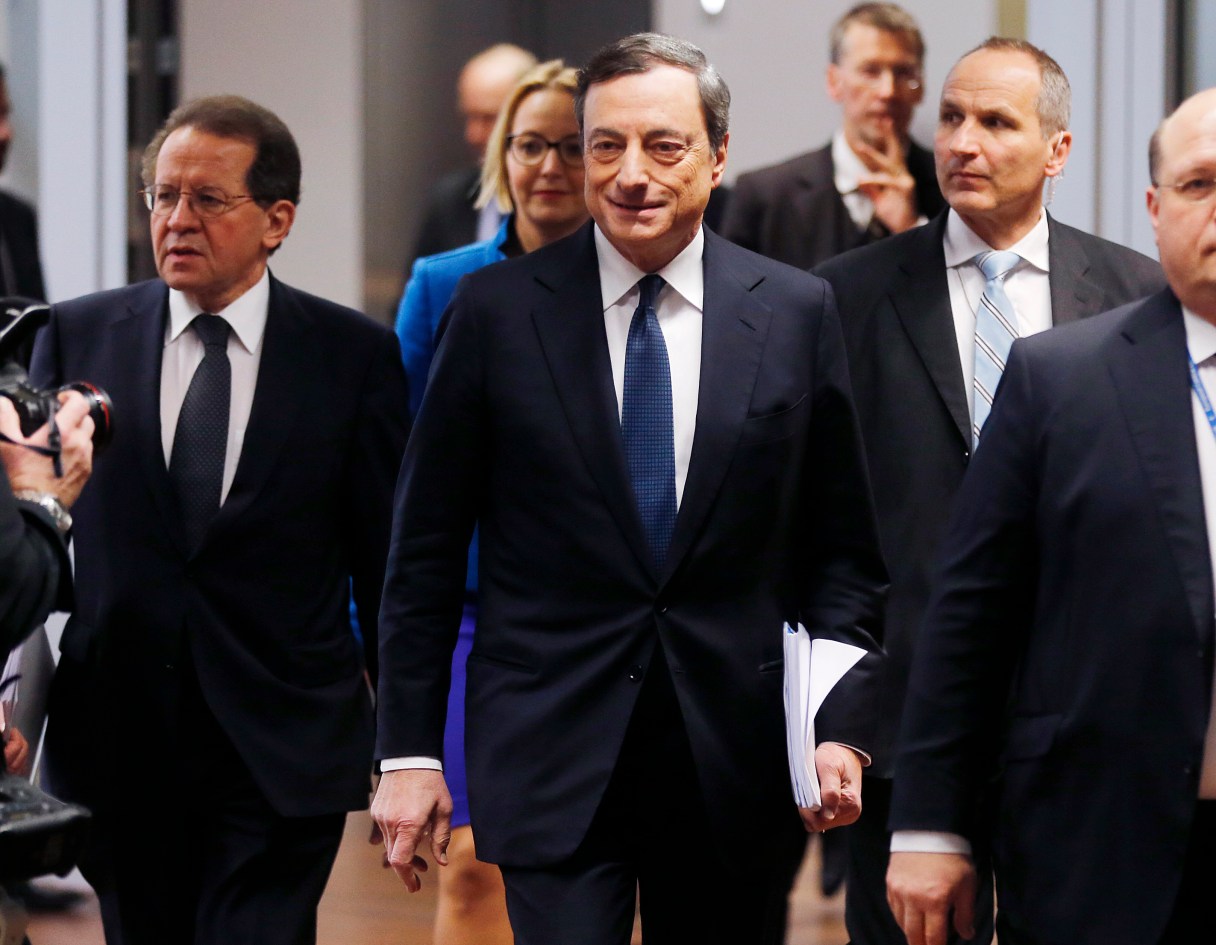
FRANKFURT, Germany (AP) – European Central Bank head Mario Draghi says the bank has “stepped up” preparations for launching new stimulus measures for the economy – but expects to make a decision on any further steps early next year.
Draghi didn’t unveil further stimulus programs on Thursday after the bank left its benchmark interest rate unchanged at 0.05 percent. The rate decision was expected as the bank says the benchmark is so low it cannot be reduced further.
Rather, Draghi said the ECB will reassess early next year the success of its existing stimulus programs and the impact of weak oil prices on the eurozone economy. If it finds that the economy needs, help, the ECB will be ready to offer more help to boost growth and inflation.
ECB staff “have stepped up the technical preparations for further measures, which could, if needed, be implemented in a timely manner,” Draghi said.
That’s a hint that the bank could pursue large-scale purchases of government bonds, a step which involves pushing newly created money into the economy to raise growth and inflation. The policy, known as quantitative easing, or QE, has been used by the U.S. Federal Reserve, Bank of England and Bank of Japan.
Stock markets turned lower and the euro rose on news that the ECB would wait before considering more stimulus.
“Many were hoping that Mario Draghi would hand the eurozone the biggest Christmas present possible today by introducing a programme of QE, but they’ve been left disappointed with the ECB deciding to wait longer,” said Dennis de Jong, managing director of UFX.com.
A big program of government bond buying has run into resistance from some eurozone members. German officials in particular worry that purchases of government bonds would reduce incentives for some eurozone states to reform their economies and could expose taxpayers to losses on the bonds.
But Draghi indicated the ECB council would not wait for unanimity among its 24 members. “We don’t need unanimity,” he said. He said new stimulus could be “designed to have consensus.”
“We have a mandate and we don’t tolerate prolonged deviations from our mandate.”
The ECB is trying to raise dangerously low inflation – a token of weak demand in the economy. It lowered its inflation outlook for next year to 0.7 percent from a 1.1 percent forecast made in September.