
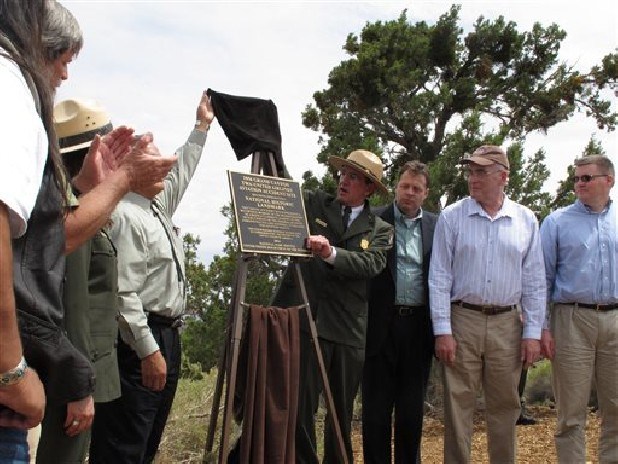
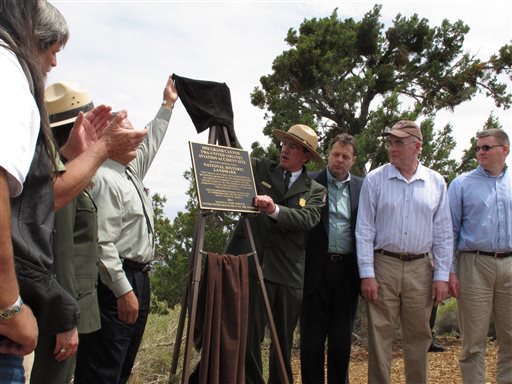
 Grand Canyon National Park Superintendent Dave Uberuaga, center, unveils a plaque at the northern Arizona park on Tuesday, July 8, 2014, that marks the site of a 1956 commercial airliner collision over the canyon as a National Historic Landmark.
GRAND CANYON NATIONAL PARK, Ariz. – Visitors peered through binoculars and spotting scopes into the depths of the Grand Canyon, straining to see the spot where two commercial airliners crashed after colliding in mid-air nearly 60 years ago. Family members of the victims gazed out over the east rim of the canyon Tuesday, trying to imagine their loved ones’ final moments in a disaster that helped overhaul U.S. aviation safety.
The 1956 crash killed all 128 people aboard the planes in the nation’s deadliest airliner disaster at the time. In response, a country already struggling with increasingly busy skies pressured Congress for major changes to improve air traffic control and radar systems and to create what became the Federal Aviation Administration.
“It really did underscore for the general public, for the first time, that much of the air space in America was uncontrolled at that time,” said Peter Goelz, former managing director for the National Transportation Safety Board. “Once you got up to 20,000 feet and beyond the terminal radars, it was see and be seen.”
At the Grand Canyon, officials are hoping to bring new awareness to the effects of the tragedy on families and American air travel. A plaque unveiled Tuesday marks the crash site as a National Historic Landmark.
“We are safer because of it,” park ranger Brian Gatlin said of the crash, standing beside a “Tragedy Remembered” sign at the overlook, where it’s impossible to see some of the wreckage that remains in the gorge.