
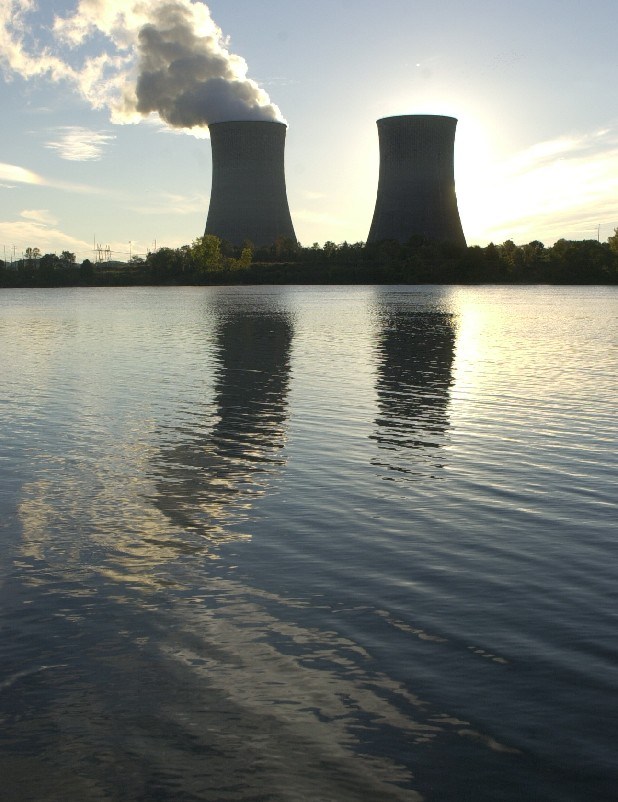
 The nuclear power plant towers at Watts Bar are reflected in Watt’s Bar lake during a clear late evening sun set.
Sun power in the valleySince 2000, the number of operating solar installations in the Tennessee Valley has grown from three to 1,927, including installations at more than 90 schools. TVA approved more than 250 new solar installations at residential and commercial sites across the valley in fiscal 2013. In 2013, Tennessee ranked seventh in the nation in total solar capacity and ninth for non-residential capacity, according to the Solar Energy Industries Association.What do you think?You may offer opinions about how TVA and distributors should price distributed energy at www.tva.gov/dgiv.
More than 3,000 TVA employees and contractors are working around the clock at the Watts Bar Nuclear Plant to add a second reactor capable of supplying all of the electricity demands of a city twice the size of Chattanooga.
From the 1,200-megawatt nuclear unit taking shape near Spring City, Tenn., towering 500-kilovolt transmission lines will carry the power generated from the multibillion-dollar power plant across TVA’s seven-state region. TVA maintains 16,086 miles of transmission lines across its service territory to carry the power generated at large, centralized power plants that have been the backbone of the TVA electric grid since the federal utility was created in 1933.
But even as TVA’s power stations have gotten bigger and transmission lines stretched further, a new type of power is gaining force. Distributed energy generated by smaller, more localized and often intermittent sources such as solar, wind or small gas-generated turbines are producing more of America’s electricity.
As new and smaller sources of generation have gotten cheaper and are backed by new battery storage systems, a growing number of power consumers are making their own power on site and more homeowners and businesses are generating power for the grid. In a few cases, they are bypassing the electric grid altogether by generating all of their power on site.