
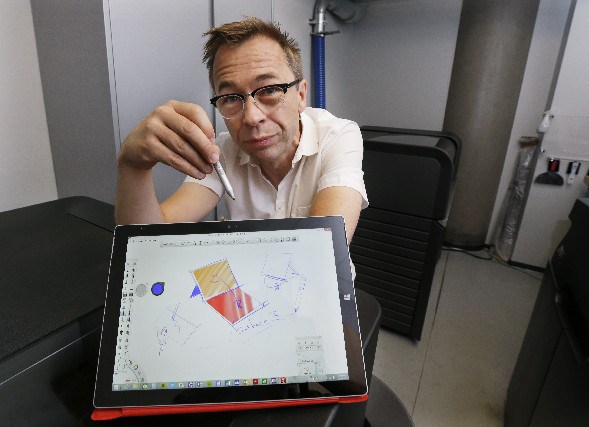
 In this photo taken July 3, 2014, Ralf Groene, chief designer for the Microsoft Surface tablet computer, poses for a photo with a Surface 3 Pro tablet computer and digital pen in a 3-D printing room at a Microsoft design lab in Redmond, Wash. As Microsoft competes with Apple and other companies for hardware sales, the software giant has put a new emphasis on design.
REDMOND, Wash. – Before Ralf Groene helped devise the look and feel of Microsoft’s Surface tablet, he designed food – or “food concepts,” he says, for people on the go. Among them: dried noodles that come wrapped around a pair of chopsticks; a tubular meal that can be pulled with two fingers from a car cup holder base; and a fork that squeezes out sauce.
Though none of these ideas made it into production, the principles behind them can be applied to computing devices that fit into busy lives, says Groene, and they are just as varied as the ones Microsoft now uses to redesign all its software and devices.
“In a way, we’ve designed Surface with very similar principles,” Groene said on a recent tour of the Surface lab on Microsoft’s sprawling campus in Redmond, Washington. “Surface is trying to dissolve into your day.”
Groene and his team designed the Surface to accompany its users everywhere. It can be used as a tablet-style news reader propped up on its kickstand while you eat your morning bowl of cereal, as a notepad to be scribbled on with a digital pen at a business meeting, and for watching a movie while sitting on your couch later in the day.
Microsoft is putting an emphasis on design excellence more than ever — to make its products more competitive with offerings from rivals Apple, Google, and Amazon and to prod its hardware making partners to dream up new, more innovative devices. In recent years, the software giant has put a priority on fashioning devices that work around people’s lives, help reduce information overload and become intimate, personal and knowledgeable about their users.