
They are 18 concept cars from around the world, created not for mass production but to think outside the box, to challenge concepts and long-held truths in the auto industry and come up with new ones. And these engineers and designers went WAY outside the box. The automobiles gathered in “Dream Cars: Innovative Design, Visionary Ideas,” an exhibit that runs through September at the High Museum of Art in Atlanta, start in 1932 and run through 2010. There’s an all-electric car from 1942. A 1959 Cadillac has radar to warn you about road obstructions. A 1956 Chrysler has a rear-facing camera and in-dash video screen. There are cars shaped like rockets-and one that’s basically a rocket on wheels. Cars covered in fabric instead of metal. Cars with interiors that look like airplanes and ones with interiors that are works of art in leather, wood and chrome. Sarah Schleuning, curator of decorative arts and design at the High and the person who spent three years tracking down the vehicles around the world, says the exhibit hopefully will spark the imagination and show people that there are no limits. “You’re around all these products of makers and thinkers who, all they thought about was the future and what was possible and what was the potential,” she says. “This is a set of people who thought, ‘If you can dream it, ake it’; it’s a really important message.”
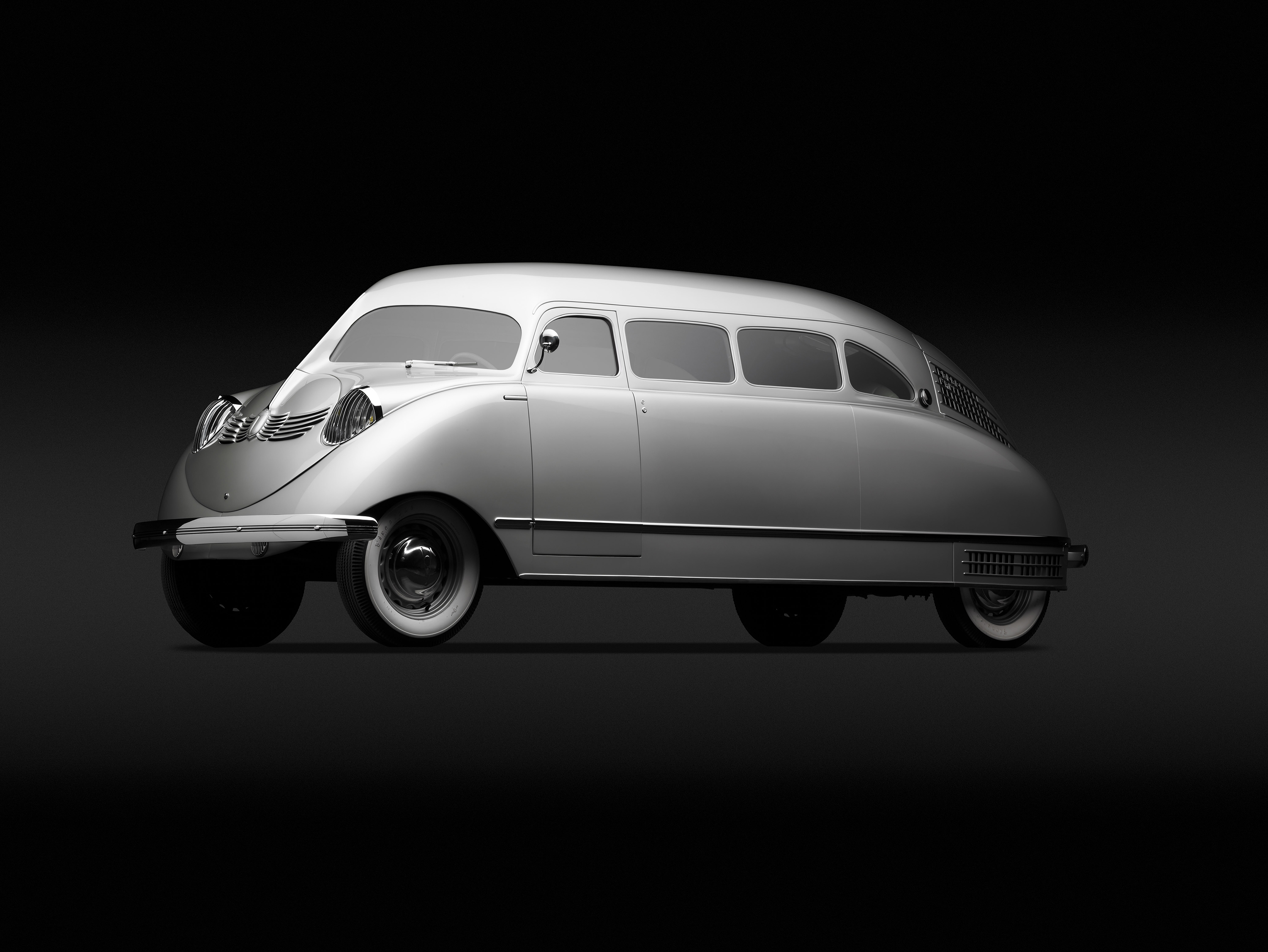
Stout Scarab, 1936.
Designed by William B. Stout.
COURTESY OF LARRY SMITH. PHOTO BY MICHAEL FURMAN.
Essentially the world’s first minivan, the rotund Scarab has a front end that looks like the smiling Cheshire Cat, including a scarab as the cat’s button-nose (Scarab makers prefer to describe the front decorations as “mustaches”). The V8 engine is in the rear and open to the air inside a elegant grille that curves up and over the rear window. Inside, there is a sofa-sized bench seat across the back, a second row of seats that can turn around to face rearwards and a fold-down table for “drinks or card playing,” as the car’s advertisements say. There are only two doors, a small one on the left front for the driver, and a bigger one on the righthand side to let people into the party pavilion.