
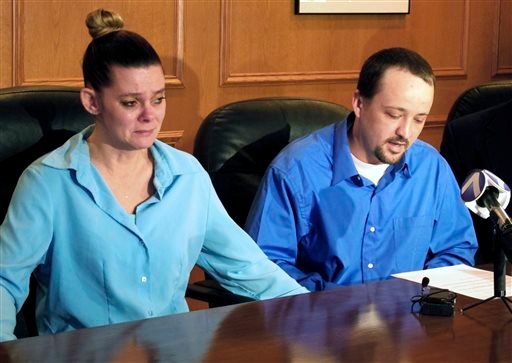
 In this Jan. 17, 2014, file photo, Missie McGuire, left, listens to her husband, Dennis McGuire, at a news conference where they announced their planned lawsuit against the state over the unusually slow execution of his father, also named Dennis McGuire, in Dayton, Ohio. The state said Tuesday, April 29, 2014, that it is boosting the amount of the two-drug combo of a sedative and painkiller “to allay any remaining concerns” after the last execution, when Dennis McGuire made repeated snorting-like gasps as he died.
By ANDREW WELSH-HUGGINS
AP Legal Affairs Writer
COLUMBUS, Ohio – The botched execution of an Oklahoma inmate is certain to fire up the debate over what constitutes cruel and unusual punishment – the phrase written into the U.S. Constitution and defined by the courts, piece by piece, over two centuries.
Convicted killer Clayton Lockett, 38, began writhing, clenching his teeth and straining to lift his head off the pillow Tuesday evening after he was supposedly rendered unconscious by the first of three drugs in the state’s new lethal injection combination.
The execution was halted, and Lockett died of a heart attack about a half-hour later, authorities said.