
Wednesday, November 11, 2026Nov 11

AP Exclusive: Drones patrol half of Mexico border

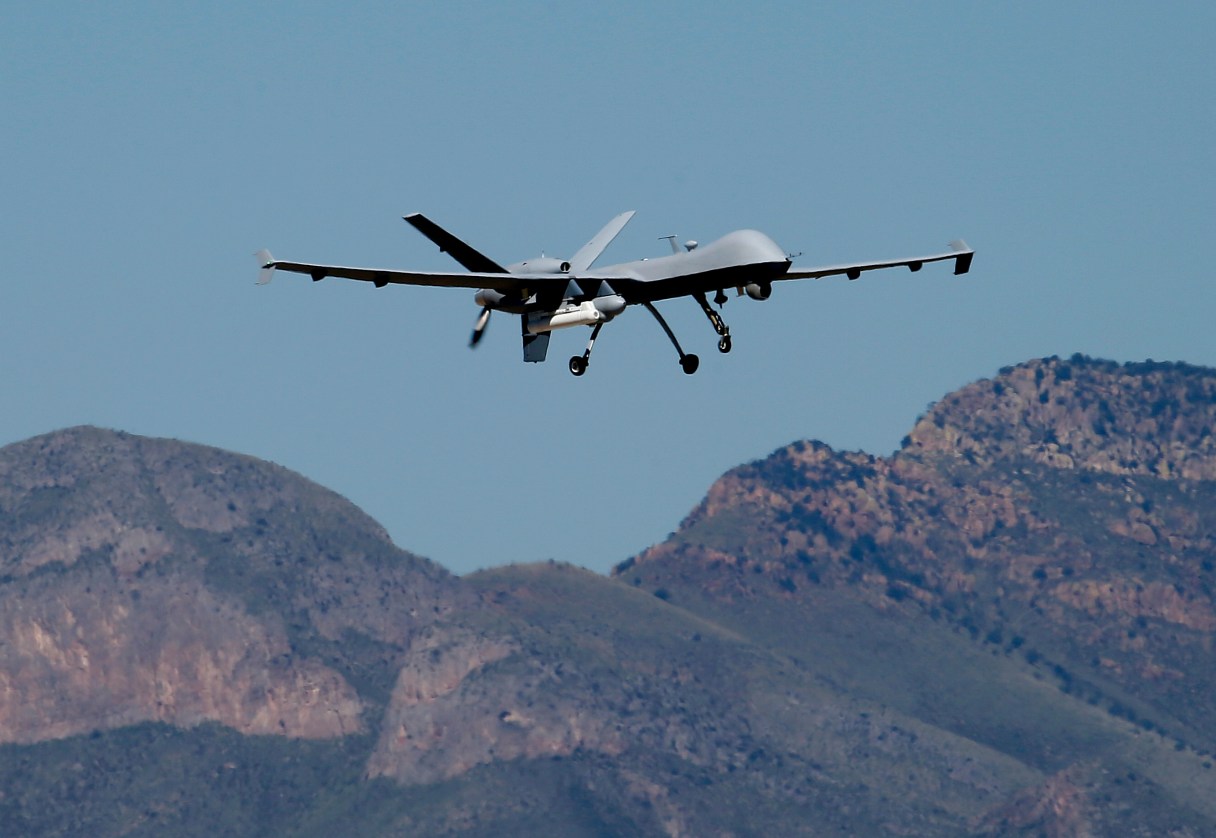
A U.S. Customs and Border Patrol drone aircraft lifts off, Wednesday, Sept 24, 2014 at Ft. Huachuca in Sierra Vista, Ariz. The U.S. government now patrols nearly half the Mexican border by drones alone in a largely unheralded shift to control desolate stretches where there are no agents, camera towers, ground sensors or fences, and it plans to expand the strategy to the Canadian border. It represents a significant departure from a decades-old approach that emphasizes boots on the ground and fences. (AP Photo/Matt York)
A U.S. Customs and Border Patrol drone aircraft lifts off, Wednesday, Sept 24, 2014 at Ft. Huachuca in Sierra Vista, Ariz. The U.S. government now patrols nearly half the Mexican border by drones alone in a largely unheralded shift to control desolate stretches where there are no agents, camera towers, ground sensors or fences, and it plans to expand the strategy to the Canadian border. It represents a significant departure from a decades-old approach that emphasizes boots on the ground and fences. (AP Photo/Matt York) A U.S. Customs and Border Patrol drone aircraft lifts off, Wednesday, Sept 24, 2014 at Ft. Huachuca in Sierra Vista, Ariz. The U.S. government now patrols nearly half the Mexican border by drones alone in a largely unheralded shift to control desolate stretches where there are no agents, camera towers, ground sensors or fences, and it plans to expand the strategy to the Canadian border. It represents a significant departure from a decades-old approach that emphasizes boots on the ground and fences. (AP Photo/Matt York)

SIERRA VISTA, Ariz. (AP) – The U.S. government now patrols nearly half the Mexican border by drones alone in a largely unheralded shift to control desolate stretches where there are no agents, camera towers, ground sensors or fences, and it plans to expand the strategy to the Canadian border.

It represents a significant departure from a decades-old approach that emphasizes boots on the ground and fences. Since 2000, the number of Border Patrol agents on the 1,954-mile border more than doubled to surpass 18,000 and fencing multiplied nine times to 700 miles.

Under the new approach, Predator Bs sweep remote mountains, canyons and rivers with a high-resolution video camera and return within three days for another video in the same spot, according to two officials with direct knowledge of the effort on condition of anonymity because details have not been made public.

The two videos are then overlaid for analysts who use sophisticated software to identify tiny changes – perhaps the tracks of a farmer or cows, perhaps those of immigrants who entered the country illegally or a drug-laden Hummer, they said.

About 92 percent of drone missions have shown no change in terrain, but the others raised enough questions to dispatch agents to determine if someone got away, sometimes by helicopter because the area is so remote. The agents look for any sign of human activity – footprints, broken twigs, trash.