
Wednesday, November 11, 2026Nov 11

Cleveland Clinic does its 2nd face transplant

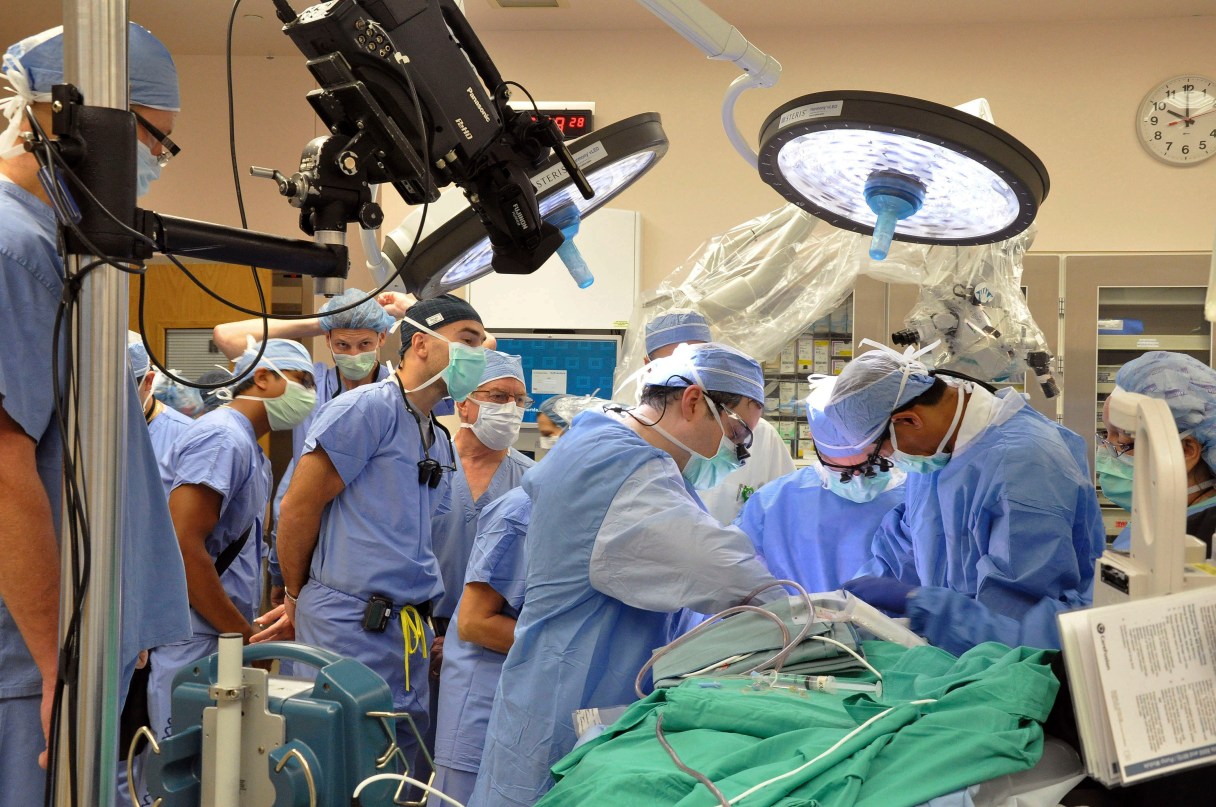
In this September 2014 photo released Tuesday, Nov. 18, 2014, by the Cleveland Clinic, doctors work during transplant surgery to replace nearly the entire face of a middle-aged man severely disfigured in a car accident. It was the second face transplant performed at the hospital in Cleveland, Ohio. The recipient wished to remain anonymous.  (AP Photo/Cleveland Clinic, Janine Sot)
In this September 2014 photo released Tuesday, Nov. 18, 2014, by the Cleveland Clinic, doctors work during transplant surgery to replace nearly the entire face of a middle-aged man severely disfigured in a car accident. It was the second face transplant performed at the hospital in Cleveland, Ohio. The recipient wished to remain anonymous. (AP Photo/Cleveland Clinic, Janine Sot) In this September 2014 photo released Tuesday, Nov. 18, 2014, by the Cleveland Clinic, doctors work during transplant surgery to replace nearly the entire face of a middle-aged man severely disfigured in a car accident. It was the second face transplant performed at the hospital in Cleveland, Ohio. The recipient wished to remain anonymous. (AP Photo/Cleveland Clinic, Janine Sot)

Cleveland Clinic surgeons have replaced nearly the entire face of a middle-aged man severely disfigured in a car accident, the hospital announced Tuesday.

The operation in late September was the second face transplant by the Ohio hospital. More than two dozen face transplants have been done around the world, starting in 2005 with a French woman mauled by her dog.

The hospital said the recipient wants to remain anonymous. In a statement released by the hospital Tuesday, the man said he is “grateful beyond words to the donor and his family for their amazing gift.”

The patient became a candidate for a face transplant after many tries to reconstruct his face failed to improve his quality of life, the hospital said in a statement. The man had trouble breathing and speaking, and the transplant offered the chance to save the limited sight in his sole remaining eye.

Doctors transplanted about two-thirds of the scalp, the forehead, upper and lower eyelids, eye sockets, nose, upper cheeks, upper jaw, upper teeth, salivary glands and nerves, muscles and skin.