
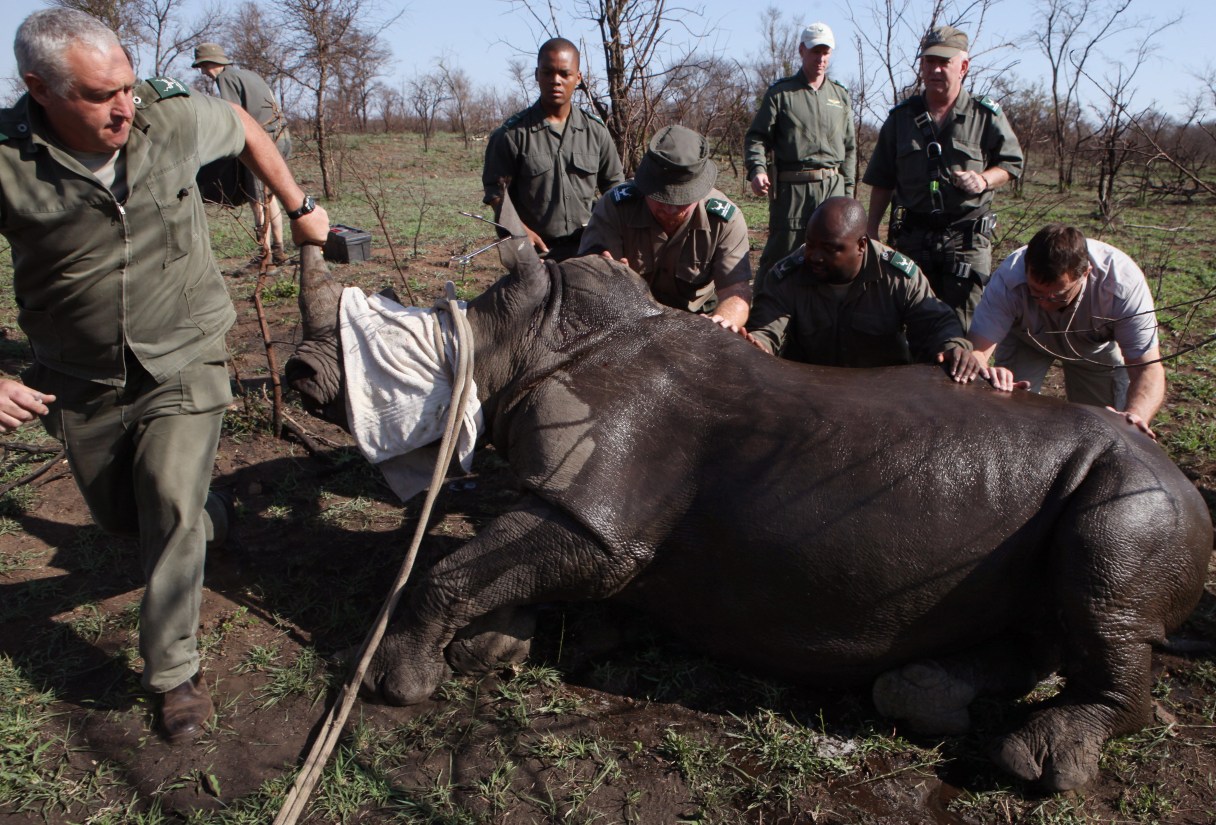
SKUKUZA, South Africa (AP) – The rhino crashes forward, pounding the earth with its broad feet. Then, as a dart’s sedative takes hold, it staggers and slouches to the ground, where South African rangers prepare to move the oversized beast by truck to an area they hope is safe from poachers.
Kruger National Park has conducted about 45 such captures since last month, part of a plan to create a stronghold within the country’s flagship reserve where rhinos will get extra protection from poachers, many of whom cross from neighboring Mozambique and are slaughtering the animals in increasing numbers. Some rhinos were moved to other parks, and the relocation “experiment,” as rangers describe it, is likely to escalate next year.
Safe havens or buffer zones have been hotly debated over the years as a way to protect civilians in some of the world’s major conflicts. South Africa is applying a variation of the idea to wildlife to try to stem surging demand for rhino horn. Some consumers in Asia, primarily Vietnam and China, view rhino horn as a status symbol and a healing agent despite a lack of evidence that it can cure. The horn is made of keratin, a protein also found in human fingernails.
The so-called “intensive protection zone” in the southern part of Kruger National Park took on new urgency when South Africa, home to 80 percent of the world’s rhinos, announced Thursday that 1,020 rhinos have been poached so far in 2014, exceeding last year’s record of 1,004.
About two-thirds of the rhinos poached this year died in Kruger, a park that’s about the size of Israel and larger than the U.S. state of Connecticut. Poachers often dodge an overstretched force of 400 rangers as well as some military units that monitor the 350-kilometer (220-mile) border between Kruger and Mozambique, and they shoot rhinos just before sunset and scoot back to Mozambique under cover of night, according to rangers.