
Monday, November 9, 2026Nov 9

This story is free to read.

Swiss agency approves trial for Ebola vaccine

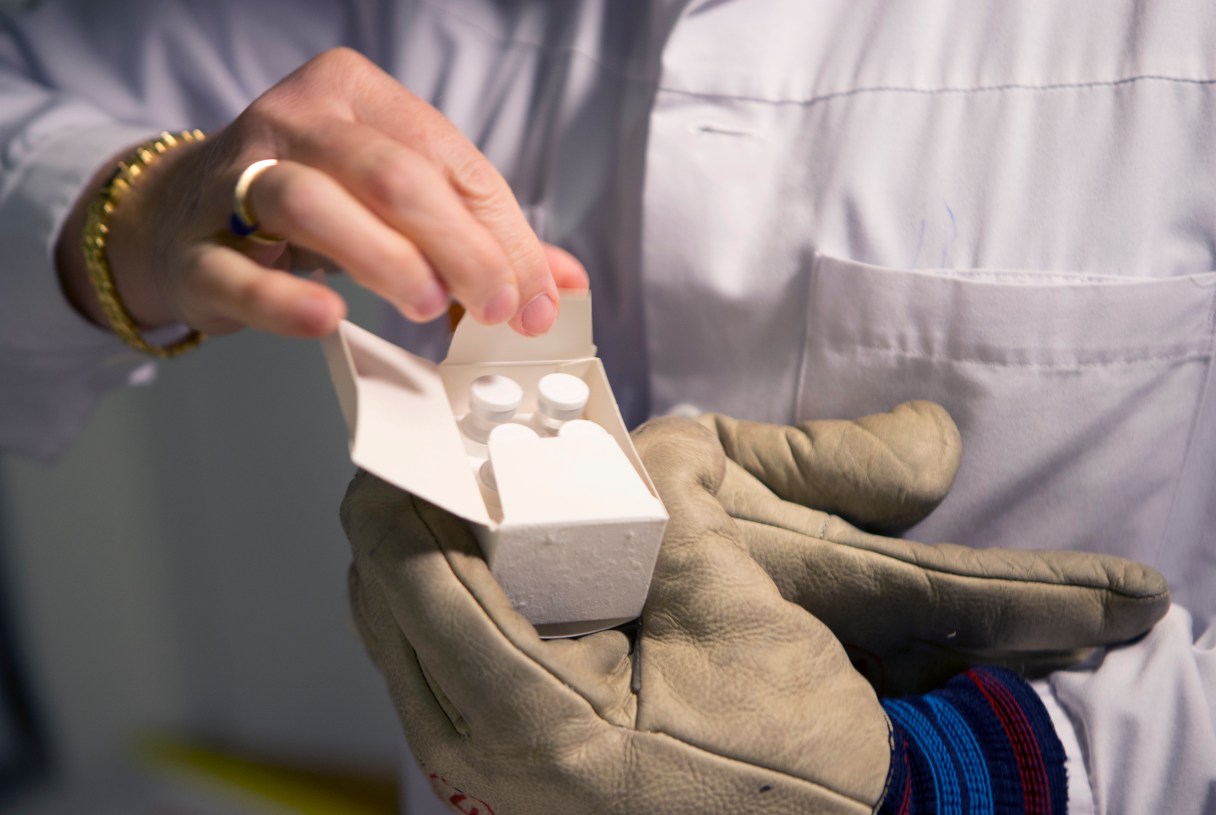
In this picture provided by the World Health Organization , WHO,  a package of vials of the first shipment of the experimental vaccine VSE-EBOV  is opened  at the Geneva Cantonal hospital on Wednesday, Oct. 22, 2014. The World Health Organization (WHO) welcomes the donation by the government of Canada of 800 vials of an experimental candidate vaccine, VSV-EBOV, against Ebola virus disease. Clinical safety trials with this experimental Ebola vaccine have already begun in healthy human volunteers in Mali, the United Kingdom and the United States of America after showing very promising results in animal research. It is expected that further safety trials will be conducted at the Geneva Cantonal Hospital with healthy volunteers. WHO hopes that by end of the year, more data about safety of the vaccine will be known. (AP Photo/WHO/Mathilde Missioneiro)  MANDATORY CREDIT
In this picture provided by the World Health Organization , WHO, a package of vials of the first shipment of the experimental vaccine VSE-EBOV is opened at the Geneva Cantonal hospital on Wednesday, Oct. 22, 2014. The World Health Organization (WHO) welcomes the donation by the government of Canada of 800 vials of an experimental candidate vaccine, VSV-EBOV, against Ebola virus disease. Clinical safety trials with this experimental Ebola vaccine have already begun in healthy human volunteers in Mali, the United Kingdom and the United States of America after showing very promising results in animal research. It is expected that further safety trials will be conducted at the Geneva Cantonal Hospital with healthy volunteers. WHO hopes that by end of the year, more data about safety of the vaccine will be known. (AP Photo/WHO/Mathilde Missioneiro) MANDATORY CREDIT In this picture provided by the World Health Organization , WHO, a package of vials of the first shipment of the experimental vaccine VSE-EBOV is opened at the Geneva Cantonal hospital on Wednesday, Oct. 22, 2014. The World Health Organization (WHO) welcomes the donation by the government of Canada of 800 vials of an experimental candidate vaccine, VSV-EBOV, against Ebola virus disease. Clinical safety trials with this experimental Ebola vaccine have already begun in healthy human volunteers in Mali, the United Kingdom and the United States of America after showing very promising results in animal research. It is expected that further safety trials will be conducted at the Geneva Cantonal Hospital with healthy volunteers. WHO hopes that by end of the year, more data about safety of the vaccine will be known. (AP Photo/WHO/Mathilde Missioneiro) MANDATORY CREDIT

GENEVA (AP) – The Swiss agency that regulates new drugs said Tuesday it has approved an application for a clinical trial with an experimental Ebola vaccine at the Lausanne University Hospital.

Swissmedic said the trial will be conducted among 120 volunteer participants with support from the U.N. World Health Organization. The experimental vaccine is to be initially administered on healthy volunteers who will be sent as medical staff to fight the Ebola epidemic in West Africa.

In a statement, the Bern-based Swiss government agency said the trial continues a series that began in the United States, Britain and Mali, using a vaccine based on a genetically modified chimpanzee adenovirus.

There are no proven drugs or vaccines for Ebola, mainly because the disease is so rare it’s been hard to attract research funding. But with governments and businesses now rapidly shifting millions of dollars to fight the Ebola epidemic centered in West Africa, WHO says two leading candidates for a vaccine have emerged.

One of them – now approved by Swissmedic for a trial – is a vaccine co-developed by the U.S. National Institutes of Health and GlaxoSmithKline, which was funded by the company, its charitable trust and funds from the U.S. and U.K. governments. GSK has said it might be able to make about 1 million doses of its vaccine per month by the end of 2015.

The other front-runner vaccine is licensed by a small U.S. drugmaker, NewLink Genetics, and was initially developed by the Public Health Agency of Canada. It has been sent to the U.S. Walter Reed Army Institute of Research for testing on healthy volunteers, with preliminary safety results expected by December.