
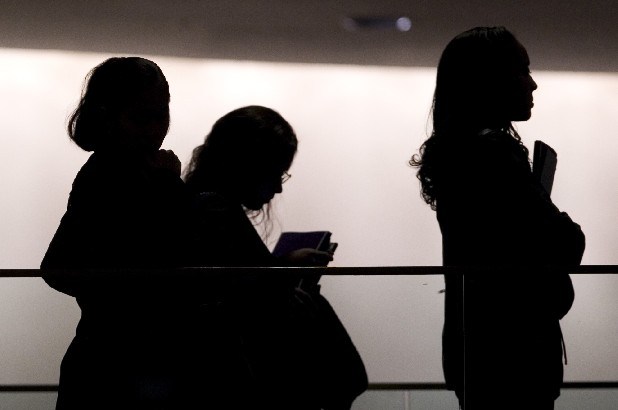
 Job seekers join a line of hundreds of people at a job fair in New York. Tough economic conditions, including the Great Recession, are blamed for a five-year drop in the number of babies born in the U.S., starting in 2007. A new study presented in a paper released Monday by the Proceedings of the National Academy of Science suggests that for some U.S. women, living through a recession can mean they will never have children.
NEW YORK – When the economy tanks, women have fewer babies. But what happens in the following years, when conditions improve?
A massive new study suggests that for some U.S. women, living through a recession can mean they will never have children.
In fact, the authors project that among women who were in their early 20s in 2008 — early in the so-called “Great Recession” — about 151,000 will forgo having any children as a result, at least by age 40.
Overall, the lingering impact of that recession may ultimately mean some 427,000 fewer children being born over the course of a couple decades, the authors say.
On a societal level these effects are small. The projected number of childless women is a tiny fraction of the 9 million women in that age group, 20-24. The drop-off in births isn’t much for a nation that produces around 4 million babies a year.