
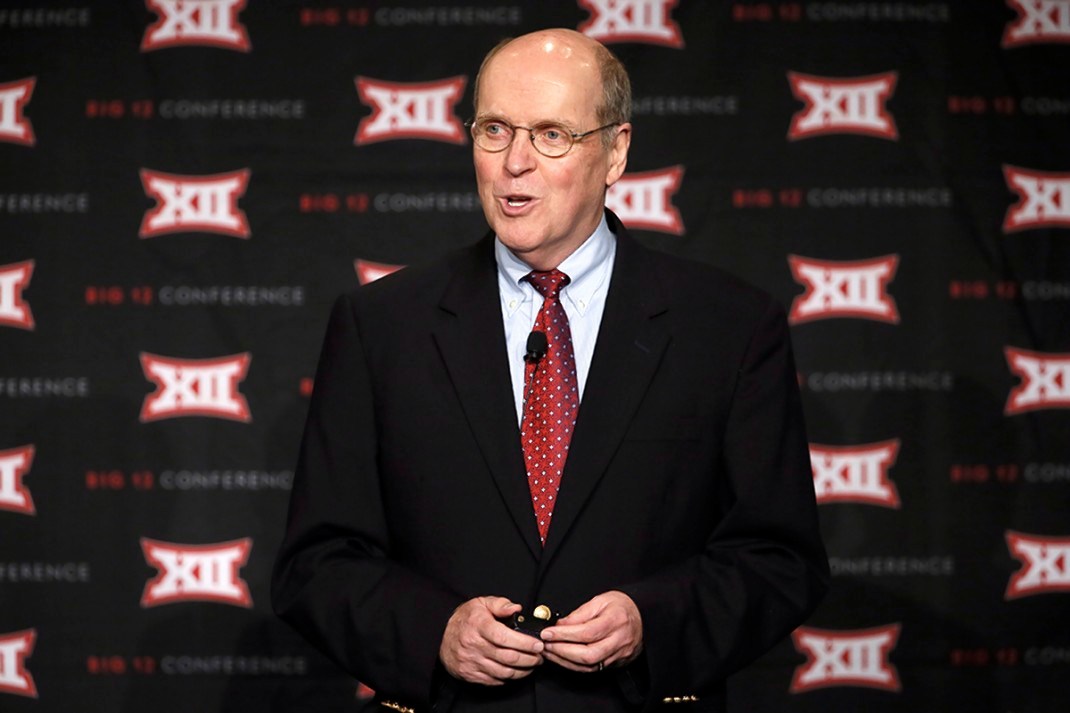

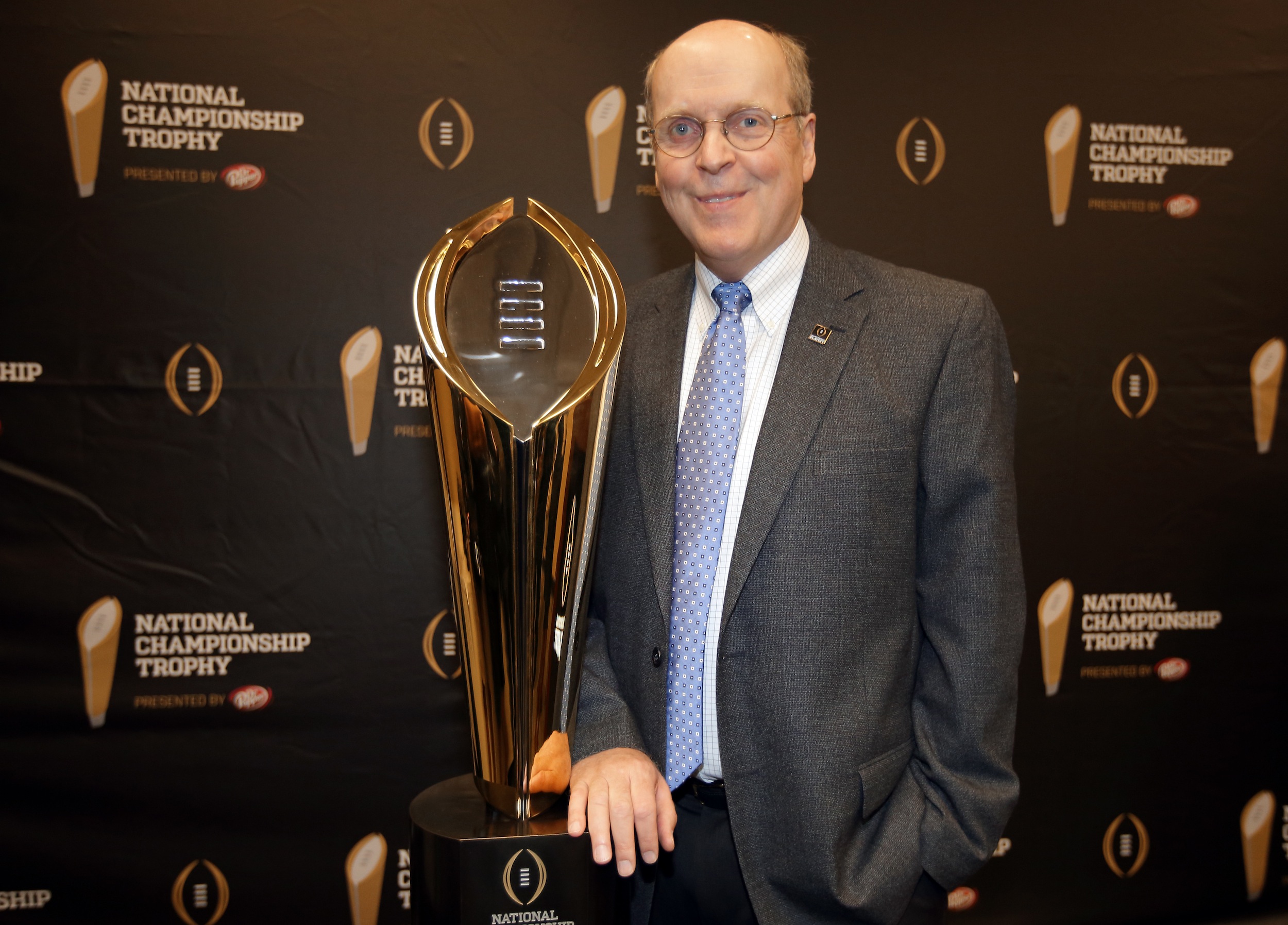
 FILE – In this July 14, 2014, file photo, College Football Playoff Executive Director Bill Hancock poses with the College Football Playoff National Championship Trophy in Irving, Texas.The College Football Playoff is a blank slate and those who created it have tried to steer clear of clutter in the hope of creating the next ubiquitous sports brand. (AP Photo/Tony Gutierrez, File)
With four spots for five power conferences, the inaugural College Football Playoff was bound to upset somebody.
It did.
The Big 12 had two viable candidates with Baylor and TCU, but Alabama, Oregon, Florida State and Ohio State ultimately made the first field. The playoff proved to be a smash hit in terms of television ratings, and the fourth-seeded Buckeyes knocked off the top-seeded Crimson Tide and the second-seeded Ducks to win their first national title since 2002.
Bill Hancock, the executive director of this new extravaganza, was a recent guest of “Press Row” on Chattanooga’s ESPN 105.1 FM to discuss the first go-around and what to expect in future years.
Q: There seemed to be more positives than negatives with the first year. Was that the case?
A: “We felt great about the playoff. We knew we had a four-team event and that team five was going to be very disappointed, but team five will be disappointed every year. We had high expectations, and the event exceeded our expectations.”
Q: The Big 12 was indecisive last fall in determining a champion. What was that aspect to the process like?
A: “From our perspective, the task was simple. We had to select the four best teams. We didn’t have to worry about conference affiliation or really worry about what the conferences were doing. Winning a conference championship is a key criteria, and the Big 12 had a tie. I don’t know if it would have mattered if the Big 12 had a different tiebreaker.
“What I do know is that Ohio State benefited from adding another victory over a quality opponent to its résumé, with that being the thumping of Wisconsin in the Big Ten championship. I think the Big 12 is doing the right thing by sitting tight, because one playoff does not make a trend.”
Q: Did you like the fact TCU was ranked third, defeated Iowa State 55-3, then dropped to sixth in the final ranking?
A: “I understand how TCU people feel, but on the other hand, a lot of this is not about what Team A does wrong but what Team B does right. Baylor ended its season with a win over Kansas State, the third-best team in its conference, while TCU by quirk of the schedule played Iowa State. Baylor enhanced its résumé, and at that point the committee looked at the two and determined that because Baylor had defeated TCU, Baylor should be ranked higher.
“Comparing Baylor and Ohio State was an interesting matter. Ohio State had played a better schedule and had been more impressive the last few weeks. The victory over Wisconsin was what pushed Ohio State ahead of Baylor.”
Q: How many people have asked you about the timetable of going to eight teams?
A: “I think it’s up to 974,000. We have a four-team tournament by contract for the next 11 years. We set it up as a 12-year arrangement because we wanted folks to know that this is stable and that it’s not going to change. We believe in this, and there is no talk in our group of expanding. I ask people why they would want eight, and they say, ‘We want more football.’ I guess that’s a good problem to have because people want more of what we’re selling, but more is not always better.
“Four is the right number for this because it lets us maintain this awesome regular season and lets us keep the bowl experience. The two coaches after last year’s championship game talked about how exhausted their athletes were after playing two quality opponents back-to-back, and I think a third game back-to-back-to-back would make things really difficult on those players.”
Q: Is there any look-in window in this contract to potentially revisit the number of teams?
A: “There is not a formal look-in to it. Our group is really solid on this 12-year arrangement. I suppose that if everybody felt strongly that it needed to change that the contract could be changed, but there is no talk now. I can’t seeing it going from no talk to unanimous talk to change it. I just don’t see that happening.”
Q: The Peach Bowl had a noon kickoff on New Year’s Eve and struggled in the ratings. Is that a concern?
A: “It isn’t. A lot of people look at TV numbers as this big, meaningful matter. Of course, we want fans to watch games on television and want higher viewership, but the early-window numbers were consistent with or even up a little bit from those same windows in the past. You can’t really look at a nighttime rating and compare it to an early-window rating.
“What we were trying to do is create tripleheaders on New Year’s Eve and New Year’s Day, and we did that. It was a remarkable time for college football fans.”
Q: This season’s semifinals are on New Year’s Eve. How do you envision year two working out?
A: “We’re happy with the New Year’s Eve setup, and we know that fans are going to watch these games. Some people have to work on New Year’s Eve, but people work on that first Thursday and Friday of the NCAA basketball tournament and still find a way to watch all those games. When we set up the playoff, we respected the Rose Bowl’s tradition of playing on New Year’s afternoon, and then the SEC and the Big 12 claimed New Year’s night and formed a new tradition in the Sugar Bowl.
“I don’t think there will be a viewership issue. People love this playoff and love these games.”
Contact David Paschall at dpaschall@timesfreepress.com or 423-757-6524.