
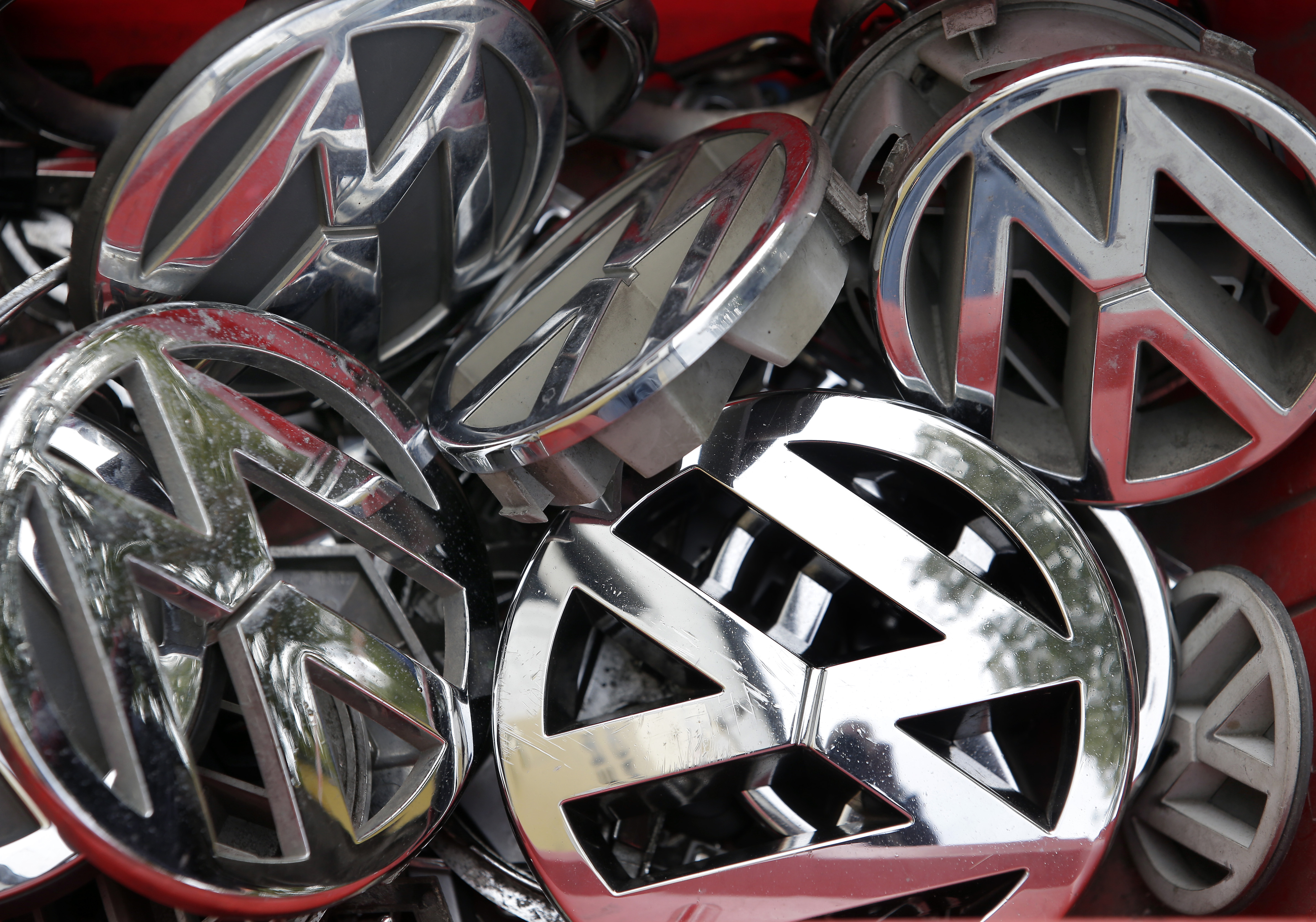
 FILE – In this Sept. 23, 2015 file photo Volkswagen ornaments sit in a box in a scrap yard in Berlin, Germany. Volkswagen said Wednesday, Dec. 9, 2015 that a problem with carbon dioxide emissions is far smaller than initially suspected, with further checks finding “slight discrepancies” in only a few models and no evidence of illegal changes to fuel consumption and emissions figures. (AP Photo/Michael Sohn, file)
So Volkswagen’s emissions deception wasn’t just a studied lie. It was a long-studied lie.
It was a deliberate decision – made more than a decade ago – to fake U.S. air standards compliance, according to the chairman of Volkswagen.
Hans-Dieter Ptsch, the chairman of Volkswagen’s supervisory board, said the decision by a few within the carmaker’s workforce to cheat on emissions tests was made after they realized they could not meet United States clean air standards legally. The decision was made, he said, in a climate of lax ethical standards.
“There was a tolerance for breaking the rules,” Ptsch was quoted in The New York Times Thursday after his first lengthy news conference since the company admitted in September that 11 million cars with diesel engines were rigged with what’s known as a “defeat device” – software to fool emissions tests. “It proves not to have been a one-time error, but rather a chain of errors that were allowed to happen.”
Ptsch and Matthias Mller, the chief executive of Volks- wagen, presented the latest findings of an internal inquiry that still continues. The company officials, speaking in Wolfsburg, Germany, said VW is not yet ready to identify those behind the decision. Nine unidentified people have been suspended.
The lie and the defeat device were hatched in 2005, VW officials said. That was when the company decided to make diesel cars the focus of its United States marketing. Three years later, in 2008, VW announced it would spend $1 billion and build an auto assembly plant here in Chattanooga, creating 2,000 jobs.
Now VW faces what Ptsch termed the “biggest test” in the automaker’s history.
Tragically, it is not now just a test for Volkswagen, but also a test for Chattanooga should VW not prove up to the task.
As VW reels from a 30 percent drop in sales and while facing up to $18 billion in environmental fines and $7.3 billion in vehicle recall costs, Chattanooga’s stake has grown: Those initial 2,000 jobs now total about 10,000 as local men and women earn their livelihoods in the VW plant, its supplier plants or in other spin-out companies and jobs somehow linked to VW.
Autoblog reported Thursday that VW blamed the cheating debacle on its push to grow the diesel business in the U.S. and tougher U.S. air regulations. But if you look deeply, the clear bottom line was greed.
The early research of third-party investigators at law firm Jones Day notes that the automaker didn’t have a way for its EA189 engine to meet nitrogen oxide requirements here within the budget.
According to The New York Times, a former executive who was involved and asked not to be identified because he did not want to offend Volkswagen said that in the years preceding the 2009 marketing push, there was an intense internal debate about what kind of emissions technology to use.
Some Volkswagen managers favored a technology called selective catalytic reduction, or SCR, which neutralizes nitrogen oxide emissions without a penalty in fuel economy or performance. Those managers argued that only SCR technology would allow Volkswagen to keep pace with ever-stricter limits on emissions of nitrogen oxide, which have been linked to lung ailments. But SCR costs more, adds weight to the car and takes up more space than other methods. It was especially difficult to squeeze such systems into the Golf or Jetta.
Some of the executives who advocated an SCR system were sidelined or pushed out of the company, The New York Times reported. Instead, beginning with the 2009 model year, Volkswagen sold cars in the U.S. that had 2-liter diesel motors equipped with so-called lean NOX traps, which are supposed to sponge up nitrogen oxide particles. The NOX traps system costs several hundred dollars less than an SCR system.
You get the idea.
What VW did was penny-wise and pound-foolish. It also was criminal. But VW’s future is now also our future.
Let’s hope the bad news stops soon, and let’s hope the new VW management team will finally roll up its collective sleeves and get on to the business of fixing the cars and the company – with honesty and morality, this time.