
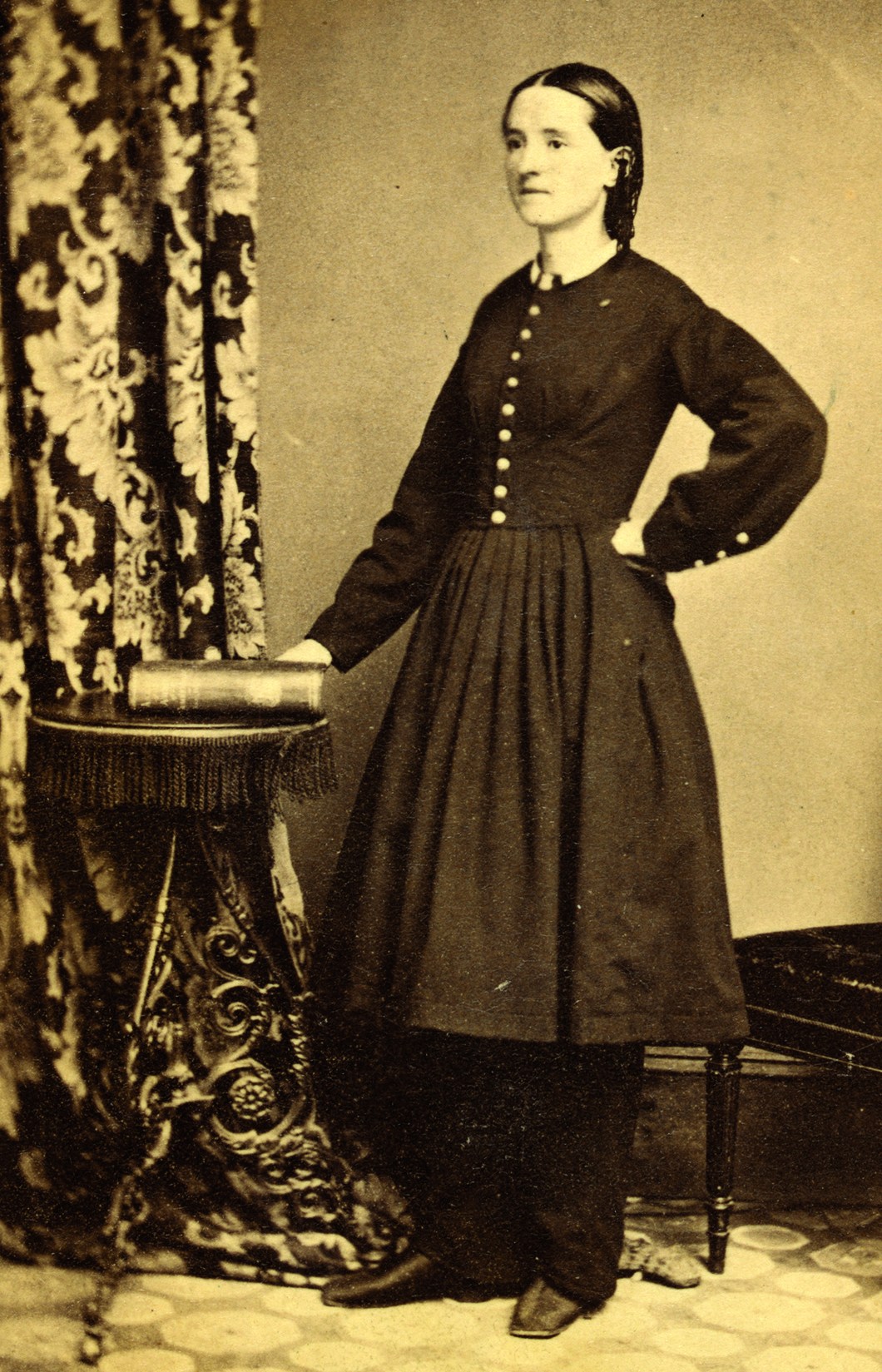
 Dr. Mary Edwards Walker, first female surgeon in the U.S. Army.
“Why don’t you wear proper clothing? That clothing is neither one thing nor the other,” barked Gen. William Sherman. The diminutive figure, dressed in a modified uniform coat with “bloomer” pants, had become accustomed to caustic remarks during her nine-year medical career. Female physicians in mid-19th century America were rare. Female military surgeons were unknown.
Mary Edwards Walker was born in Oswego, N.Y., in 1832. She worked on the family farm as a child and never wore women’s clothing, which she considered too restrictive. Teaching school to pay her way through Syracuse Medical College, she graduated in 1855, the only woman in her class. She married a classmate, Dr. Albert Miller, and they went into practice in Rome, N.Y. She omitted the word “obey” from the marriage ceremony and initially used the hyphenated name, Dr. Miller-Walker. Their practice did not do well — due mainly to the lack of trust in female physicians.
When the Civil War broke out, Dr. Walker volunteered her services to the Union Army. Despite her medical degree, she was allowed to serve only as a nurse, treating Union wounded at a Washington, D.C.-area hospital after the First Battle of Bull Run. She made herself well known to military officials in the nation’s capital, becoming somewhat of a pest in constantly seeking appointment as a surgeon. Angered at the lack of response, Walker added a second medical degree to her resume.
In an effort to rid themselves of Walker, federal officials sent her in September 1863 to Tennessee to be an “acting assistant contract surgeon,” a civilian doctor employed by the military. In this capacity, she treated wounded from the Battle of Chickamauga in Chattanooga military hospitals. Her peers either ignored or teased her. One colleague referred to her as a “medical monstrosity.” However, she had become the first female surgeon employed by the U.S. Army.
When the surgeon of the 52nd Ohio Infantry unexpectedly died, and Walker’s contract was about to expire, Gen. George Thomas appointed her assistant surgeon of the 52nd. The men of the unit, encamped around Lee and Gordon’s Mill, were not happy, and the medical staff sought her dismissal — to no avail.
“She had the rank of first lieutenant and dressed like any other officer. She wore curls so that everybody would know she was a woman,” a member of the regiment remembered. “She was 32 years of age … slender and rather frail-looking in body. The men seemed to hate her, and she did little or nothing for the sick of the regiment.”
As neither the soldier-patients nor the medical staff would allow her to stay busy, Walker began leaving Union lines and treating Southern civilians living around the mill.
After helping a Confederate doctor perform an amputation on April 10, 1864, she was captured by Confederate troops and arrested as a spy. She was sent to Richmond, Va.’s notorious Castle Thunder prison for four months and then exchanged, proudly on an equal basis, for a male surgeon from Tennessee. After her release, she served in the Battle of Atlanta and then supervised a female prison in Louisville, Ky., and a Nashville orphanage.
Dr. Walker continued to pester the military for a commission as a surgeon with the rank of major. In 1866, the U.S. Army, on the recommendation of Gens. Sherman and Thomas, instead chose to award her the Medal of Honor, citing her bravery in the Chattanooga and North Georgia areas as well as her four months in prison.
At war’s end, Walker became active in the women’s suffrage movement and lectured and wrote on women’s health care, dress reform and temperance. She worked with Susan B. Anthony but eventually fell into disfavor, partially due to her penchant for dressing in men’s clothing including a top hat.
In 1917, the Army revoked all Medals of Honor not given for “combat with the enemy,” including Dr. Walker’s. She refused to surrender her medal, saying the Army could take it “over her dead body.” She continued to wear it until her death in 1919, one year before the passage of the 19th Amendment guaranteeing women the right to vote.
President Jimmy Carter restored her Medal of Honor in 1977. Today, it is displayed in the Women’s Corridor of the Pentagon. Dr. Mary Walker remains the only female to win the nation’s highest military honor.
Dr. Anthony Hodges, a retired dentist, serves on the Advisory Board of the National Medal of Honor Museum. For more, visit Chattahistoricalassoc.org or call LaVonne Jolley 423-886-2090.