
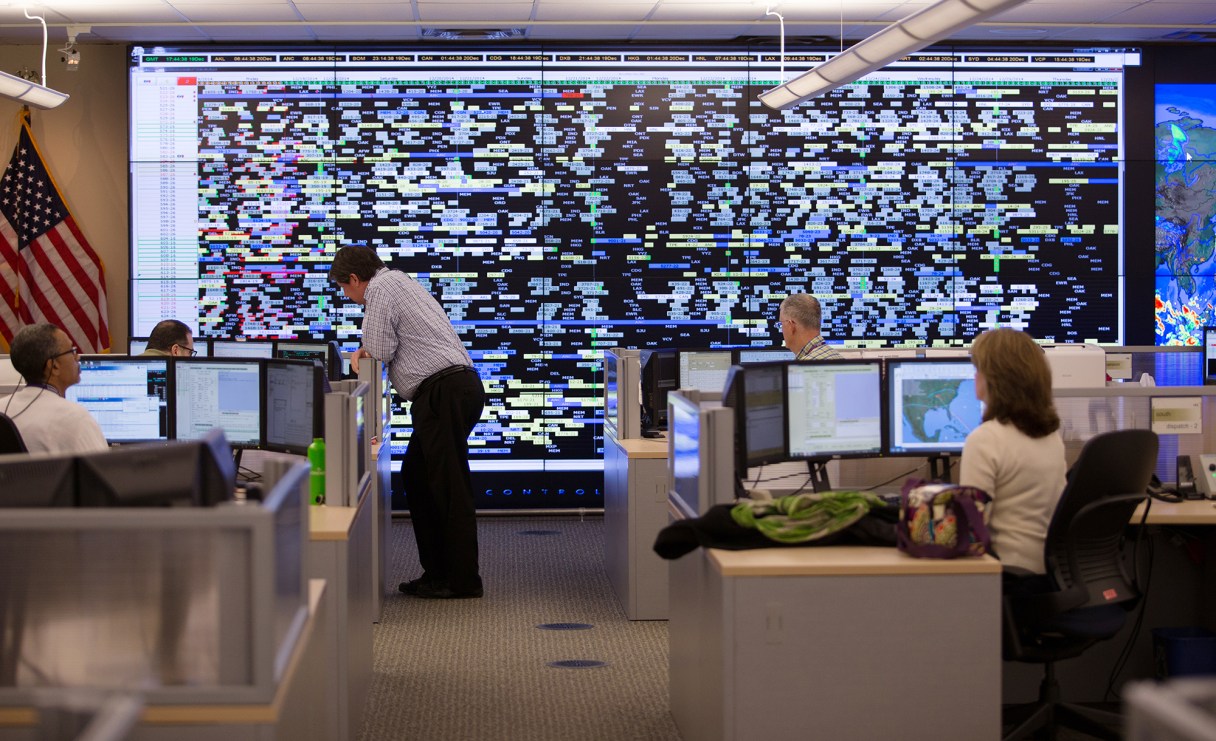
MEMPHIS, Tenn. (AP) – On the fourth floor of Module F at a non-descript but sprawling FedEx campus nestled between Winchester Road and Shelby Drive on Airways Boulevard, a massive video wall featuring 36 40-inch LED screens displays real-time information on global weather patterns and the locations of hundreds of FedEx Express jets.
“That’s the ultimate big screen,” said David Lusk, senior manager of the FedEx Express Global Operations Control Center, or GOC as most employees refer to it.
Operating 24 hours a day, seven days a week, 365 days a year, the GOC is the nerve center for FedEx Express’ global supply chain system, responsible for everything from monitoring weather conditions around the world to how much time pilots have spent in the air and what flight crews were served for lunch.
At 8:30 a.m. daily, a handful of GOC managers assemble in a roughly 1,800-square-foot “war room” inside Module F and talk via conference call with other high-level FedEx officials to review the previous day’s operations and chart a course for exercising command and control for an enterprise that includes over 600 aircraft and operates in 220 countries and territories.
“This operation has been around for about 40 years so there’s not much we haven’t seen,” said Lusk. “Most of the time it’s an uneventful call.”
The GOC is called upon several times a day to manage impacts on its global network and GOC managers are essentially delegated the authority of the company’s chief operating officer, empowered to make decisions ensuring FedEx delivers.
From a hurricane bearing down on the East Coast to typhoons in the Western Pacific, an earthquake in China, ice storm in the Midwest, tsunami in the Indian Ocean, no-fly zones or a war on the other side of the world, the GOC monitors it all.
The GOC team includes a staff of 15 meteorologists tasked with providing short- and long-range weather forecasts so GOC managers can make contingency plans to ensure the system keeps moving.
Like the GOC itself, the 15-member weather team operates in shifts 24 hours a day, seven days a week, 365 days a year. Even during the most extreme weather events, the team helps keep the company’s employees, aircraft, trucks and millions of packages moving safely through the network.
“We’re looking at the weather globally and just like there’s always a FedEx airplane in the air, there’s always a FedEx meteorologist on duty here,” said Kory Gempler, manager of the company’s meteorology department. “Weather impacts us every day, everywhere. Just because it’s nice in one place means it’s not nice somewhere else.”
The meteorology department began in 1986 when FedEx founder and Chairman Fred Smith decided his crew members needed the best weather information available. Since then, the department continues to fine-tune its operations and today the team uses advanced flight tracking tools that show the exact location of every FedEx aircraft in the sky. The massive, color-coded “War Board” lets team members track any potential disruption as it relates to weather or maintenance delays.
The team uses weather “dashboards” to access forecasting information in real time. Those dashboards allow team members to overlay other weather agency data with the team’s own forecasts to show where weather watches and warnings are in effect.
The largely unheralded weather team plays a crucial role in critical decision-making that affects the on-time delivery of packages and the safety of company team members around the world. The key is being able to give as much notice as possible about potential problem spots so GOC managers can make informed decisions to keep the supply chain humming along.
“The better the forecast and the better the advance timing of the forecast, the better they can manage the weather risk,” said Gempler. “We can’t stop the weather from happening, but we can tell them when we are expecting problems so they can make informed decisions.”
Early last December, freezing rain, ice and snow slammed the Dallas area, covering everything in its path in a nasty mix of wintery precipitation and threatening to disrupt FedEx operations. It could have been a disaster that set the Memphis-based company back for weeks just as it entered its busiest period of the year.
But the meteorology team saw the winter storm system approaching and all the flights and cargo were rerouted to Memphis.
“When you have airplanes skidding off the runways and trucks running off the highways it’s a safety issue, it’s an issue for the employees and it’s a situation for our customers so we just pulled back and said we’ll work around this weather and wait until it improves,” said Gempler.
Rival UPS wasn’t as lucky. The winter weather storm caused huge delays for UPS, which at one point had to bring in more than 900 managers from across the country to help manage the aftermath.
“Winter weather can cause quite a challenge for us and it’s about moves we can make to mitigate potential problems in the supply chain,” said Gempler. “By avoiding that weather, and realizing that it was going to be a major impact, we relocated all those packages to another sorting facility and we were able to avoid a nightmare.”
___
Information from: The Memphis Daily News, http://www.memphisdailynews.com